
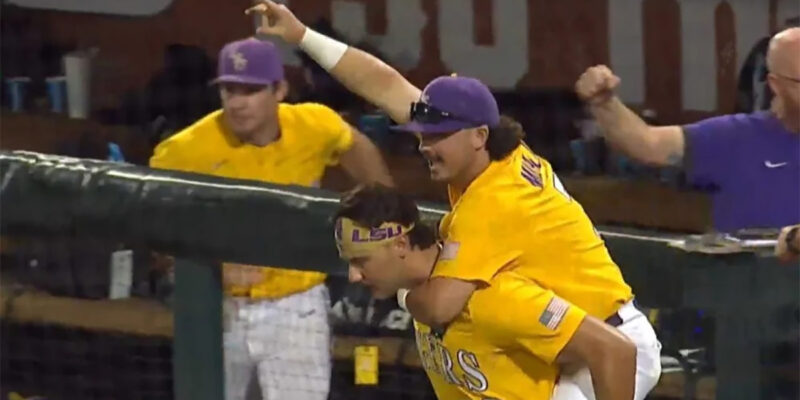
Today I’ve got an American Spectator column up about LSU’s national championship in baseball, won Monday with an 18-4 clobbering of Florida. Some folks seem to have trouble accessing it on iPhones and Androids, so here’s a lengthy excerpt…
Both LSU and Florida hail from the SEC, which is unmistakably the powerhouse of college baseball. Ten of the league’s 14 teams made the 64-team NCAA baseball tournament; of those 10, eight made up half of the top seeds in the 16 four-team regionals and hosted those mini-tournaments at their home parks. And seven of the 10 advanced to the NCAA Super Regionals by winning in the regionals.
Both LSU (Kentucky) and Florida (South Carolina) had to beat SEC teams in the Super Regionals to make it to Omaha for the College World Series. LSU then was stuck in a bracket with Tennessee in Omaha and had to beat the Volunteers twice.
So the fact that the final was an all-SEC affair wasn’t much of a surprise to either program. SEC baseball has taken on a fervor that matches that of football in a lot of other conferences: Most SEC stadiums are on par with at least Double-A minor-league stadiums, and the crowds the conference draws are often larger than some of the weaker major-league franchises.
And the talent on the field in the SEC is at least as strong as that of Double-A these days. In fact, with the advent of the NCAA allowing players to profit off their name, image, and likeness (NIL) — which makes them capable of becoming endorsers and doing other things to brand themselves quite lucratively — college baseball, particularly in the SEC, has now become a moneymaking opportunity.
That means players are more often going to college rather than signing with major-league organizations out of high school. And it means teams like LSU and Florida and the others who made it into this year’s College World Series are loaded with big-time talent. That makes for amazing baseball. Nearly every game of the College World Series, before the final series and the shift in winds this past weekend — which saw a regular 20 mph current blasting straight out to center field — was decided by two runs or less.
It took big league talent to win. College baseball is no longer a quaint little afterthought. It’s taking its place as a major sport now.
On Saturday, Sunday, and Monday, for example, the two teams featured all three of the finalists for the Golden Spikes Award, the college baseball equivalent of the Heisman Trophy. LSU outfielder Dylan Crews won the Golden Spikes, and his teammate, pitcher Paul Skenes, was named the College World Series Most Outstanding Player. Crews and Skenes are likely to be the first two players selected when Major League Baseball conducts its draft in a couple of weeks. But Florida pitcher/first baseman Jac Caglianone was also a Golden Spikes finalist, and he’s expected to be the top pick in the 2024 major league draft.
And Florida outfielder Wyatt Langford will be one of the top three players drafted this year.
It would be no surprise at all to see all four players ensconced in the Baseball Hall of Fame in Cooperstown when it’s all said and done. They’re nothing short of amazing, and the three-game series battle was epic.
For LSU, the entire series was epic. The Tigers had to fight through a gauntlet of pitchers nobody in the history of college baseball has ever had to. Every starting pitcher LSU faced — Andrew Lindsey from Tennessee, Josh Hartle from Wake Forest, Drew Beam from Tennessee, Seth Keener from Wake Forest, Wake’s Rhett Lowder, and Florida’s Brandon Sproat, Hurston Waldrep, and Caglianone — is projected to be drafted by the end of the third round either this year or next, and at least four — Beam, Lowder, Waldrep, and Caglianone — are future first-round picks.
They had to fight through the loser’s bracket to get to the championship series, knocking out Tennessee and then beating top national seed Wake Forest twice in the space of three straight days, but they won the title anyway.
They won because Skenes was magnificent, pitching 15-plus innings and giving up only two runs in wins over Tennessee and Wake Forest. They won because the number-two starter Ty Floyd, who might go as his as the first round this year in his own right, struck out an amazing 29 batters in two starts, including 17 in a sensational performance in Saturday’s win over Florida.
And because Thatcher Hurd, the third-best pitcher and a sophomore with high draft prospects of his own, was magnificent both in relief appearances earlier in the series and on Monday night. Hurd gave up a base hit and a home run to the first two batters he faced on Monday against Florida, spotting the Gators a 2–0 lead, and then he retired 18 of the next 20 batters he faced. Meanwhile, LSU’s hitters chased Caglianone early and then feasted on Florida’s worn-out bullpen, answering Florida with six runs in the second inning and continuing to pour things on.
That was revenge for Sunday. LSU had run out of pitching, so head coach Jay Johnson sacrificed the game by sending out a procession of little-used arms to save Hurd and top reliever Riley Cooper for the final game. The results were ugly — a 24–4 spanking — but ultimately nonfatal. In fact, the whipping gave a flagging offense the motivational kick in the pants it needed to get revenge.
Baseball is funny like that. It’s a game you can lose by 20 runs one day and win by 14 runs the next day. And it turns out that in LSU’s case, winning by 14 is better than winning by 20.
Johnson has been the coach at LSU for only two years. He was at Arizona before coming to Baton Rouge; there, he’d taken two teams to Omaha in five years, making the CWS finals in 2016 only to lose to Coastal Carolina, and then returning in 2021. But in the time he’s been at LSU, he’s revived a program that hadn’t won a national championship in 14 years. It’s hard to believe LSU last won in Omaha in 2009. They’ve been good since, but not great.
This team, though, was great. Great coaching, great players, great stories. LSU spent 12 weeks as the No. 1 team in the nation before faltering late, due in part to some bullpen injuries that required Johnson and his staff to rejigger his pitching staff, and then recovered to make a massive postseason run.
Great fans, too — a bar near the stadium runs an annual gimmick during the College World Series. It’s a Jell-O shot challenge — the bar, Rocco’s, sells $5 overpriced Jell-O shots to customers who profess their allegiances to one of the eight teams playing, then keeps a tote board with standings based on sales. Some of the proceeds from the challenge are donated to food banks back home in the communities the teams hail from.
Ole Miss, who won last year’s national championship and, this year, in a testament to just how tough the SEC is, couldn’t even make the NCAA tournament, set the old record for the Jell-O shot challenge. Rebel fans bought some 18,700 and change of them.
When LSU made it back to Omaha for the first time since 2017 (ironically enough, that LSU team lost two games to Florida in the CWS championship series), the fans took the Jell-O shot challenge quite seriously. When it was over, Ole Miss’ record lay in tatters — LSU fans bought 68,888 of them, spending more than $324,000 to take things to a new level.
This year’s College World Series took things to a new level. College baseball has never been better. It looks and feels quite different, in terms of culture and values, than other sports, and fans, particularly of the powerhouse programs, have taken note.
And LSU, which has done more to put the sport on the national map than any other school, is back on top. And with players like Hurd and third baseman Tommy White — who hit 24 home runs and had an astounding 105 runs batted in in 66 games as a sophomore this year — returning, they’re not likely to go away any time soon.
It isn’t just me talking about college baseball’s rise as a major sport. Here was ESPN’s Scott Van Pelt and Kyle Peterson post-CWS…
The sport is clearly moving up, and paradoxically enough the two rules changes which are driving its rise are being blamed for negative effects in other sports. First is the transfer portal – two of LSU’s three best players, Paul Skenes and Tommy White, not to mention Thatcher Hurd who was the winning pitcher in Monday’s national title game, are transfers. The CWS was dotted with high-profile transfer players, as the freedom of movement not only centralizes talent, in the case of an LSU or a Tennessee, but also disperses it – most of Oral Roberts’ best players were transfers from big schools looking to cement playing time at a mid-major.
But second is NIL.
Baseball has always been treated as a second-class citizen where college athletics are concerned. As a Division 1 program you get a measly 11.7 scholarships to spread out over a 35-man (plus up to five graduate student players) roster. That means other than a few start players most of the guys on a team are paying their own way. But with NIL, particularly at an SEC school, most players can earn enough from the notoriety of being on that roster to offset tuition and other expenses and are therefore now effectively full-scholarship athletes.
And in the case of a White, Skenes, Crews or Tre Morgan, well above that.
What this means is a commitment to LSU, say, is probably worth as much as a half-million dollars over three years in college – so if the major league teams aren’t drafting you in the first five or six rounds, generally speaking it doesn’t make financial sense to turn pro unless you’re afraid you won’t develop as a pro prospect playing in the SEC.
Advertisement
And the effect of that is most of LSU’s recruits, even the higher-profile ones, will make it to school. That’s something which wasn’t true before. And it applies to other high-major programs in the top conferences as well.
So as Peterson says, the game is better. In fact, it’s better than ever. It’s top-heavier, and it’s a lot tougher for the under-resourced programs of old, the Cal State Fullertons and Maines of the world who used to be frequent contenders in Omaha and in regionals, to consistently match up with the likes of the SEC, and that might be a little less fun. We all love watching cinderella acts in the NCAA’s basketball tournaments, and to be fair, Oral Roberts was that in Omaha this year.
But the big boys are all serious about baseball now. The sport is growing, despite having been starved of scholarships by the NCAA all these years. And LSU has reclaimed its role as the premier program.
That’s an awful lot of positivity in a time we could use it. We’re grateful.
Advertisement
Advertisement
