
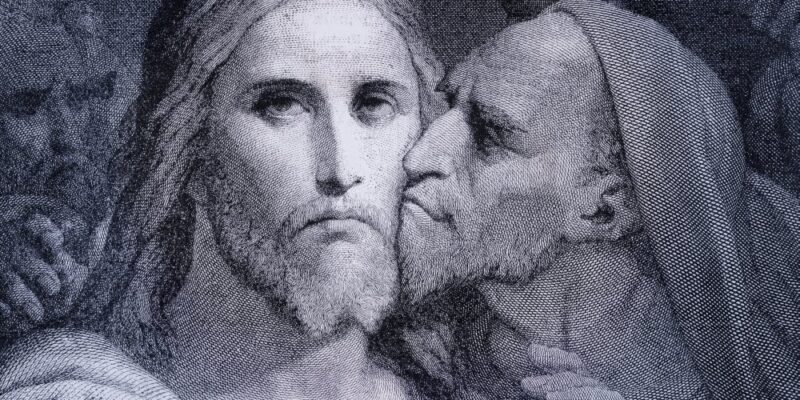
Today is Holy Wednesday, historically referred to in the Western Church as Spy Wednesday. It is a direct rebuke of Judas Iscariot, the great betrayer, the one who ensnared Christ the Lord, his friend and master.
At the Traditional Latin Mass (TLM), the Gospel of Luke is appointed, specifically Ch 22:39-71 and 23:1-53. This account of Christ’s Passion includes Judas’s handing of Jesus over to the authorities at Gethsemane. In the Byzantine Rite, Judas’s betrayal is recounted as well, but the account comes from Matthew Ch 26:6-16 at the evening Presanctified Liturgy of Pope St. Gregory the Great.
America is in great need of repentance, not only in our government branches and institutions, but by we the people ourselves. Too often we get caught up in a degree of blaming that creates a false impunity inside us. Guilty. Government without God will always turn corrupt. Always. Equally so, individual souls. And when individual souls turn their backs on God with addictions and glorifications of this material-, entertainment-, pleasure-driven world, we become a mob not unlike that which yelled for the release of Barabbas the murderer and for the crucifixion of Jesus Christ, the innocent Lamb of God.
Personal awakening continues and will continue to emerge as we learn the diabolical truth on all those celebrities we have status-worshipped for decades while we’ve given God Almighty only the occasional passing glance. We’ll listen to degenerate music and movies over and over again, yet have the audacity to quote Scripture and speak against “vain repetition” when it is time to justify and excuse our lack of devotion to prayer. We are hypocrites, all, myself included.
Now is the time to admit these things to ourselves, when the mercy and grace of God is about to be among its greatest in the liturgical year. We as Christians move into the holiest days of the holiest week of the year, and it would help us all—not to mention combat our tyrannical government and entertainment industry—to reflect seriously on these things. How have we been spending our time this Lent so far? Has it been to grow our own holiness and relationship with the Crucified Savior? I for one continue to be mercifully enlightened on the awful spiritual posture of my past, where even my “best Lents” and “best Holy Weeks” still involved far too little fasting and prayer. And that is to say nothing of those days and nights when I openly sinned just because I believed I could hide behind the veil of foolish youth.
I grew up thinking that one day “long ago” would feel like “long ago,” thus detaching me from the sin, like an old peeling photograph. How wrong I was.
Foolish I have been indeed, and the ruse was on me. God shall not be mocked. Such youthful presumption of God’s mercy has come back around for years now to hit me hard in the heart and soul, new waves and realizations of my rejection of Love itself sweeping over me in both wakefulness and in dreams.
There is no suffering greater perhaps than the merciful sting of God’s arrow when he strikes the heart with memory.
In a word, or two, I have been Judas Iscariot, and so many a day has served as Spy Wednesday. I ask you reader to consider where it is in your life that you can help shift the mob of the world from shouting for Barabbas, and instead shouting for Christ the Lord. I don’t know any of you, and yet we need each other, now more than ever, if we are to give God his just due and fight the evil that surrounds us, if we are to carry our small part of the Cross as Simon the Cyrenian once did.
This internal betrayal is not merely a private tragedy; it is the blueprint for the spirit of our age. In 1928, in Miserentissimus Redemptor, Pius XI diagnosed this very “mob mentality” that defines our modern institutions and entertainment-driven culture. Writing on the necessity of making reparation to the Sacred Heart of Jesus for such idolatrous atrocities, he observed how the rejection of Christ’s authority leads a society to repeat the horrors of the Passion, and what we must do to perpetually repair the rift in the relationship:
Advertisement
[T]he sins of men and their crimes committed in every age were the cause why Christ was delivered up to death, and now also they would of themselves bring death to Christ, joined with the same griefs and sorrows, since each several sin in its own way is held to renew the passion of Our Lord: “Crucifying again to themselves the Son of God, and making him a mockery” (Hebrews vi, 6).…And so even now, in a wondrous yet true manner, we can and ought to console that Most Sacred Heart which is continually wounded by the sins of thankless men, since – as we also read in the sacred liturgy – Christ Himself, by the mouth of the Psalmist complains that He is forsaken by His friends: “My Heart hath expected reproach and misery, and I looked for one that would grieve together with me, but there was none: and for one that would comfort me, and I found none” (Psalm lxviii, 21).
When we see our leaders and “status-worshipped” celebrities mocking the natural law, they are simply the modern heralds of that ancient, cowardly cry for Barabbas. They offer us a murderer, the chaos, the material distraction—while we stand by in a daze treating Jesus Christ as a philosophy, as something “personal” but not incarnate. It is a double mindedness condemned by Scripture, and to our doom. We cannot fight any external tyranny until we recognize the tyranny of Judas Iscariot within.
The following text is applicable, and provides a Doctor of the Church’s weight to my measly words today. It is a collection of excerpts from one of St John Chrysostom’s dozens of homilies on the Gospel of Matthew:
Then went one of the twelve, he that was called Judas Iscariot, unto the chief priests, and said unto them, What will you give me, and I will deliver Him unto you?
Then. When? When these things were spoken, when He had said, it is for my burial, and not even thereby was he moved to compunction, neither when he heard that the Gospel should be preached everywhere did he fear (and yet it was the language of unspeakable power), but when women showed so much honor, and women that had been harlots, then he wrought the devil’s works.
So great an evil is covetousness, this made him both a traitor, and a sacrilegious robber. Hearken, all you covetous, you that have the disease of Judas; hearken, and beware of the calamity. For if he that was with Christ, and wrought signs, and had the benefit of so much instruction, because he was not freed from the disease, was sunk into such a gulf; how much more shall you, who do not so much as listen to the Scripture, who are constantly riveted to the things present, become an easy prey to this calamity, unless you have the advantage of constant care.
Every day was that man with Him, who had not where to lay His head, and every day was he instructed by deeds, and by words, not to have gold, nor silver, nor two coats; and yet he was not taught self-restraint; and how do you expect to escape the disease, if you have not the benefit of earnest attention, and dost not use much diligence? For terrible, terrible is the monster, yet nevertheless, if you be willing, you will easily get the better of him. For the desire is not natural; and this is manifest from them that are free from it. For natural things are common to all; but this desire has its origin from remissness alone; hence it takes its birth, hence it derives its increase, and when it has seized upon those who look greedily after it, it makes them live contrary to nature. For when they regard not their fellow countrymen, their friends, their brethren, in a word all men, and with these even themselves, this is to live against nature.
Whence it is evident that the vice and disease of covetousness, wherein Judas, being entangled, became a traitor, is contrary to nature. And how did he become such a one, you may say, having been called by Christ? Because God’s call is not compulsory, neither does it force the will of them who are not minded to choose virtue, but admonishes indeed, and advises, and does and manages all things, so as to persuade men to become good; but if some endure not, it does not compel. But if you would learn from what cause he became such as he was, you will find him to have been ruined by covetousness.
And how was he taken by this calamity? One may say. Because he grew remiss. For hence arise such changes, as on the other hand, those for the better from diligence. How many for instance that were violent, are now more gentle than lambs? How many lascivious persons have become afterwards continent? How many, heretofore covetous, yet now have cast away even their own possessions? And the contrary again has been the result of remissness…
And all these things have I said, to show that if we be vigilant, no one shall harm us; and that the harm arises not from poverty but from ourselves. Wherefore I beseech you with all diligence to put away the pest of covetousness, that we may both be wealthy here, and enjoy the good things eternal, unto which God grant we may all attain, by the grace and love towards man of our Lord Jesus Christ, to whom be glory world without end. Amen.
St John Chrysostom’s warning is clear: covetousness and remissness are not just ancient vices; they are the architects of every betrayal—even today. As we stand on the threshold of the Holy Week and the Triduum, we must decide which part we will play in the drama of the Passion. Will we remain in the “mob,” pushed into the degenerate sirens of our age and the false promises of comfort and security? Or will we, like the Cyrenian, put our shoulder to the wood?
The “Spy Wednesday” of our past does not have to be the final chapter of our story. God’s arrow of memory is not meant to kill us, but to wake us—to pierce the veil of our own hypocrisy so that we might finally see Love itself. This Holy Week, let us stop shouting for Barabbas. Let us stop hiding behind the “peeling photographs” of our youth. Instead, let us offer our hearts as the ground where the cleansing fire of Christ’s Sacred Heart can finally purge us once and for all.
The Cross is moving toward us. His Heart is beating. May we have the courage to compassionate him.
RELATED ARTICLE
HOLY WEEK: This Kind Is Not Cast Out But By Prayer and Fasting
May everyone named directly or referenced indirectly ask forgiveness and do penance for their sins against America and God. I fight this information war in the spirit of justice and love for the innocent, but I have been reminded of the need for mercy and prayers for our enemies. I am a sinner in need of redemption as well, for my sins are many. In the words of Jesus Christ himself, Lord forgive us all, for we know not what we do.
Advertisement
Advertisement
