
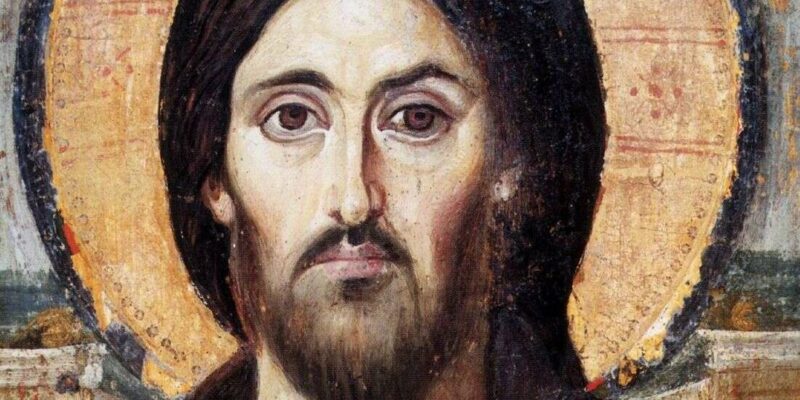
Before 1969 and the sweeping changes made in the wake of Vatican II, the Church knew how to order her feasts like she ordered her doctrine–with precision, purpose, and poetry. St Michael’s feast stood on September 29, St Gabriel’s on March 24, and St Raphael’s on October 24–today. Three archangels, three missions, three pillars of the heavenly court.
Professor Plinio Corrêa de Oliveira speaks to this:
Regarding devotion to the Angels, something rarely spoken about today is that Heaven is a true court. When I was a boy and the egalitarian spirit was less pervasive in society, more was said about the Heavenly Court. Books of piety, religion teachers and people in general spoke much more about the Heavenly Court.
The idea of a heavenly court is based on the idea that God stands before the Angels and Saints as a King before his court. Because of the similarity that exists between Heaven and creation, the earthly courts in many ways are images of the Heavenly Court. For example, following the monarchic protocol that existed to make the work of the King easier, there were eminent nobles who assisted the King when he received placets, that is, the requests of his people.
See, we say “Christ is King,” but do we really mean it? Where is his kingdom, his court, the “monarchic protocol” if so?
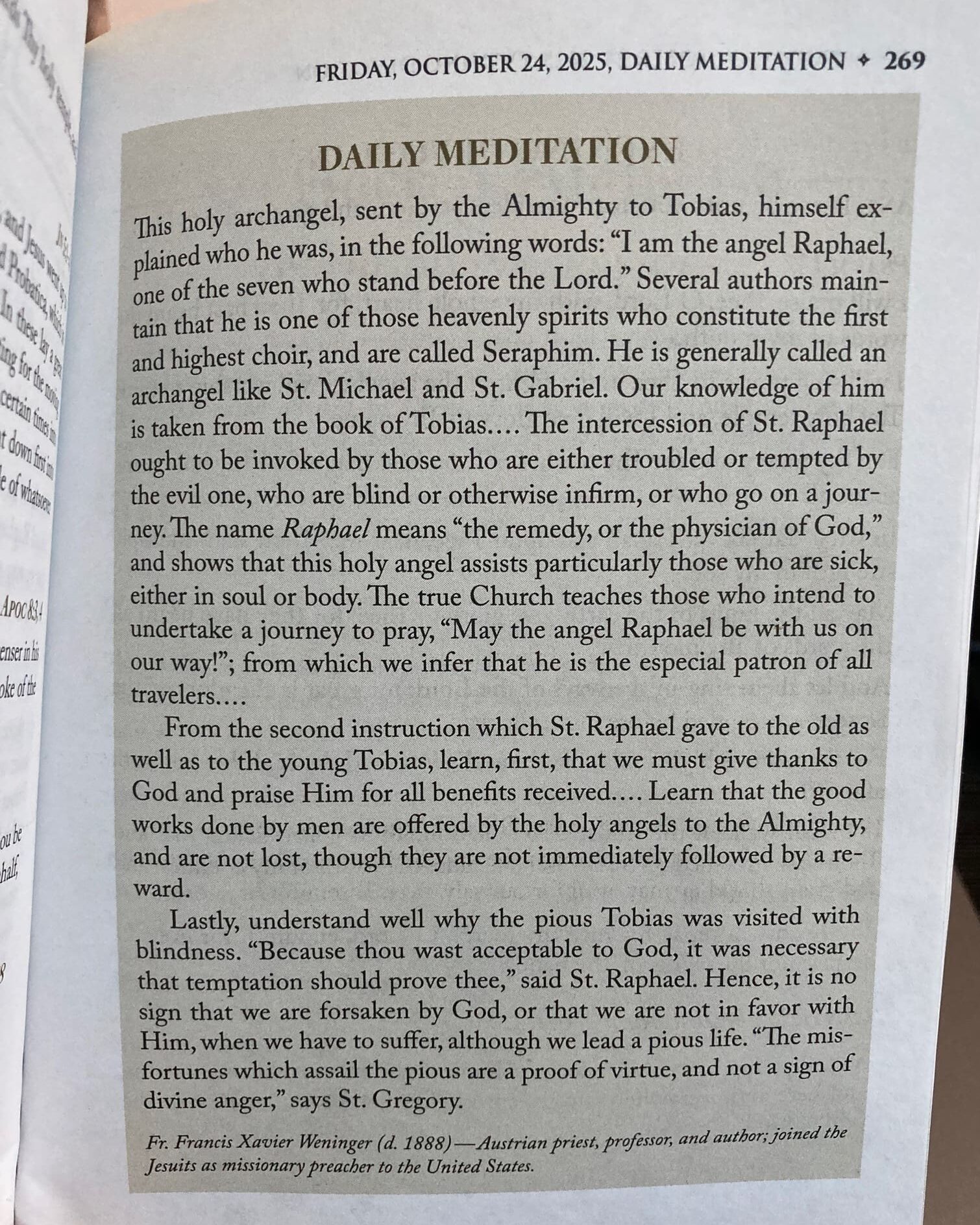
Here is the Daily Meditation for today, the feast of St Raphael:
With the 1960s and the overhaul, however, came Modernism’s rearrangement–a calendar collapsed into sometimes-confusion, a “reform” that mismashed the archangels like colors of Playdough into one generalized “Feast of the Archangels,” as though the celestial hierarchy were an administrative redundancy to be streamlined, “modernized.” What was once distinction became dilution.
Michael defends in the battle. Gabriel reveals God’s messages. Raphael heals and is a protector on any journey. And when you blend their work into one amorphous feast, you lose not just theological beauty–you lose intelligibility. You get a bunch of silly toddler-looking beings with wings flying around aimlessly with no job, no duty, no mission.
Angels are supposed to be frightening because they oppose Lucifer and his minions. Angels are formidable because they do their job.
We get fired up in agreement when it comes to coaches saying that about their players, but the angels? Nah.
Heaven, just like any organization worthy of championships, operates by order. There is a court before the King, and each rank serves a divine purpose. Until we rediscover that–until we recover the concept of hierarchy–we can chant Christus Rex (Christ is King in the vernacular) all we want, but it won’t mean much. For what is a king without a kingdom? What is a throne without ministers? What is kingship without the order that reflects it on Earth?
Did you know that the formal title of the Feast of Christ the King in the Church calendar, established by Pope Pius XI, was originally 1925 (Quas Primas) to counter the rise of secularism and remind the world that true authority and order come only from Christ? Did you know he meant that to mean in the temporal, secular societies because 1925 was right in the thick of the rise of Communism? Did you know it was placed on the calendar in relation to All Saints Day and All Souls Day for a reason, along the lines of that logic? Did you know it was changed for a very specific, one might say nefarious, purpose?
(But always seemingly so innocent and always with sound reasoning!)
St Raphael’s story in the Book of Tobias reveals this truth in its marrow:
7 For it is good to hide the secret of a king: but honourable to reveal and confess the works of God. 8 Prayer is good with fasting and alms more than to lay up treasures of gold: 9 For alms delivereth from death, and the same is that which purgeth away sins, and maketh to find mercy and life everlasting. 10 But they that commit sin and iniquity, are enemies to their own soul.
11 I discover then the truth unto you, and I will not hide the secret from you. 12 When thou didst pray with tears, and didst bury the dead, and didst leave thy dinner, and hide the dead by day in thy house, and bury them by night, I offered thy prayer to the Lord. 13 And because thou wast acceptable to God, it was necessary that temptation should prove thee. 14 And now the Lord hath sent me to heal thee, and to deliver Sara thy son’s wife from the devil. 15 For I am the angel Raphael, one of the seven, who stand before the Lord.
None of this is sweet, cute, “angelic” courtesy–it’s the law of right worship. There is mystery where there must be reverence, and revelation where there must be faith. Raphael teaches us that divine secrets are not ours to expose like modern scholars dissecting a frog; they are His to unveil through grace, through prayer, through obedience.
When Tobias prayed, fasted, and gave alms–the three ropes of our Lenten braid–Raphael was sent to heal him, and to deliver Sara his son’s wife from the devil. He did not come as a symbol or an inner awakening, not in a group of winged creatures indistinguishable from the billions of others flying around in the clouds, but as a distinct being with a distinct job delivering real grace–a healing agent handed down through the divine hierarchy.
And that’s exactly what Modernism denies. Pius X warned in Pascendi that modernists reduce revelation to religious experience, Christ to a man more conscious of divinity than Divinity Himself. The supernatural–lost inside the psychological. When you flatten heaven, you flatten Earth. When you clutch the horizontal too tightly, you lose sight of the vertical beam pointing upwards. When you erase angels, you erase hierarchy. When you erase hierarchy, you erase kingship.
So here we are–half a century into the post-1969 free-for-all–still trying to say Christ is King while living as though he has no court, no order, no law above our feelings. We can glibly say it all we want, but God shall not be mocked (Galatians vi.7)
The powerful angel Raphael stands against that sickness, that poison, that rot of the soul and understanding. His very name means “the remedy, or the physician of God.” He heals the blindness of Tobias, yes, the infestation of Sara, yes–but today he is standing among us waiting to heal the blindness of a Church that has forgotten what an ordered cosmos looks like.
If only we’ll ask him.
Because healing, if we believe Scripture, like revelation and defense, only makes sense within hierarchy. And until the heavenly court is honored once again on Earth, until the house is put back in order, the Kingdom will remain something we type in Facebook posts having absolutely no idea what we’re talking about.
Advertisement
Advertisement
