
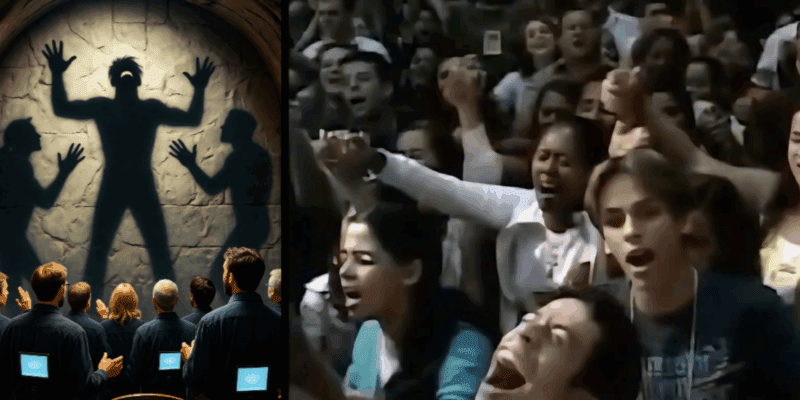
What happens when revelation itself becomes a matter of “personal experience”? When Christ ceases to be the Eternal Word and becomes instead a symbol of our own interior awakening?
Those questions aren’t theoretical anymore–haven’t been for a long time. From long documented, millenia-long efforts to change the “tradition” St Paul warns us to hold onto in Scripture, it has, almost unbelievably, become the foundation of what many consider a new religion entirely. Hard to argue against that, if you put even a little bit of reading into papal encyclicals of the past vs the modern ones, not to mention the latest ecumenical council’s unmistakable break from so many things the Council of Trent in the mid-1500s deemed anathema for the rest of time. This is when the Church was fending off foes from Luther and the 1517 Protestant Revolution. Those important decrees included the Traditional Latin Mass.
Pope Pius X, who held the keys in the early 20th century, warned of the wolves throughout his pontificate, perhaps most strikingly in his infamous, frankly brilliant encyclical Pascendi Dominici Gregis. The teaching warned that modernists were not merely erring in doctrine–they were transfiguring reality itself.
This space’s latest output has included several articles and a YouTube video on Pius X and Pascendi. It is multi-pronged in its argument. Here are the two paragraphs we will reflect on specifically today. It is dense, but I’ve bolded a few terms to help in clarification; certainly, he begins the document more lucidly, and I invite you to peruse some of that more introductory material in my other work:
9. However, in all this process, from which, according to the Modernists, faith and revelation spring, one point is to be particularly noted, for it is of capital importance on account of the historico-critical corollaries which are deduced from it. – For the Unknowable they talk of does not present itself to faith as something solitary and isolated; but rather in close conjunction with some phenomenon, which, though it belongs to the realm of science and history yet to some extent oversteps their bounds. Such a phenomenon may be an act of nature containing within itself something mysterious; or it may be a man, whose character, actions and words cannot, apparently, be reconciled with the ordinary laws of history. Then faith, attracted by the Unknowable which is united with the phenomenon, possesses itself of the whole phenomenon, and, as it were, permeates it with its own life. From this two things follow. The first is a sort of transfiguration of the phenomenon, by its elevation above its own true conditions, by which it becomes more adapted to that form of the divine which faith will infuse into it. The second is a kind of disfigurement, which springs from the fact that faith, which has made the phenomenon independent of the circumstances of place and time, attributes to it qualities which it has not; and this is true particularly of the phenomena of the past, and the older they are, the truer it is. From these two principles the Modernists deduce two laws, which, when united with a third which they have already got from agnosticism, constitute the foundation of historical criticism. We will take an illustration from the Person of Christ. In the person of Christ, they say, science and history encounter nothing that is not human. Therefore, in virtue of the first canon deduced from agnosticism, whatever there is in His history suggestive of the divine, must be rejected. Then, according to the second canon, the historical Person of Christ was transfigured by faith; therefore everything that raises it above historical conditions must be removed. Lately, the third canon, which lays down that the person of Christ has been disfigured by faith, requires that everything should be excluded, deeds and words and all else that is not in keeping with His character, circumstances and education, and with the place and time in which He lived. A strange style of reasoning, truly; but it is Modernist criticism.
10. Therefore the religious sentiment, which through the agency of vital immanence emerges from the lurking places of the subconsciousness, is the germ of all religion, and the explanation of everything that has been or ever will be in any religion. The sentiment, which was at first only rudimentary and almost formless, gradually matured, under the influence of that mysterious principle from which it originated, with the progress of human life, of which, as has been said, it is a form. This, then, is the origin of all religion, even supernatural religion; it is only a development of this religious sentiment. Nor is the Catholic religion an exception; it is quite on a level with the rest; for it was engendered, by the process of vital immanence, in the consciousness of Christ, who was a man of the choicest nature, whose like has never been, nor will be. – Those who hear these audacious, these sacrilegious assertions, are simply shocked! And yet, Venerable Brethren, these are not merely the foolish babblings of infidels. There are many Catholics, yea, and priests too, who say these things openly; and they boast that they are going to reform the Church by these ravings! There is no question now of the old error, by which a sort of right to the supernatural order was claimed for the human nature. We have gone far beyond that: we have reached the point when it is affirmed that our most holy religion, in the man Christ as in us, emanated from nature spontaneously and entirely. Than this there is surely nothing more destructive of the whole supernatural order. Wherefore the [First] Vatican Council most justly decreed: “If anyone says that man cannot be raised by God to a knowledge and perfection which surpasses nature, but that he can and should, by his own efforts and by a constant development, attain finally to the possession of all truth and good, let him be anathema” (De Revel., can. 3).
According to the Modernist playbook, faith does not begin with God revealing himself to man. It begins, instead, with a vague sense of “the Unknowable”–a feeling, a religious sentiment–emerging from within the human subconscious. Then, to make that feeling intelligible, it attaches itself to a phenomenon: a miracle, a prophet, or, in the most dangerous example, Christ himself.
We, man, creates religion, creates Jesus Christ, based on the emotions, the sentiments, that well up in us.
From here it is not difficult to see where suddenly we as Catholics are being told that all religions lead to God.
Once faith has “possessed” this phenomenon, Pius X explains, it performs a double, murderous maneuver–a transfiguration and a disfigurement. It elevates the object beyond its real nature and strips away anything that contradicts the believer’s emotional interpretation. Thus, the Christ of faith becomes something different from the Christ of history. The divine Word becomes the symbol of the believer’s own consciousness.
That’s not theology–it’s psychology masquerading as revelation.
And it certainly is not Catholicism.
Pius X, along with several popes before and after him, saw it coming. In paragraphs 9 and 10 here, he identifies the seed of this distortion: vital immanence—the idea that all religion arises naturally from within man, not supernaturally from God. From this poisoned soil, the “new gospel” grows. Christ becomes “the choicest man” rather than the God-Man; revelation becomes a feeling rather than a fact. In the name of progress, the supernatural order collapses into the psychological.
If you watch my video, you’ll see two favorites of Catholics–Padre Pio and Bishop Sheen–were warning about this as well.
This–along with its contributing cousins of culture and politics, driven by a multifaceted complicit media–is the modern psyop. It’s not just because it’s digital and widespread–it’s because it’s internal. If it feels real, psychologists have convinced us that it is real. It doesn’t need to silence us if it can sedate us first. It doesn’t need to burn the Church–not necessarily yet–if it can neuter the militancy of her foundation, her sense of the divine in all its objective, historical, hierarchical, sacramental reality.
This is why Pascendi matters now more than ever. What Pius X called “audacious and sacrilegious assertions” have since become the assumptions of catechisms, homilies, and Vatican documents–and thus assumptions of unwary fellow Catholics who have no idea what wolves are inside the fence. The shift from faith as assent and disciplined obedience to apostolic succession and tradition, to faith as sentiment and full of the feels, wasn’t a correction–it was a coup.
If religion emerges from human feeling, then there is no revelation to obey, no Christ to follow, no Church to defend. There are only personal journeys and evolving consciences.
We once knew it as moral relativism but alas too many never learned to recognize it in our own homes.
Pius X saw this future. And the question I beg all of my family and friends to ask themselves right now is safe enough, I believe–Are we living this future as we speak?
My mother saw it, most of it. She got swept up in raising a family and going along with the flow just like most everyone. I spoke to her about some of this before she died four years ago. Her conversations with me all of a sudden made more sense to both of us.
This all is so personal.
The only way out of this nightmare–the only real counter-psyop–is to rediscover revelation as revelation: something received, not invented; something divine, not psychological; something incarnate, not imagined.
That’s the fight for the Christian Faith today. That’s why Pascendi still burns like a warning flare from over a century ago–illuminating how modernity hung around long enough to eventually make man the measure of God.
Advertisement
Advertisement
