
I write this–I come–in peace. Like a Pilgrim in a cartoon.
But all of this at least has to be considered.
There are some simple realities that control much of what we believe. Whoever owns the publishing houses, whoever owns the words, controls the history passed down.
With history and the words of textbooks as our backbone, we ask, “Who decided the ‘first’ Thanksgiving?”
History isn’t simply recorded with integrity, even though we follow the things we learn along the way–particularly through school textbooks–as though they were religion. Certainly it continues to be difficult for me to come to terms with many of the things I both learned and taught along the way. But come to terms with it I must, else I risk an even further psychosis, a mental and spiritual split between deception and truth, between the two seeds of Genesis that I’m now finding go a lot further than simply whether or not I’m behaving myself on the weekend.
This is why I spend so much time researching Church History. I continue to crawl back, decade by decade, checking for inconsistencies and breaks in pattern. That is why I challenge Modernism in the face of Tradition. There is no point of return for me, and I aim at least to pass healthy questions on to readers, particularly my loved ones.
All of this, for me, is about eternal life. Both for myself and those loved ones.
We get a glimpse of how deceptive and sinister history can be by simply observing how publications and headlines work in the present time. We cannot bemoan modern media and not at least ask questions about the things we learned inside schools and through textbooks created by the very same power elite through the decades and centuries. Not practicing this very basic, common sense exercise is what helps create the cognitive dissonance, the schizophrenia inside.
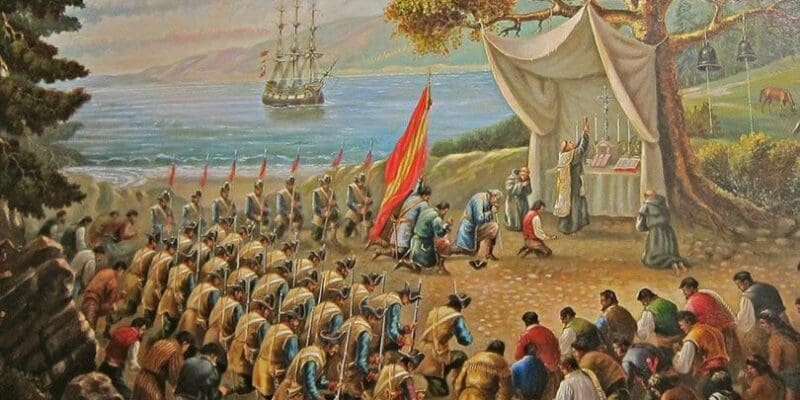
Current events and history both are published, edited, narrated, and thus shaped by those who control the words. Consider the article “The First Thanksgivings Were Catholic,” which tells of the 1598 expedition of Don Juan de Oñate and his Mass of thanksgiving on April 30 near today’s El Paso, Texas–claimed to be the second Thanksgiving in the United States.
The first, apparently, took place in St Augustine, Florida, which, apparently again, should be considered the first permanent European settlement:
The first Thanksgivings were celebrated by Spanish explorers, not pilgrims. It is Florida that today proudly claims the first Thanksgiving, with a feast and celebration between the Spanish and Timucuan Indians on September 8, 1565, 56 years before the Mayflower landed at Plymouth in 1621. Therefore, St. Augustine – and not Jamestown – is the first permanent European settlement and oldest city in North America. Another correction for many history books.
Keep in mind, my fellow Catholics, that adjoining these Thanksgivings was the crux and summit of our faith, the ultimate ritual of gratitude and thanksgiving–the Holy Sacrifice of the Mass.
Lost.
I have a working hypothesis on this, in the light of broader research work, but to delve into it would simply be too far afield today. My aim is not to pick a fight. But I will offer this: I have worked tirelessly over the last few years, particularly the last several months, to create an ecosystem of Socratic questioning that can provide a safe space to consider totally foreign possibilities while keeping the benefit of cover.
Study it all, pray on it, and one day you can say you knew it all along. It’s fine. The point is to get people thinking about all of this–how much and how easily we have been duped about nearly everything imaginable.
START WITH THESE
The First Real Thanksgiving: St. Augustine in 1565
The First Thanksgivings Were Catholic
Our Oldest City and First Thanksgiving
The narrative presented–permanently concretized by the national holiday we anticipate–diverges sharply from “other” history out there. The standard school-book version of the first Thanksgiving as a 1621 Plymouth feast–and our own previous discussions on the reality of how we are memory-holed with everything from Covid to 9/11 to JFK and well beyond–should collide in a way that at least makes us stop to think.
Add the fact that Protestants and Catholics were not exactly pals back then and the reality of who controlled the printing press, and you may develop some serious, healthy reservations about whether or not turkey will continue to be a companion of Lions and Cowboys oh my in the future.
My wife and I have already made the break. We celebrated Thanksgiving on November 11, a special date in Catholic history. Next year we may very well celebrate it on April 30 or September 8:
Since the last Thursday of November is a random date to commemorate Thanksgiving, I propose that Catholics in Texas commemorate on this day the conquest of Don Oñate and the Franciscan priests, rather than that bitter harvest of the Puritans. I am sure that this will glorify Our Lord Jesus Christ and gain his blessing for our future.
The fact that Catholics also celebrate the Nativity of the Blessed Virgin Mary on September 8 enhances the attraction.
Perhaps the most stunning question for Catholics is why actual Catholic priests never talk about this. If some do, then forgive me if I’ve simply missed out on those particular good shepherds.
When an idea goes un-published or un-emphasized–whether by textbooks, media, or publishing houses–it behaves as if it never existed. And that “behavior” is specifically how history can be altered and created. As we’ve seen in our studies on Modernism in the last several weeks, when authority over what must be believed shifts away from the deposit of faith and into the control of narrative, the Church’s “official memory” itself becomes suspect. Pius X’s critique of Modernism hinged on the idea that when doctrine is quietly dissolved by shifting language, it isn’t replaced by nothing–it’s replaced by something else. That “something else” begins with words–what gets said, who says it, where, and when. Controlling the vocabulary becomes controlling the history, controlling the present, controlling the future.
The same applies to a nation’s “official memory,” made even more diabolical when the same powers that be are busy conflating Church and State, busy trying to convince us that it is good, noble, indeed religious, to treat Thanksgiving as a day of unity for all Americans, for all Christians–Catholic and Protestant alike. If the articles above and so many other reputable sources out there are true, then it is an absolute embarrassment for Catholics to acquiesce their way through the last Thursday in November every year as though none of how it actually came about at our expense matters.
And I say all this having had an anticipatory Thanksgiving dinner for my wife’s family’s sake just last night, just to go with the flow.
No need to rock the boat when we see them so seldom.
I don’t think it’s anything over which I have to go see a priest in Confession, but certainly it is just one of those little illustrations of my own hypocrisy that knows no bounds at times. Or maybe it’s just the product of a society that is so steeped in its false fairy tales that to break rank with things like this would make you seem like an alien from Neptune.
I think my mother-in-law just walked upstairs when I tried to tell her what I was writing about. Love you, Mom.
The answer to all of this is certainly not to abolish Thanksgiving as we know it. Impossible, obviously. But perhaps one small step could be to do a little reading, do a little soul-searching, and maybe sit down as a family to consider some Catholic alternatives. There are many, as November 11 and the feast of St Martin de Tours provided for my wife this year. It’s ok to play around with it a little bit, memorialize it one day next year and another the next until you get it down. Dr Horvat explains why an alternative is actually more in line with what we are hoping America can become, a society entrenched less in a sinister, self-serving federal government:
If the New Spain colonies had not set aside their Catholic heritage, perhaps today Florida would be celebrating its Thanksgiving day on September 8, while Texas would have its own special feast on April 30. This would be more in keeping with the healthy spirit of regionalism which characterizes organic society.
History isn’t neutral. It is narrated. Words matter. And the guardians of those words are, in effect, guardians of memory, identity–and ultimately, destiny.
And the decision to federalize a particular day for Thanksgiving is not just political, not just arbitrary.
The ecosystem I’ve been building may provide more clarity for my delicacy today.
In short, this all should matter to the American Catholic.
Advertisement
Advertisement
