
“There’s no way to bargain with the Communists—you get nothing.”
– Cardinal Zen
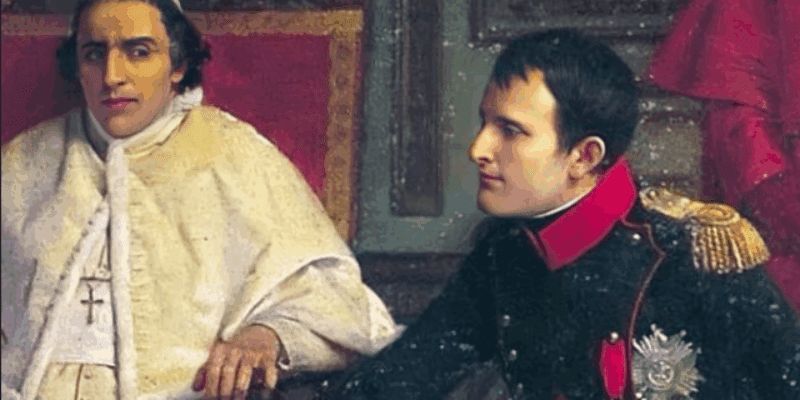
A century before Pope Pius X and his seeming-war on Modernism, there was Pius VII–governing in the wake of the French Revolution, that spiritual earthquake which left thrones toppled, altars defiled, and the Church infiltrated by wolves.
Napoleon and Pius VII have quite the story–a clash between Caesar and Peter that deserves its own retelling–but for now, one piece must suffice.
LEJEUNE/PIUS X RELATED ARTICLES
The Silence That Speaks of Another Master (MONDAY)
In his 1800 encyclical Diu Satis, written as France burned with revolutionary zeal and religious apostasy, Pius VII did what every true pope does by nature of his office: he watched, and he warned. He reminded the bishops of their sacred duty to guard the deposit of faith, even when the price was persecution. Despite being inside the wake of revolution and, frankly, still in the midst of it, any compromise would prove far more dangerous than direct confrontation.
Hindsight is 20/20, I suppose–but hindsight is still what we must make.
Yet one can’t help wondering–what choice did they have? Time and again, the Church has been placed in a pincer, forced to choose between survival and surrender, with the world applying pressure precisely to make the shepherds falter–and the sheep scatter. The strategy of the enemy–indeed, the Enemy–never really changes.
Genesis 3:15.
Shepherding the Shepherds
Much of what Catholic critics judge as “political” seems to be, in truth, spiritual leadership under siege—men trying to navigate impossible choices engineered by those who hate the Church and seek her ruin, just as they sought to destroy Christ on the Cross. You can almost trace the impious fingerprints: the same old serpent, the same stiff-necked rebellion of the Old Testament, the same refusal to let God reign.
It is, without question, a great conspiracy.
Here is how Pius VII put it in Diu Satis:
11. Therefore it is Our duty to help men and nations who are in distress, and to eliminate all present and threatening evils. For “Christ has given pastors and teachers for the perfecting of the saints, for the work of the ministry, for the building up of Christ’s Body, until we all come together to the unity of faith and knowledge of God’s son.” If ever anything deters, prevents, or delays any one of us from performing this task, what a disgraceful sin he will commit! Therefore, omit no watchfulness, diligence, care, and effort, in order to “guard the deposit” of Christ’s teaching whose destruction has been planned, as you know, by a great conspiracy.
12. Do not admit anyone to the clergy, entrust to no one the ministry of the mysteries of God, allow no one to hear confessions or preach sermons, do not transfer any administration or office to anyone, before you carefully weigh, examine and “test their spirit to see if they are of God.”
And then:
20. I cannot conceal from you at the end of this letter, venerable brothers, “Since my sorrow is great and the pain of my heart unceasing,” my feelings for my children, the peoples of France, and other peoples still seething with the same madness. Nothing would be more desirable to me than to give my life for them if their safety could be achieved by my death. We do not deny — rather, We proclaim — that the bitterness of Our grief is much diminished by the invincible purpose which several of you have displayed. We remember this daily. Men of all kinds, age, and rank have followed this example. They do so, preferring to suffer any insults, dangers, losses, and penalties, and to face death itself. They consider this nobler than to be defiled by the stain of an illicit and wicked sacrament thereby committing sin and disobeying the decrees of the Apostolic See. Indeed, the courage of ancient times has been renewed no less than the cruelty.
In an age when promotion up the hierarchy is too often tied to personal policy rather than piety according to Church teaching, those words sting—and they should.
Name the modern shepherds who face “death itself” for the Catholic faith. They exist, yes–but what are they representing? Who are they fighting? And who, exactly, is casting stones at them?
Such words, like those of Pius X and so many others, read like prophecy. The boil has been slow–centuries slow–until now most Catholics no longer recognize what has happened.
Is this the Great Deception, the “operation of error” warned of in 2 Thessalonians?
Hm.
The Papal Nuncio & the Modern Vision
On the more recent front, the papal nuncio to the United States, Archbishop Christophe Pierre–occupying the same post once held by Archbishop Viganò–has urged bishops to “choose” between two paths: one aligned with the new synodal model and another with the so-called “rigid traditionalists.” His speech, delivered at the bishops’ assembly in Baltimore, was wrapped in all the usual phrases–“journey,” “discernment,” “synodal communion”–the soft language of a hard and most pernicious revolution.
It’s all so nice isn’t it?
Such was the mantra preached by Cardinal Christophe Pierre, the papal nuncio to the United States, during the bishops’ assembly in Baltimore. His words — drenched in the language of “vision,” “journey,” and “synodal communion” — could have been lifted straight from any Vatican press release of the past decade.
But beneath the diplomatic courtesies and polished rhetoric, behind the pious grins and secret winks, lies a deeper sickness namely the substitution of Christ’s mandate with the ideological program of modernism known as synodality.
Pierre exhorted the bishops to remain faithful to “Francis’ pastoral path” and to the “vision of the Second Vatican Council.” He declared that the Council’s documents are “the map for the journey ahead,” and warned that any divergence from Francis’ “pastoral vision” is a deviation from the true way forward.
Ominously he also quoted Francis:
“It is not yet time for a Vatican III, because we have not yet finished implementing Vatican II.…”
Pierre warned against “polarization,” urging bishops to “embrace the synodal style of communion.”
In other words, he was encouraging them to silence the faithful who resist the program, suppress the traditional liturgy that offends the “spirit of the age”, and drown the ancient faith in endless dialogue. Synodality — that shapeless word now used to justify every deviation — is wielded like a hammer to crush the remnants of orthodoxy.And then, with astonishing blindness, the nuncio praised Francis and even his successor, calling the new pontificate a “maturation” of Francis’ legacy — a “fidelity to the spirit of the Council.” Thus the circle completes itself. The Council begets Francis, and Francis begets a “Church of the Council.” The Gospel is replaced by “the spirit of the age,” and the deposit of faith by the endless process of “discernment.”
This is what happens when the Church denies her own history and rebels against its Founder. This is what happens when she trades the faith of the Apostles for the fashions of theologians. The modernists have no continuity. They have only destruction and reconstruction — a new “church” for a new world, one that worships another “Christ” and has as its goal the total annihilation of 2,000 years of Catholicism.
It is as if the 1960s Council must never end. There must always be more dialogue, more renewal, more self-dismantling. Build back better. Solve et coagula. “Polarization” is condemned–but only one side is ever silenced.
We are to test the spirits indeed–and yes that can include remaining obedient to the true teachings of the true Church.
This is how Modernism—Pius X’s “synthesis of all heresies”—operates. It replaces objective faith with the journey, authority of those above with consensus from below, and obedience to God with conformity to the pulse of our social media feeds. It speaks now of “accompaniment” instead of infiltration, of “listening” instead of testing those spirits. Synodality—the shapeless word that justifies every deviation from Christ’s commands—has become the hammer used to crush Christian orthodoxy.
The Catholic Faith has been hijacked. The deposit once guarded by faithful shepherds, once protected as sacred trust, has become an object of endless negotiation among those designed never to agree in the first place.
The Gospel has replaced by a reading of reactions people get on their posts.
St Augustine’s City of God has been reimagined to fit the City of Man.
What happens when shepherds are asked not to feed the flock, but to poll it instead, as though God has granted everyone a vote?
The Rot is Older Than Vatican II
These are the fruits of, among other things we could but won’t get into, the French Revolution—so-called life, liberty, freedom, democracy. Everyone gets a vote, it’s the rules. We have assumed this was the way for our entire lives. But ask yourself, where has that gotten us? And is it even true under God?
The nuncio’s appeal to “unity” is the oldest trick in the book. Such virtuous-sounding words are how secret societies have always deceived.
Unity around what exactly?
The unity of the Church has never been built on silence or surrender to other faiths, but on the Cross—on vigilance, faith, and fidelity to Christ’s commands. That is where the unity must be.
Pius VII warned us plainly—the destruction of Christ’s teaching was “planned by a great conspiracy.” It is not merely political or Communist or Modernist—it is spiritual, secret, ancient, serpentine. He knew the first duty of bishops: watchfulness and action against this secret capture of the Church.
This is not new, no. And it certainly didn’t just begin in the 1960s. But don’t mistake the age of the battle for an excuse to sit it out. That battle still waxes new today. We are called to defend Christ as the Church Militant once did—no matter the cost, the odds, or the outcomes. We can lose a hundred battles, and yet still we must fight. Today, in 2025, it is simply our turn.
St Augustine spoke of it—the two seeds, the enmity. Genesis 3:15.
And there will be an endgame. The opportunities will end.
Are you willing, are you really willing, to gamble your soul—your children’s souls—on the hope that none of this will come to its head in your lifetime?
Christ said the gate to heaven was narrow—are we going to take him at his word?
My hope today is that we ask, what does it mean to defend Christ in our time? What does it mean to guard his truth?
It means fighting for the faith for the seventy-odd years we are given. It means testing spirits, not “accompanying” them into error. It means vigilance. It means watchfulness.
It means prayer and fasting. It means the Rosary every single day.
Fail to do this or even take it lightly—and we may very well find ourselves inside 2 Thessalonians, and that another spirit was leading us all along.
Advertisement
Advertisement
