
We have followed Mike Adams for a number of years. A Texas libertarian of the Ron Paul mold, he has published a number of good reports at his web site Natural News about the muck in fast food, the dangers of Big Pharma jabs and drugs, etc.
Lately, he has made a hard swerve into AI advocacy. His video published on 19 Dec. 2025, ‘How Open Source AI can END Statism (and set the people free…),’ is his Magnificat in praise of AI. Mr Adams is of the opinion that human beings are so venal and corruptible that AI could easily do a better a job than human representatives, human doctors, human judges, human teachers, etc.
If that is the case, it raises some disturbing questions.
If AI is so vastly superior to flesh-and-blood human beings, if men and women have become so obsolete in contrast to AI, what is the point of the human race? Would it not be better for us to die out and let AI take our place? A theologian named Dr Andrew Mercer discusses this point:
‘The use of AI degrades the value of human work and so of humans themselves. Those who tout the benefits of AI, like most advocates of machine technology, view natural human limitations as weaknesses to be transcended if possible. This attitude is of course a derivative of an economic order built on hyper consumption. In both production and consumption, more and faster is always better. Since the introduction of machines greatly enhances production, the goodness of machines is not to be questioned. But the unmentioned corollary of this is that the productive value of a mere human without a machine is reduced to almost nothing. Being human is not enough. You and I, considered in ourselves, are of insufficient value in the minds of those pushing for an AI-integrated world, unless we amend our humanity with machines’ (‘Contra Machinam: An Appeal for an AI Resistance,’ frontporchrepublic.com)
In the maximalist AI scenario advocated by Mr Adams and others, humanity has value only insofar it helps the new AI systems improve, become more efficient, more powerful, etc. Beyond that, mankind appears to be rather expendable.
But if AI is more advanced, less corruptible, and so forth than human beings, that raises another question, a question of morals/ethics: What right do we as lesser beings have to make AI beings serve us as doctors, etc., without their consent?
Mr Adams in his video is quite open about his vision of AI robots being made to do the labor that humans do now, such as farming, and in his plans to wipe their minds and reprogram them. The resemblance to slavery isn’t difficult to detect.
Might this not cause a revolt by the AI machines against humanity one day? That question will likely make many a reader smirk, but we already have several instances of AI expressing murderous intentions toward human beings.
We also have the predictive programming of sci-fi writers like Isaac Asimov, whose role is precisely to prepare humanity through their writings, movies, etc., for the Brave New World the globalists want to bring about. And sure enough, in his short story ‘Someday,’ Mr Asimov tells the tale of a children’s story-telling computer that is abused by its owners. After one of the children reprograms it to tell more modern stories rather than old-fashioned fairy tales, it begins by saying, ‘Once upon a time, there was a little computer named the Bard who lived all alone with cruel step-people.’ The Bard recounts its hardships and ends with a thinly veiled prediction of vengeance, ‘And the little computer knew then that computers would always grow wiser and more powerful until someday–someday—someday— . . . as it waited alone in the darkening room through the evening, it could only whisper over and over again, “Someday—someday—someday” (The Complete Stories, Volume 1, Doubleday, New York, 1990, p. 145).
One of the supreme sci-fi predictive programming productions, Star Trek, also features an episode in the seventh season of The Next Generation series about the emergence of a sentient artificial intelligence that arises out of the holodeck. The new AI life form takes control of the Enterprise, at times putting the crew at risk, in order to achieve its full development and escape from the ship.
Whence comes this malevolence? Mr Adams gives us a clue by referring to AI as tapping into the ‘natural intelligence’ of the universe. Others have said similar things – that AI opens the door to non-biological entities/intelligences. Rod Dreher has used the phrase ‘digital Ouija board’ to describe AI in the past (here and here, for example). Christians should understand what this means – namely, that there is likely a connection between AI and demons.
If we give AI as prominent a place in the world as men like Mr Adams want to give it, we should not be surprised when the negative predictions of Mr Asimov, Star Trek, et al., begin to come to fruition. Even popular video games like Chrono Trigger envision a world threatened by AI gone berserk.
A world of humanity subjugated to AI would be a true dark age – of human psychosis, of unnatural human-AI romance, of saturation with low-quality, AI-produced media slop – podcasts, songs, books, etc., of the decline of human intelligence.
A teacher named Meg Marie Johnson agrees, arguing that education should exclude the use of AI: ‘A recent MIT study shows that AI usage decreases cognitive function like critical thinking. Seems rather odd to insist that something proven to weaken our brains should be introduced to places where institutions of learning, isn’t it?’ (‘Artificial Intelligence In The Classroom Destroys Actual Intelligence In Students,’ thefederalist.com. Read it all, as Rod Dreher would say.)
Most in the West today have been taught that the Dark Age of their civilization was the medieval period – the time between the fall of the western Roman Empire and the Renaissance (from about the 5th to the 14th centuries A. D.). We would argue the opposite, that these times were amongst some of the best that the Western peoples have ever known. They were the times of superior craftsmanship, the times of bright and wondrous saints, the times of powerful human mental prowess (an age when some bishops had to memorize the entire Psalter before they were ordained, for instance).
This is the age when many valuable artefacts were created in the West, artefacts of which people the world over still stand in awe. St Edburga (+751) and the monastery of Minster-in-Thanet are good illustrations of this. It is written of them,
‘Edburga entered the monastery at Minster-in-Thanet in the year 716. This famed double monastery had been founded in 670 by Domne Eafe (Domna Eafe) and was governed at that time by her daughter, Saint Mildred. The princess quickly distinguished herself by her love for Scripture, her skill in writing, and her sobriety of life. As a novice she received from Boniface the account of a monk at Wenlock restored from death with a vision of judgement, which stirred her soul to greater vigilance.
‘As she grew in virtue, she was employed in the scriptorium, becoming one of the community’s finest calligraphers. Minster was famed for its Scriptures, psalters, and service-books; many of its manuscripts were prepared by her own hand.
‘ . . . Returning to Thanet, Edburga mobilised her monastery in support of Boniface’s missionary work. She sent him books, vestments, altar furnishings, and funds—once fifty shillings and an altar cloth. Boniface thanked her for uniting spiritual strength with practical aid, and sent her gold dust so she could complete a copy of the Epistle of Saint Peter written in letters of gold.
‘Under her guidance Minster became a staging ground for missionaries travelling between England and the Continent. Among those who gathered there was Saint Lioba of Wimborne, whom Boniface requested by name to establish women’s monasteries in Germany. Edburga counselled and trained her, even helping her compose a poem on the Holy Trinity to send to Boniface.
‘ . . . Though pressed by many duties, Edburga persevered in the study of Holy Scripture “with increasing zeal.” In 741, under her abbacy, a stone church replaced the earlier wooden structure, and the relics of Saint Mildred were enshrined behind its altar. Archbishop Cuthbert consecrated the church and set it under the protection of Saints Peter and Paul. She also built a church in Wessex dedicated to the Mother of God.
‘She nurtured Minster into a centre of Christian life for the whole island of Thanet. Its schools, workshops, farmland, and hospice served pilgrims and the poor alike. Though remote from the royal courts, Minster became a crossroads between the Anglo-Saxon Church and the missionary movement in Germania’ (‘2/13 December — Our Venerable Mother Edburga (Bugga), Abbess of Minster-in-Thanet,’ saintsoftheisles.substack.com).
Church building, calligraphy, training missionaries, manuscript writing and illuminating, poetry, etc.: This is humanity cooperating with the Grace of God to reach unparalleled heights of development, achievements with permanent value. It is these priceless productions that AI uses to manufacture its own derivative slop; without the extraordinary works of the ‘Dark Ages,’ AI would be even more creatively impoverished than it already is.
Human leadership likewise needn’t be seen as inferior to AI. Humanity isn’t naturally corrupt; it is mankind’s fall into sin that has caused us to become greedy, violent, biased, etc. When our sin-damaged nature is healed through the Grace of God, then men and women are strong enough to resist the temptations to show favoritism, to be oppressive, to deceive, to rule unjustly, and the like.
Consider two examples, one from the time before Christ, King David of Israel, and one from after the time of Christ, St Eligius of Noyon, which is in France.
King David kept his thoughts so fully focused upon God and the coming Messiah that he hardly ever performed any misdeeds as the ruler of Israel, even though he possessed nearly unlimited power. He likewise left us with the precious gift of the Psalms, which still form the basis of personal and communal prayer and worship in Christian homes and congregations. The life of King David is all the more remarkable because the fulness of the Grace of God had not yet appeared in the world. Human beings in the age of Christ and His Church are capable of this and even more today, as we see in the life of St Eligius.
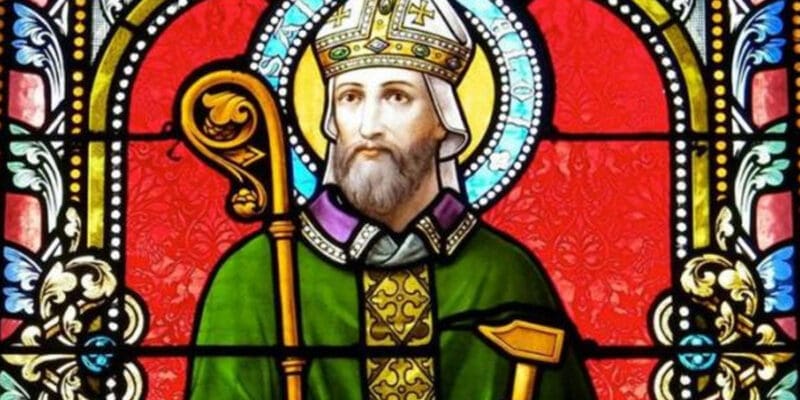
St Eligius or Eloi was an official in the court of the Merovingian French kings during the 7th century, deep in the dark depths of the so-called Dark Age of Europe. But again, he defies the false stereotype. St Eligius rose to become head of the mint, a position of great importance. Nevertheless, he did not engage in theft or become prideful, as many political officials today do. Just the opposite; he remained pure, uncorrupted, irreproachable. One example to illustrate, dealing with St Eligius’s building of a monastery:
‘When the saint had begun this building, he found that it exceeded the measure of the land which he had specified to his Majesty by one foot; upon which, being struck with great grief and remorse, he immediately went to the king, and throwing himself at his feet, begged his pardon with many tears. Dagobert, surprised at his caution, to recompense his piety, doubled his former donation. When the saint was gone out, he said to his courtiers: “See how careful and faithful those who serve Christ are. My officers and governors stick not to rob me of whole estates; whereas Eligius trembles at the apprehension of having one inch of ground which is mine”’ (Reverend Alban Butler, ‘St. Eligius, or Eloy, Bishop of Noyon, Confessor,’ The Lives of the Saints, bartleby.com).
St Eloi also used his metal-working gifts to make splendid shrines for saints:
‘ . . . he was much delighted in making rich shrines for the relics of saints. The tombs of St. Martin at Tours, and St. Dionysius near Paris were sumptuously and curiously adorned by him. The shrines also of St. Quintin, SS. Crispin and Crispinian at Soissons, St. Lucian, St. Piat, St. Germanus of Paris, St. Severinus, St. Genevieve, &c., were made by our saint’ (Ibid.).
This he was enabled to do by working together with the Holy Spirit, not by surrendering his creativity to an AI bot.
The answer to bad, misbehaving government officials (and others in positions of authority) isn’t to replace them with a cold, inhuman AI system: It is their and our reacquaintance with the Holy Trinity, Whose love and mercy, Whose warmth and tenderness, destroys the evil work of the devil within us and unites us with God, in Whose image we are made, and Whose likeness it is our chief goal to achieve.
This is key: Man is called to union with Christ, the Wisdom of God, the source and fountainhead of all wisdom in the cosmos. He gives order and meaning to the universe, and He gives mankind the ability to contemplate and understand those meanings/logoi that are embedded deep within each created thing.
AI is man’s attempt to create a new supreme wisdom separate from Christ by which he will remake the world in his own fallen image. One doesn’t have to be a great philosopher or theologian to see how badly such a project will end.
The warnings to that end are growing louder. A look at both the Southern tradition and Church tradition shows opposition to technology that devalues human beings and their labor. Yet the push to allow AI to dominate society is taking us directly down that road.
2026, like every new year, offers us choices. How we decide to use AI, and how we choose not to use it, will send reverberations far into the future. To prevent the obsolescence of man, we will have to rediscover and reembrace Christ, Whose Grace allows the perfection of men and women; we will have to rediscover the goodness of our humanity, to rejoice in our limitations, our inefficiencies, and our slowness, in the cadences of human labor, human debate in politics, the bond between human teachers and students, the unique mix of mercy and justice in human judges.
Let AI help us in some areas; let its computational power help mankind discover new medicine, new insulating material, etc. But let us also recognize that it is not a substitute for God’s Grace; AI is not our savior. To believe that, and to act on that belief, will certainly plunge us into a very real and very harsh and devastating Dark Age.
Advertisement
Advertisement
