
The deleterious effects of unrestrained immigration are being felt all over the West: From Germany’s importation of millions of violent Syrians and Turks to Minnesota’s corrupt Somalis to Texas’s Sharia communities to Indian worker visa scams in Kentucky.
Louisiana has been spared much of that, thankfully, though there are voices at the highest levels who are eager to attract outsiders, irrespective of their place of origin, as a way to illustrate that her economy is growing.
That would be a horrible mistake, and we don’t need additional Muslim terrorist attacks in New Orleans as proof. LSU’s new head football coach Lane Kiffin will do just fine.
Coach Lane is not a native Southerner. He was born in Lincoln, Nebraska, and has spent most of his life moving from one place to another, from California to North Carolina. He is a quintessential modern-day rootless cosmopolitan man.
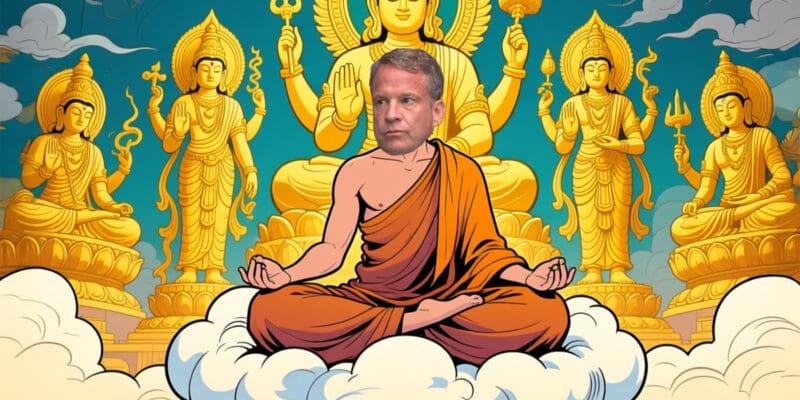
Unsurprisingly, his religious convictions reflect that. He is an avid practitioner and promoter of the Indian religious practice of yoga:
‘There was one special request for Jenn Milz, the owner of Yoga Culture in Athens, Georgia, when hosting Lane Kiffin and the Ole Miss football coaching staff for a private workout on Oct. 18.
‘ . . . Kiffin and the Ole Miss coaches have made a habit out of pregame exercise. The staff has taken hot yoga or hot Pilates classes the morning of road games at Kentucky, Georgia and Oklahoma in 2025.
‘ . . . It’s become an important part of the Rebels’ routine on the road’ (Sam Hutchens, ‘Lane Kiffin, Ole Miss coaches do hot yoga classes before road games. Here’s what they’re like,’ clarionledger.com).
Coach Lane is continuing this practice in Baton Rouge.
Some folks are probably asking, ‘What’s the big deal? The man’s using it to get some exercise, to focus, relax, etc.’
In a world that is as spiritually confused and chaotic as ours is, Lane Kiffin’s proud promotion of yoga probably doesn’t seem like a problem at all to many people. But a deeper look shows that there is a problem. Yoga isn’t just an exercise program; it is a religious program:
‘“Yoga is not an exercise, but an act of worship,” teaches His Eminence Metropolitan Nektarios of Argolis of the Greek Orthodox Church, who is holding an event next Sunday to warn people about the dangers of Far Eastern spirituality.
‘“When we have repentance in church, whether it be a small confession or a big one, we don’t do it for fitness reasons. We make a confession to God. This is the same thing that people do during yoga, which is what we are trying to explain”, says Metropolitan Nektarios, reports Greek City Times.
‘ . . . Met. Nektarios is not alone in his views. For instance, the Greek Holy Synod reacted to the UN’s decision to designate June 21 as International Day of Yoga in 2014, stating that the practice of yoga has “no place in the lives of Christians” since it is a fundamental aspect of Hinduism and as such is not considered a “form of exercise” but of worship.
‘As the Synod explained, yoga poses were created as expressions of worship of the pantheon of Hindu gods and are considered offerings to these “gods,” who Christians know to be demons.
‘ . . . A number of saints and elders of the 20th century have also been known to speak out forcefully against yoga and other Far Eastern spiritual practices, including St. Paisios the Athonite, Elder Sophrony, Fr. Seraphim (Rose), and the martyred Fr. Daniel Sysoev.
‘ . . . See also our articles, “Hidden Fire: Orthodox Perspectives on Yoga,” and “On Christianity and Yoga from a Former Adherent of the Latter,” both by former practitioners of yoga.
‘See also the video, “Yoga is Not Gymnastics,” by Klaus Kenneth, a former practitioner who became a spiritual child of Elder Sophrony’ (‘Greek hierarch organizing event on dangers of Yoga,’ orthochristian.com).
Coach Lane will probably win many games at LSU, perhaps even an NCAA championship. But at what cost? As LSU’s head football coach, he will be one of the most prominent figures in the entire State. Many, especially the young, will look up to him and try to imitate him. Yet doing so will lead them away from Christ and toward a false religion.
The leadership of Louisiana has failed us again. They declare with their words that they are Christians and that they care about preserving the unique culture that has grown up here (a culture that is an outgrowth of the Church), but they deny their words with their actions: by inviting Left Coast Meta into deeply conservative Richland Parish, by praising Church-weakening religious pluralism, now by placing an openly practicing Hindu in one of the most high-profile positions in Louisiana.
Louisianans aren’t ‘Undifferntiated Human Matter’, to quote the insightful Frenchman Renaud Camus; people and cultures aren’t interchangeable. Louisianans, by and large, have been and still are devoted to Christ. We desperately need Louisiana’s leadership to recognize all of that, and to act accordingly, by making some real, concrete efforts to promote and strengthen Christianity in Louisiana – efforts that have been sadly lacking heretofore. Just consider the top foreign countries sending students to LSU: China, India, Nigeria, Bangladesh, Nepal. Are these students going to strengthen Louisiana’s cultural core of French, English, Irish, etc.? Doubtful.
Given the modern animus against kings, Louisiana’s leadership will probably gnash their teeth at being unfavorably compared with them. Nevertheless, they could learn a lot from the good examples of some of the Christian kings of France. We will close without commentary with this passage from the life of the most praiseworthy French saint, Eligius of Noyon (+7th century, Feast Day Dec. 1st), which will hopefully spur them to action:
‘[King] Clotaire dying in 628, his son and successor Dagobert, entertained so just an idea of the saint’s virtue and wisdom that he frequently consulted him preferably to all his council about public affairs, and listened to his directions for his own private conduct. Eligius took every favourable opportunity to inspire him with sentiments of justice, clemency, and religion. The king was so far from being offended at the liberty which the saint took in his councils and admonitions, that he treated him with the greater regard; which drew on him the envy and jealousy of the whole court, particularly of the vicious part of the nobility, who did all in their power to blast his character. But their calumnies were too weak to do him any prejudice, and served only to give his virtue a fresh lustre, and enhance Dagobert’s veneration for him, who loaded him with favours; though it never was in his power to make him rich, because all that the saint received was immediately employed in relieving the necessitous, or in raising charitable and religious foundations. The first of these was the abbey of Solignac, which he built two leagues from Limoges, on a piece of ground granted him by the king for that purpose. The saint richly endowed it, peopled it with monks from Luxeu, and made it subject to the inspection of the abbot of that monastery. This new community increased considerably in a little time, and consisted of a hundred and fifty persons, who worked at several trades, and lived in admirable regularity. Dagobert also gave our saint a handsome house at Paris, which he converted into a nunnery, and placed in it three hundred religious women under the direction of St. Aurea, whose name occurs in the Roman Martyrology on the 4th of October’ (Reverend Alban Butler, ‘St. Eligius, or Eloy, Bishop of Noyon, Confessor,’ bartleby.com).
Advertisement
Advertisement
