
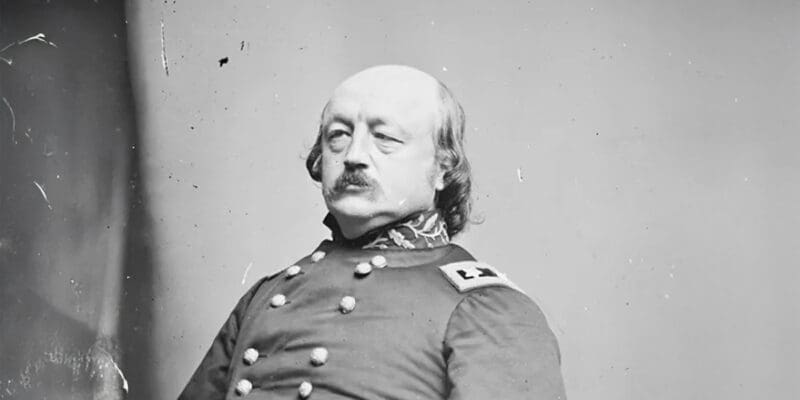
At one time, the leading women of New Orleans were on the receiving end of violent threats. Yankee General Benjamin Butler issued his General Order No 28 in 1862, which threatened to treat the ladies of New Orleans as prostitutes, earning him a place of infamy in New Orleans history:
‘ . . . it is ordered that hereafter when any female shall by word, gesture, or movement insult or show contempt for any officer or soldier of the United States she shall be regarded and held liable to be treated as a woman of the town plying her avocation.
‘ . . . Perhaps the most infamous order of the Civil War, Major General Benjamin Butler issued the above two weeks after taking command of New Orleans. . . . The resulting order gained public disdain and international attention because Butler instructed his troops to treat any woman who insulted them as a prostitute’ (Laura June Davis, ‘The Infamous “Woman Order” of Occupied New Orleans,’ civilwarmonitor.com).
Amazingly, today in New Orleans the leading women – like Cantrell and Moreno – are doing their best to protect the illegal immigrants who are a threat to women and other innocents in and around the city:
‘Mayor LaToya Cantrell said the city will not assist in any law enforcement actions that go against public safety.
‘“The city of New Orleans stands in solidarity with every resident and making sure that they know their rights, and you know what, they all feel safe,” Cantrell said.
‘ . . . Mayor-elect Helena Moreno also addressed Catahoula Crunch, saying the city has a duty to ensure due process for all residents’ (Parker Boyd, ‘New Orleans protesters demand ICE-free zones amid federal immigration operation,’ fox8live.com)
And also:
‘Moreno recently released a brief “know-your-rights” guide for those stopped by federal immigration enforcement agents, along with a list of legal resources.
‘New Orleans Police Department Superintendent Anne Kirkpatrick has been more restrained in her response to the deployment, saying that the department would act as a “partner,” providing assistance to federal immigration agencies when needed for public safety, but at the same time pledging that NOPD officers would not be directly involved in immigration investigations or arrests’ (Charles Maldonado, ‘Homeland Security announce launch of immigration operation in New Orleans,’ laillunimator.com).
Their permissive attitude toward illegal immigrants poses a danger not just to their cities but also to the broader family of Louisianans.
In this context, Senator Conrad Appel made some good remarks on the necessity of cooperation between State and city officials in Louisiana. But he did not answer a key question that is hovering at the margins of his essay: What should be done when city officials refuse to cooperate for the well-being of their cities and of the whole State, when they engage in behavior that brings real harm to their cities and to the State?
Ideally, the State government would step in and put a stop to the harmful behavior.
In general, we like the idea of local communities directing as many of their own affairs as possible. But State government is different from the federal government. The federal government was created by the States, not the other way around. The former cannot therefore unmake the latter.
It is a different matter when speaking of States and the cities within them. The cities of a State did not create that State; the cities were given life by the State government. The State government should therefore have the final authority to command the cities when conflicts occur.
Louisiana’s constitution complicates this matter unnecessarily. In the sections on home rule, home rule may be ended only by a majority of the voters belonging to the particular city (Article VI, Section 5C).
An amendment should be presented to Louisiana’s voters that would allow for temporary suspension of home rule in a case of urgent need if approved by a supermajority of the both chambers of the Legislature.
Until such a measure is adopted, there is a possible workaround. The governor has fairly broad emergency powers under Louisiana law to ensure the safety of the citizens of the State should some threatening danger arise (Revised Statutes 29:724):
‘A. The governor is responsible for meeting the dangers to the state and people presented by emergencies or disasters, and in order to effectuate the provisions of this Chapter, the governor may issue executive orders, proclamations, and regulations and amend or rescind them. Executive orders, proclamations, and regulations so issued shall have the force and effect of law.
‘B.(1) A disaster or emergency, or both, shall be declared by executive order or proclamation of the governor if he finds that a disaster or emergency has occurred or the threat thereof is imminent. The state of disaster or emergency shall continue until the governor finds that the threat of danger has passed or the disaster or emergency has been dealt with to the extent that the emergency conditions no longer exist and terminates the state of disaster or emergency by executive order or proclamation, but no state of disaster or emergency may continue for longer than thirty days unless renewed by the governor.’
Some of the powers explicitly given to the governor in this part of the Statutes include the following:
‘Direct and compel the evacuation of all or part of the population from any stricken or threatened area within the state if he deems this action necessary for the preservation of life or other disaster mitigation, response, or recovery.’
‘Control ingress and egress to and from a disaster area, the movement of persons within the area, and the occupancy of premises therein.’
‘Utilize all available resources of the state government and of each political subdivision of the state as reasonably necessary to cope with the disaster or emergency.’
What Louisiana is facing in New Orleans with the massive numbers of illegal immigrants is a grave threat that we believe meets the threshold of an emergency. These illegals are straining key institutions – healthcare, police, education. Wages are suppressed by their presence, harming the financial well-being of native Louisianans. Violent crime committed by them threatens life itself.
If this goes on, Governor Landry must use the powers granted to him in the Revised Statutes to put an end to the lawlessness. We love localism, but it can’t be used to shield malefactors. An infection in one part of the body must be cured, or it will spread and cause the whole body to weaken and die. Likewise, rampant, unchecked criminality in one location of Louisiana, if not stopped, will spread its effects to the rest of the State. Fragmentation and chaos lie down that road, one most folks probably would rather not go down.
As Sen Appel suggested, Gov Landry should try to negotiate with the leadership of New Orleans first, but if they refuse to cooperate, then he should use his emergency powers to sideline them until order is restored to the city.
That said, we must return to the subject with which we opened this essay: the leading women of New Orleans. The hierarchy of virtues under which they live and rule has been inverted. Christian virtues have been replaced by fraudulent demonic substitutes: Self-sacrificing service by them on behalf of the people of New Orleans has given way to self-serving behavior that enriches them at the expense of New Orleanians. That has to be corrected for the long-term health of New Orleans.
One way to straighten that out is to make known once again to the people of the City the wonderful example of the saints from Church history. Let them read their lives and see their icons; let them sing hymns to honor them and ask for their help with life’s problems; let them imitate all the good things they find in the lives of the saints. The examples of the saints who were also earthly rulers would be especially important in this regard. Saint-Empress Theophano (reposed circa 893 A. D., Feast Day 16 Dec.) is one such ruler for them to devote some attention:
‘Saint Theophanó was a pious and virtuous Empress, who was greatly praised by the chroniclers of her time because of her evangelical life, her almsgiving, and her exceptional piety. . . .
‘The Holy Empress Theophanó and her husband Leo were imprisoned for three years, because Leo was falsely accused of plotting to assassinate his father, Emperor Basil. After obtaining her freedom,Theophanó spent her life in prayer and fasting, earnestly struggling for her salvation. . . .
‘Though she lived in the world, she renounced everything worldly, and became a benefactor of the poor. She also built churches and monasteries, or restored those in need of repair. She was a true mother to her subjects, caring for widows and orphans, and consoling the sorrowful.
‘Despite all the grandeur and wealth surrounding her, she preserved her customary humility and modesty. She preferred to dress in simple clothing so that she would not recognized. Accompanied by two trusted servants, she would visit the homes of the poor and the persecuted, offering her assistance. Her faith was such that she was found worthy of the gift of performing miracles’ (‘Saint Theophanó the Wonderworker, wife of Emperor Leo the Wise,’ oca.org).
If the people of New Orleans were to grow up being nourished by the lives of women like Empress Theophano, the chances of them being drawn to the likes of LaToya Cantrell or Helena Moreno as their political leaders would fall drastically, and the willingness of those who did get elected to engage in graft and other irresponsible behavior would also fall.
Civilization-shaping changes are happening all over the world. We are being faced with critical decisions here in Louisiana as well. The choices we make will reverberate for years to come. New Orleans, once the Queen City of the South, still remains the leading city of Louisiana. Her future will play a large role in determining Louisiana’s future. The time for temporary fixes or turning a blind eye to the disastrous problems unfolding there has passed. The time for more permanent, long-term solutions has come. If Gov Landry and the rest of the State and City governments fail at this critical moment, they may well join General Butler on the list of most despised figures in the history of New Orleans and all of Louisiana.
Advertisement
Advertisement
