
(Citizens of a New Louisiana) — It all started with a phone call. As a data guy by nature, it’s difficult to answer an opinion question like which state Senators may be out of sync with their districts. However, thanks to the data-driven approach to everything we do here at Citizens for a New Louisiana, I set out on a mini-adventure to discover the answer.
To be frank, many people in Louisiana’s political realm play everything by gut instinct, guesswork, or they just make it up as they go. In fact, most of the assumptions voters bring to the polls on election day are dramatically wrong.
This organization is different — it always has been. The catalyst that birthed our movement was a shocking discovery: one particular assumption held by literally everyone was actually the result of a very well-crafted public relations campaign.
That’s the trick. When someone tells you something is true (not just in politics), learn to ask a single, piercing question: “How do you know?” That technique doesn’t just work on well-meaning (or not-so-well-meaning) people; it also works on yourself. Next time you’re tempted to vote a certain way, or repeat a particular rumor, think to yourself, “How do I know this to be true?” That one question could start you on your own mini-adventure of discovery, too.
Misconceptions About “Safe Districts”
For years, Louisiana politics has relied on a familiar shorthand: safe districts, unwinnable seats, foregone conclusions. Campaigns are discouraged before they begin. Voters are conditioned to believe their choices don’t matter. And incumbents benefit from an aura of inevitability that often goes unexamined.
But when you actually look at the data — like one of those ambiguous images, where the brain can flip between two or more distinct interpretations — you suddenly can’t unsee what had eluded you at first glance.
With that concept in mind, I pulled precinct-level election returns from the 2024 presidential election and applied them to the Louisiana Senate district shape files. I sprinkled in some demographic overlays and star ratings from our legislative scorecard for some additional background.
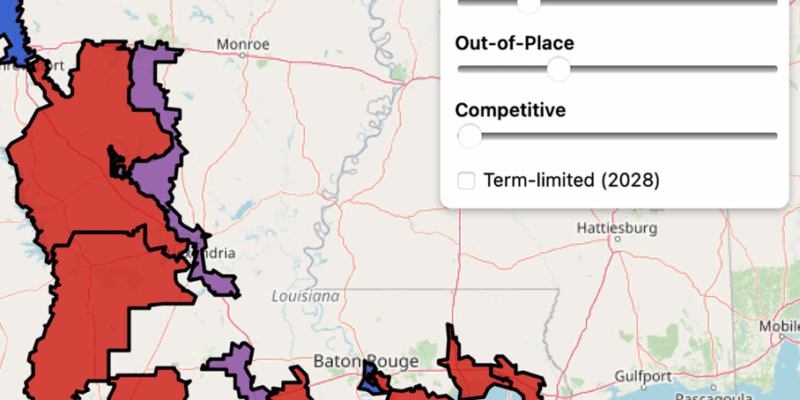
Data can be boring, so I programmatically turned all of that raw data into an interactive map of Louisiana Senate districts, simple enough for anyone to use. This tool allows anyone to adjust competitiveness, alignment, and electoral margin in real time. What emerged was not red vs. blue so much as politically mispriced districts.
The Case Study That Changed My Mind: Senate District 24
Perhaps the most striking example is Senate District 24, currently represented by staunch Democrat, Sen. Gerald Boudreaux. Conventional wisdom has long held that this district is so heavily majority-minority that it is functionally unreachable by anyone outside a narrow Democratic Party lane. That assumption has shaped recruitment, fundraising, and strategy for years. But the data tells a different story.
When we examine the Trump vs. Harris presidential vote share split, District 24 falls squarely into what political analysts would classify as competitive, even if that reality isn’t widely acknowledged. In fact, the margin is the single narrowest of any Senate district in the state. Even with lopsided Demographics, the district didn’t give either Trump or Harris a majority. It was a razor-thin 49.0% to 49.6% — enough that candidate quality, turnout, and coalition-building matter a great deal.
In other words, this is not as locked of a seat as everyone may believe. It’s the definition of a toss-up district. That finding alone should prompt a rethink. But there’s more.
A Rare Open Seat in an Already Crowded Field
Sen. Boudreaux is term-limited, meaning District 24 will be open in the next cycle (2027). Open seats behave very differently from incumbent-defended ones, particularly in districts with ambiguous partisan signals.
Early chatter suggests three to four Black Democratic Party candidates are actively considering a run, including:
- Rep. Tehmi Chaisson (D 5/10)
- Rep. Dustin Miller (D 3/10)
- “Comedy Hour” Kenneth Boudreaux (D 1/10)
At the same time, Keith Kishbaugh, a white Republican, has been widely mentioned as a probable entrant. Based on the district’s actual voting behavior — not its reputation — this data should be encouraging to him. There’s also a wildcard: Julie Emerson, a term-limited House member who’s currently running for U.S. Senate. She resides in the district as well.
This is no longer a theoretical exercise. It is a live, evolving political contest — one that looks far more competitive on paper than many observers would expect.
This Matters Beyond One District
District 24 is not an outlier. Across the state, our map reveals other Senate districts where:
- Presidential margins are tight
- Legislative voting behavior diverges sharply from district ideology
- Turnout dynamics could swing outcomes
- “Safe seat” assumptions suppress competition
These conditions don’t guarantee upsets. But they do mean that outcomes are shaped by effort, messaging, and candidate strength. When competition disappears, accountability is soon to follow. When accountability is gone, voters lose leverage. Ours is the kind of data that can change all that.
Explore the Data Yourself
By now, you should know me well. I’d never ask readers something so presumptuous and, well, droll as to take my word for it. Instead, below is an embedded interactive map that lets you explore Louisiana Senate districts for yourself. The data table under the map also responds to your map selections.
You can:
- Adjust a slider to highlight competitive races
- Identify districts where legislative voting is out of step with voter preferences
- Filter for term-limited seats
- Click districts to see detailed breakdowns
- Re-sort the table by clicking on the column header.
The goal isn’t to tell anyone how to vote — but how they already voted. This shows where assumptions may have been misplaced. Because sometimes, the most consequential political fact isn’t who’s running, but who never bothered to try.
Click here to open the map in a new window.
Advertisement
Advertisement
