
Perhaps one of the best takes from this article is when I’ll write “People no longer know how to know.”
One of the most bewildering experiences on this Traditional Catholic road has been discovering that conversion does not move in straight lines, that Tradition is not a neat, true counter to post-Vatican II Catholicism, that discovering the beauty and truth of the Latin Mass does not mean you’ve reached the end.
I am learning that these are simply inspired and managed “yeses” to God as precursors to something more.
Like St Thérèse of Lisieux being afraid to walk down the stairs and her mother encouraging her to simply take the next step.
Many of us were drawn to Tradition not as an aesthetic preference or a political posture, but as penitents—souls exhausted and reputations ruined by the ambiguity, outright contradiction, and a quiet realization that something essential had been taken from us without our consent. For me, this general sentiment was exacerbated by the COVID scam and the ridiculous images of Eucharistic abuse and “Mass from your recliner.”
The diocesan Latin Mass was the first shock of oxygen, the first slow steps into a cold ocean. Then came others like the FSSP, then a CMRI I didn’t even distinguish back then as separated, then the SSPX—each step feeling less like rebellion from something wholly lacking substance and more like finally walking in the direction my conscience had been pointing for years.
How many memories and instincts have I looked back on concerning the Ordinary Form of the Mass and the American way of Catholicism and realized that I was right….
But I had no outlet, I had no knowledge of Tradition even existing. So I sought out other paths.
Conversion Is Circuitous
There is a strange and unsettling sensation that accompanies the conscious walk toward God’s truth: the feeling of being pulled further in, while simultaneously being commanded back out. Drawn deeper into the logic, coherence, and sacrificial clarity of Tradition—while at the same time feeling an undeniable obligation to speak to Catholics of the Ordinary Form and even to Protestants, not as adversaries, but as fellow souls standing in a widening field of confusion. There are a number of people I’ve grown close to and love out there, and the growing belief that they are in no way prepared for what is happening and what is coming brings the sorrow of Jeremias on my soul.
Not to mention the sorrow of not knowing if you’re even in the right place in the radical world of Tradition those same family and friends choose not even to approach.
Or if you’re even supposed to multiply your gift of writing when in truth it should be the shepherds doing the teaching. Popes of the past like Gregory XVI and Leo XIII have warned against the illicit publication of material:
We must include that harmful and never sufficiently denounced freedom to publish any writings whatever and disseminate them to the people, which some dare to demand and promote with so great a clamor. We are horrified to see what monstrous doctrines and prodigious errors are disseminated far and wide in countless books, pamphlets, and other writings which, though small in weight, are very great in malice. We are in tears at the abuse which proceeds from them over the face of the earth. Some are so carried away that they contentiously assert that the flock of errors arising from them is sufficiently compensated by the publication of some book which defends religion and truth. Every law condemns deliberately doing evil simply because there is some hope that good may result. Is there any sane man who would say poison ought to be distributed, sold publicly, stored, and even drunk because some antidote is available and those who use it may be snatched from death again and again? – Gregory XVI, Mirari Vos
These dangers, viz., the confounding of license with liberty, the passion for discussing and pouring contempt upon any possible subject, the assumed right to hold whatever opinions one pleases upon any subject and to set them forth in print to the world, have so wrapped minds in darkness that there is now a greater need of the Church’s teaching office than ever before, lest people become unmindful both of conscience and of duty. – Leo XIII, Testem Benevolentiae Nostrae
So the uncomfortable tension squeezes from a number of seemingly disparate directions. It is terrifying at times, a reminder every hour of every day of St Paul’s exhortation to work out my salvation with fear and trembling.
All of it, in all its discomfort and alienation, raises the question so few want to ask out loud—
What if this is not just about finding Catholicism in its truest form, but every day and always on the path, having to work out your own temporal punishments in realizing that the very voices who brought you along through Tradition in earlier stages could very well be a part of the fracture and ultimate deception themselves?
In other words, the realization that God in his mercy has been drawing you closer and closer to Him, but along the way in His justice allowing you to function inside operations of error illustrated in 2 Thessalonians?
You may say this doesn’t matter, as long as you get there. But I will tell you it does, because when you are trying in vain to convince your siblings about the truth of Tradition, but are frequently redirecting course yourself, the futility of it all crashes down on you like a forsaken Temple.
Watching the Watchmen
Archbishop Carlo Maria Viganò’s recent, scathing words have forced out into the open a question I have had about controlled opposition inside the Church and its media. And it includes some of the most recognizable names in the Trad movement, including Burke and Schneider.
That old instinct starts talking to you again about all those YouTube videos you’ve seen and wondered about: Why are certain Traditional voices so elevated, while others are not?
Did you know that answer already?
Did you know that answer and simply didn’t want to rock the Traditional boat with Trad friends because you’re having to rock enough boats on other fronts and other battles?
And then again: Is Viganò even right about this?
You believe he is, but are you right?
In calling out not only the architects of the synodal revolution but also the “traditionally conservative” figures long treated as safe guides, Viganò is not merely escalating rhetoric. He is illustrating a far more unsettling possibility—that some voices many Traditional Catholics have relied upon as bulwarks may themselves be compromised, stalled, or have functioned—knowingly or not—as pressure points designed specifically to keep the resistance within the control of the enemy.
This is what happens in the Republican-Democrat dialectic in politics, after all.
It is precisely how the Hidden Hand, the ancient enemy, they of the “impious” nature many a saint have warned about, operate—through layers of plausible deniability and the construction of a thousand false binaries inside the one you finally thought was terminal, the one you finally thought was right, the one you finally thought was of and for God.
But in their cunning and magick, they understand that about humanity as well.
None of this is an accusation against Catholics sincerely trying to find the path. But it is, indeed, a warning.
Especially if you don’t understand, at least on an elementary level, how vicious and intent these people are in destroying Christ’s Church from within. And if they can’t because Christ promised it would never happen, that doesn’t mean they can’t bring as many souls down to hell with them as possible.
Did I mention this was terrifying?
All of this should be sobering even to the most committed Traditional Catholic.
If it is possible for visible enemies of the Faith, whether they are valid or not, to occupy what the faithful assume are positions of authority—and Viganò argues persuasively that it is—then it is also possible for apparently friendly voices to serve as instruments of confusion or misdirection, and ultimately, damnation. Not wolves in the obvious disguise of Modernism, but purportedly trustworthy conservative, traditional shepherds who speak just enough truth to prevent souls from following that truth to its logical and sacrificial conclusion.
Am I saying I have turned my back on the Burkes and Schneiders of the war? Maybe? Maybe not? I really don’t know. But one thing is clear from both this story and the ongoing work I’ve been doing on controlled opposition in politics: the realization itself that Viganò spotlights is destabilizing enough. Such an understanding leaves no room to coast into autopilot.
When the old binary of Novus Ordo vs Vetus Ordo arose, many of us felt safe, as though we’d arrived. We should have known it wouldn’t be that easy. Any penitent should know that there is justice to be satisfied for our past willing communion with the sins encouraged by the false bride. And that means the operation of error will subsist through each new step alongside God’s mercy and reward, for those who actively seek him out. At some point, the comfort of “at least I know where I stand” erodes, because we cannot stand still for long. Suddenly even the word Traditionalist feels insufficient, even dangerous, if it becomes a substitute for vigilance and the humility to admit that God may very well have another footstep for me tomorrow.
This is where yet another temptation could enter: retreat.
All of this can be exhausting, and frankly, embarrassing on some level. The instinct can be to withdraw into tribes not unlike the places we started, to speak only to the like-minded, to treat Ordinary Form Catholics or Protestants as hopelessly compromised or irrelevant, or even to treat other factions of Tradition as not being in the correct camp. All of that may indeed be true. But we must move beyond the intellect here, because there truly are many, many, well-meaning people out there who are not in our camp. This is precisely where Christ’s command to spread the Good News presses hardest against the current.
Christ did not entrust the Faith to a self-sealing remnant content to admire its own coherence.
Especially when so many different factions believe they have achieved it.
Many of us feel—often against our preferences—that we are being compelled to translate clarity without diluting it, to speak truth without weaponizing it, to remain rooted in Tradition while refusing to treat it as a private refuge. That does not mean flattening doctrine or pretending the differences are unimportant. It means recognizing that the crisis may no longer be primarily liturgical or jurisdictional.
It very well may be anthropological, metaphysical, epistemological.
People no longer know how to know.
A Clear Criterion
Viganò’s critique lands with such force precisely because it names the nefarious features most Catholics still refuse to face: a Church structure that can be infiltrated, a hierarchy that can be occupied, and a conservative resistance—whether Burke and Schneider are a part of that or not—that too often stops short of the real conclusions that will actually win souls over.
This does not invalidate Tradition, but it does run the risk of redefining it—along with so many other stolen words of the Modernists. Tradition is absolutely necessary—but Viganò’s critique exposes the danger of treating Tradition as an identity rather than a discipline of truth that must be continually sharpened under obedience.
So where does that leave us?
Not merely unsettled or trembling with a St Pauline fear.
Not merely stripped of illusions that suits and veils are enough.
But right back to where we’ve always been with family and friends—personally responsible before God, not before factions.
We may never know why God chose us to know. I wonder that every day. Why not that brother, or that sister? But even amidst the “not knowing how to know,” we must move. We must take the next step like St Thérèse.
The Little Way—the next step—is indeed little.
But it is decisive.
When even trusted voices must be tested, when visible authority can no longer be relied upon as a sufficient guide, God does not leave the soul without a rule of navigation. He does not ask us to improvise truth. He does not ask us to guess.
He gives us one.
There is one and only one discipline that guarantees a soul is being led where God intends—provided it is joined to the active pursuit of truth and the rejection of self-deception.
The Rosary.
The Rosary, the Rosary, the Rosary.
This is not something sentimental.
Nor is it something aesthetic.
Nor is it a replacement of the more powerful sacraments (wherever those lie).
What it is, is obedience to something God put in our hands, quite literally—a form of fidelity that does not depend on jurisdictional clarity, clerical credibility, or ecclesial stability. It is something we do not have to wonder is valid, invalid, or insufficient.
Devotion to the Rosary—real devotion, daily devotion, disciplined devotion, saying it three or six or nine times a day here and there in the spirit of St Padre Pio—places the soul, even the most sinful, under the tutelage of the Woman who crushes the serpent’s head. She simply cannot mislead. She simply cannot confuse. She forms our discernment by conforming the intellect and the will to Christ Himself, not by bypassing reason, but by purifying it.
In an age when people no longer know how to know, the Rosary restores the semantics of reality. It orders the mind. It disciplines the imagination. It purifies intention. It humbles pride. And perhaps most importantly for this story, it exposes error and sharpens discernment—not by Viganòian argument alone, but by interior clarity that survives when arguments fail.
Without it, the discernment this story exposes will collapse into opinion, character assassination, and ridicule.
Without it, even Tradition becomes just another tribe.
This is why the Rosary prayed for true discernment in these baffling times is not optional, not a spiritual add-on for those already serious because they attend the Latin Mass. In an age when even the sacraments are being questioned, it is the only discipline that cannot be counterfeited, co-opted, or neutralized.
Those who pray it faithfully will not be lost—even if they are finding their steps for a time.
We are not promised that the terrain will remain familiar. We are not promised we’ve finally arrived at our church parish home. But we are promised grace—and grace is given to those who submit to it.
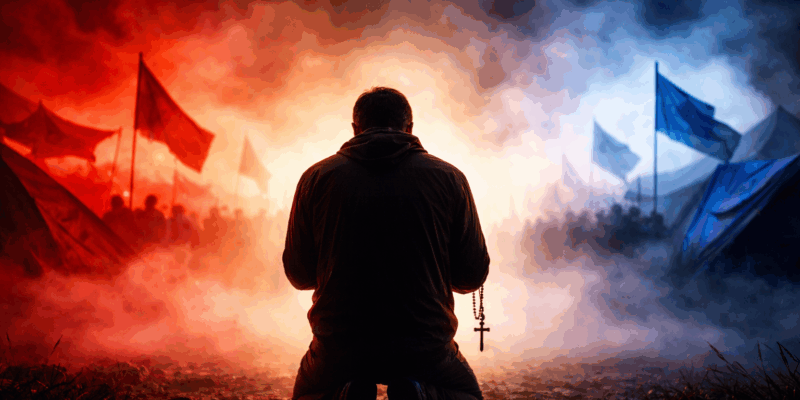
And submission, in this hour, does not look like finding the perfect camp or making assumptions simply because we don’t attend the Novus Ordo anymore. It looks like kneeling daily before God through His Mother, refusing to surrender the intellect, refusing to outsource the conscience, and refusing to stop stepping simply because we’re different from “those Catholics over there.”
The Rosary is not a compromise.
It is not quietism.
It is formation for combat.
It is clarity when authority fractures.
It is fidelity when categories fail.
It is the weapon of this war—and the one place a Catholic can kneel and know he is not lost.
Advertisement
Advertisement
