
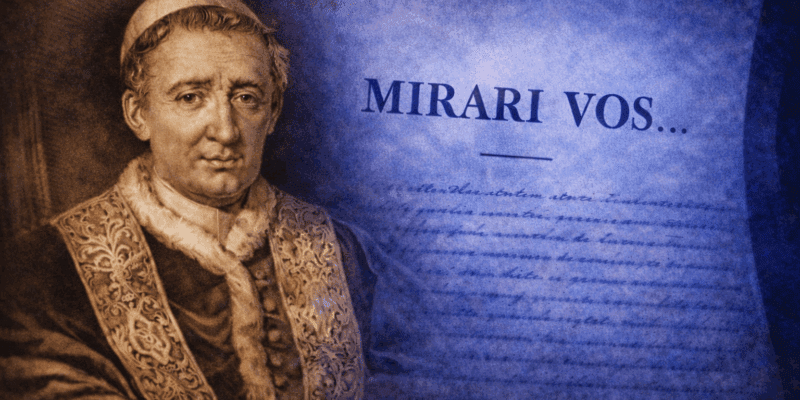
While even well-meaning Catholics, if they read them at all, are tempted to treat papal encyclicals as period pieces—interesting, reverent, but safely sealed off from the present—Pope Gregory XVI’s Mirari Vos refuses to stay in the museum. Written in 1832, in the shadow of the French Revolution and Pope Pius VII’s own unique warnings, conspiracy, and ideological upheaval, Gregory opens not with theological abstraction as one might assume, but with a lived crisis—a real cross—describing a pontificate inaugurated amid storms, treason, impiety, and coordinated chaos, which he interprets not as random disorder but as a deliberate assault on the Catholic Church, on Christendom.
He writes:
You know what storms of evil and toil, at the beginning of Our pontificate, drove Us suddenly into the depths of the sea. If the right hand of God had not given Us strength, We would have drowned as the result of the terrible conspiracy of impious men. The mind recoils from renewing this by enumerating so many dangers; instead We bless the Father of consolation Who, having overthrown all enemies, snatched Us from the present danger.
He is not a pope writing poetry here for a small deal. He is a shepherd diagnosing an insidious pattern, one that moves through agitation, “enlightenment,” indulgence, impunity, and finally, once the ground is laid to be welcomed with open arms—outright rebellion.
Mirari Vos and American Politics
Because Gregory frames the post-Enlightenment, post-Revolutionary fervor as spiritual before it is political, his language cuts against our comfortably numb instincts, where everything is reduced to man-made parties and platforms, rigged and at-the-ready polls and numbers. He speaks of conspiracies of impious men, of factious actors exploiting the populace’s indulgence, of authority delayed not by weakness but by the sheer volume of fires that must be put out to preserve order. This matters, because Gregory is not pitting public order against the moral life in a vacuum. He is warning what happens when their shared end is forgotten.
Order without divine truth becomes rule by mob; morality without divine order dissolves into sentiment, as we’ve seen with Pius X and what would come to be known as “Modernism.” Modern electoral theater depends on this fracture, or, this inversion, and unfortunately, goes largely unnoticed, keeping both sides locked in a false dialectic that guarantees neither will ever fix anything.
This is where the juxtaposition becomes unavoidable. As Americans cycle through presidential and midterm elections puffed up with propaganda and false dichotomies, we are trained to see every crisis as proof that our side must vote harder next time, must win harder next time, rather than asking whether the system itself is broken beyond repair in the first place. Is it, in truth, producing a bystander effect that rewards mob rule and punishes sovereign, Christ-inspired movement?
Trump, whatever one makes of him, has functioned less as a solution than as a stress test, triggering conversation, narrative warfare, discernment (hopefully), and a furthering of the psychosis (sadly) across voter bases and institutions. This is not praise or condemnation for Trump, a president I’ve gone through, over the course of the last decade, the process of first questioning, then supporting because of the children, then co-opting for my Christian crusade, then finally disconnecting from altogether.
My point today is simply observation of a man—like him or not, God-ordained or not—is an absolute lightning rod we can utilize to embellish our own faith life.
And that observation is a virtue the spectacle cannot tolerate.
It is an observation we can graft onto Gregory’s grief in paragraph 4 of the encyclical:
We come to you grieving and sorrowful because We know that you are concerned for the faith in these difficult times. Now is truly the time in which the powers of darkness winnow the elect like wheat. “The earth mourns and fades away….And the earth is infected by the inhabitants thereof, because they have transgressed the laws, they have changed the ordinances, they have broken the everlasting covenant.”
Such disobedience, carried forward to today, has created a moral and religious desensitization by design. Reverence and ancient liturgical worship has eroded to the point where only the “new” or the “novel” or the “progressive” is relevant and considered worthy of the moral high ground.
God Almighty and the Operation of Error
Through St Paul, God Himself in Scripture warned against traipsing too far down the road of perdition. It is a part of even the awakened’s punishment for previous frivolousness—the blessing of being awake but the bane of being able to do so little about it.
2 Thessalonians II.9-11 reads:
“…Whose coming is according to the working of Satan, in all power, and signs, and lying wonders, 10 And in all seduction of iniquity to them that perish; because they receive not the love of the truth, that they might be saved. Therefore God shall send them the operation of error, to believe lying:11 That all may be judged who have not believed the truth, but have consented to iniquity.”
[10] “God shall send”: That is God shall suffer them to be deceived by lying wonders, and false miracles, in punishment of their not entertaining the love of truth.
(Douay-Rheims, traditional Catholic translation)
And Romans I.24–28:
Wherefore God gave them up to the desires of their heart, unto uncleanness, to dishonour their own bodies among themselves. Who changed the truth of God into a lie; and worshipped and served the creature rather than the Creator, who is blessed for ever. Amen. For this cause God delivered them up to shameful affections. For their women have changed the natural use into that use which is against nature. And, in like manner, the men also, leaving the natural use of the women, have burned in their lusts one towards another, men with men working that which is filthy, and receiving in themselves the recompense which was due to their error. And as they liked not to have God in their knowledge, God delivered them up to a reprobate sense, to do those things which are not convenient.
The emphases on God Himself ordaining the error—mine.
Similar divine chastisement and mercy is shown in the Old Testament in Exodus with the Israelites. And again with Jeremias leading to the Babylonian Exile. Sometimes God allows time to pass in order to punish us back to him; the consequence not immediately following the sin, people don’t compute the cause and effect—and don’t repent until urgency strikes, thereby making the return to God more sincere.
He allows further sin and therefore a greater distance down the road to hell as punishment for previous sins. All because his initial mercies and gentle callings were ignored.
In other words, it seems to be the pattern of the last resort.
It is frightening, once you come to understand this—people deceive themselves into believing God somehow changed between the Old and New Testaments. It is one reason why, undoubtedly, St Paul exhorts his followers to work out their salvation with “fear and trembling” (Phill II.12). Justice and mercy have always been two sides of the same divine coin, and God loves us too much to simply let us go without a fight.
Locating the Moral High Ground
Observe carefully, and you see Gregory XVI and the butterfly effect at work: small concessions to “progress,” compounded over time, producing a culture that mistakes infiltration for reform and apathy for obedience. The result is not freedom, but intentional and managed disorder, curated apostasy.
This helps explain why national politics now feel theatrical rather than corrective. Elections have become ritualized releases of national pressure, a substitute cog of a national religion that offers only temporary answers, change without repentance, participation without hierarchy, and opinion without responsibility. The Hegelian Dialectic operates cleanly here: provoke crisis, manufacture reaction, present resolution—each cycle tightening the noose while insisting nothing fundamental has changed. “Revelation of the Method” appears not in secret, but in plain sight, breadcrumbing its way through speeches, policies, and slogans, daring the public to notice and daring it even more to do nothing.
Humiliation Ritual 101, and perhaps this is what Gregory XVI would be most sorrowful for if he lived in today’s times.
To locate the moral high ground, the faithful must first learn to recognize the enemy, the terrain. In paragraph 5, Gregory seems either to be announcing what he will write on in the body, as any good speech writer does, or to be taking the opportunity to consolidate his sorrow and ire in one paragraph before the reader loses touch. It is long, but it worth the read. It summarizes everything Gregory recognizes as enemy activity, and he does not hold back:
We speak of the things which you see with your own eyes, which We both bemoan. Depravity exults; science is impudent; liberty, dissolute. The holiness of the sacred is despised; the majesty of divine worship is not only disapproved by evil men, but defiled and held up to ridicule. Hence sound doctrine is perverted and errors of all kinds spread boldly. The laws of the sacred, the rights, institutions, and discipline — none are safe from the audacity of those speaking evil. Our Roman See is harassed violently and the bonds of unity are daily loosened and severed. The divine authority of the Church is opposed and her rights shorn off. She is subjected to human reason and with the greatest injustice exposed to the hatred of the people and reduced to vile servitude. The obedience due bishops is denied and their rights are trampled underfoot. Furthermore, academies and schools resound with new, monstrous opinions, which openly attack the Catholic faith; this horrible and nefarious war is openly and even publicly waged. Thus, by institutions and by the example of teachers, the minds of the youth are corrupted and a tremendous blow is dealt to religion and the perversion of morals is spread. So the restraints of religion are thrown off, by which alone kingdoms stand. We see the destruction of public order, the fall of principalities, and the overturning of all legitimate power approaching. Indeed this great mass of calamities had its inception in the heretical societies and sects in which all that is sacrilegious, infamous, and blasphemous has gathered as bilge water in a ship’s hold, a congealed mass of all filth.
Read it again and see beyond the words. Language like “heretical societies and sects” is not just castaway wording —it is absolutely identification, only camouflaged. And the fact that they and so many other words inside papal encyclicals of the 18th, 19th, and 20th centuries had to be camouflaged—when for centuries they didn’t have to be—is perhaps evidence of the infiltration itself, an infiltration Leo XIII would clearly allude to in his long version of the St Michael prayer a mere half-century after Gregory.
So many breadcrumbs, if only we’ll read. The 1800s say it all.
See the anomalies.
See the poison.
See the patterns.
Resist the false urgency of politics.
Remember that before there was a republic, there was a Church.
Remember that before there was a vote, there was a king, a call, and a conscience.
If we can do that, when the noise recedes from time to time as it inevitably does, what will remain for our consideration is not who will be winning future elections that are fake in the first place, but whether we allowed ourselves to be formed—or deformed—by the spectacle that owns it all.
Advertisement
Advertisement
