
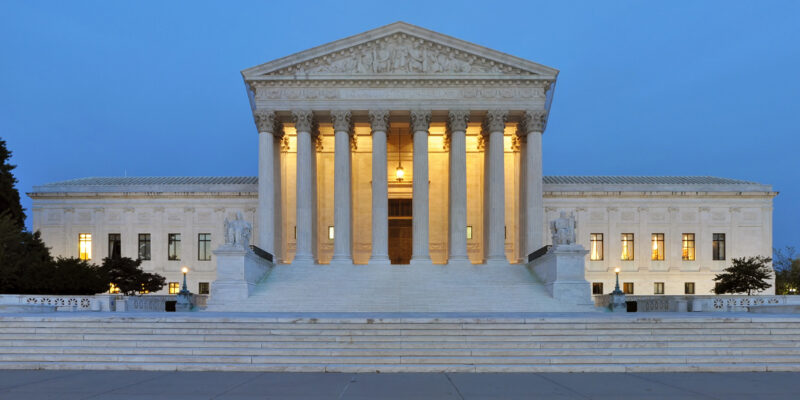
We admit to being sticklers for the notion that words have fixed meaning, and that the framers of the various State and federal constitutions had definite ideas in mind when they crafted those documents. Yesterday’s very good post by Ethan Vogin at The Hayride having made the single objection to President Trump’s State of the Union speech that Trump should not have so sharply criticize the Supreme Court for its ruling on tariffs brings this to mind, because the President was correct in his characterization of the Supreme Court’s decision.
At first glance, Chief Justice Roberts appears to have a pretty good argument in his ruling accepted by the majority in the case of Learning Resources v Trump, the significant federal Supreme Court case regarding President Trump’s ability to levy tariffs. He finds, among other things, that the words of the International Emergency Economic Powers Act (IEEPA) that grant the president the power to ‘regulate importation’ do not include the power to levy tariffs. This he bases on a strictly dictionary definition of the word ‘regulate’. Furthermore, he relies on the bare text of the federal constitution, Article I, Section 8, that only the Congress has the power of levying taxes in all their varied forms (including tariffs).
It turns out that his focus is too narrow. The words and clauses are not looked at in their broader historical context and practice. In so doing, he leaves himself vulnerable to arguments from those directions. And Justices Thomas and Kavanaugh happily launch those legal volleys, which make the majority’s opinion untenable in the end.
Both Thomas and Kavanaugh cite numerous instances of the United States Congress granting the president the power to regulate tariffs (which were never overturned by the federal Supreme Court). Some examples, from Justice Thomas’s dissenting opinion:
‘Since the 1790s, Congress has consistently delegated to the President power over foreign commerce, including the power to impose duties on imports. “‘Practically every volume of the United States Statutes’” contains broad delegations to the President in the area of foreign commerce. Id., at 80, n. 5 (quoting Curtiss-Wright Export Corp., 299 U. S., at 324).
‘The First Congress gave the President the power to “prescribe” “rules and regulations” that would “gover[n]” any person licensed to trade with Indians. 1 Stat. 137. Trade with Indians was regarded as “a matter of external relations.” McConnell 333. In delegating this power, Congress did not specify or limit what kinds of regulations the President could impose. Act of July 22, 1790, 1 Stat. 137–138. Pursuant to that broad delegation, the President restricted trading “[d]istilled [s]pirits,” required each trader to “give intelligence” to the Government, and subdelegated to his superintendents the power to “assign the limits within which each trader shall trade.” 61 Timothy Pickering Papers, Massachusetts Historical Society 4 (Aug. 28, 1790);see also Letter from G. Washington to H. Knox (Aug. 13,1790), in 6 Papers of George Washington 244–245 (D. Twohig ed. 1996). Any person who violated the President’s regulations would owe $1,000 “payable to the President.” 1 Stat. 137.
‘Succeeding early Congresses delegated many more powers over foreign commerce to the President. . . .
‘Congress likewise delegated to the President the power to set duties on imports. In 1815, Congress delegated to the President the power to lower reciprocal duties when he was “satisfied” that other nations’ trade practices no longer operated “to the disadvantage of the United States.” Act of Mar. 3, 1815, ch. 77, 3 Stat. 224. In 1824, Congress delegated to the President the power to lower and to reimpose duties in response to foreign nations’ trade practices. See Act of Jan. 7, 1824, 4 Stat. 2–3. Throughout the early decades of the Republic, Congress continued to delegate to the President similar powers over duties on imports on a regular basis. See, e.g., Act of May 24, 1828, ch. 111, 4 Stat.308; Act of May 31, 1830, ch. 219, 4 Stat. 425; Act of July 13, 1832, ch. 207, 4 Stat. 578–579. Presidents frequently changed the rates of duties on imports as to various foreign nations pursuant to these delegations.’
And that is only a small sampling of the instances that he lists of the Congress delegating not only tariffs but also other Article I, Section 8, powers to the executive branch.
Likewise, from Justice Kavanaugh’s dissent (again, not a complete list):
‘ . . . contrary to the tenor of the plaintiffs’ and the Court’s arguments here, it would not have been at all unusual or surprising for Congress, when enacting IEEPA in 1977, to authorize the President to impose tariffs. Since the early days of the Republic, Congress has regularly granted the President the power to regulate foreign trade, including via tariffs.
‘A few examples: In 1810, Congress authorized the President to prohibit imports from Great Britain or France if either nation violated the neutral commerce of the United States. Cargo of Brig Aurora v. United States, 7 Cranch 382, 382–384, 388 (1813); 2 Stat. 606.
‘In 1890, Congress granted the President the power to impose import duties in response to duties imposed by other countries on American exports. Marshall Field & Co. v. Clark, 143 U. S. 649, 680–681 (1892); 26 Stat. 612.
‘In 1922, Congress empowered the President to levy import duties under certain conditions. J. W. Hampton, Jr., & Co. v. United States, 276 U. S. 394, 400–402 (1928); 42 Stat. 941.
‘In 1930, Congress enacted Section 338 of the Tariff Act, which authorizes the President to impose tariffs when he finds that “any foreign country places any burden or disadvantage upon the commerce of the United States.” 19 U. S. C. §1338(d); 46 Stat. 705.’
Justice Kavanaugh also undermines the majority opinion by citing past examples of presidents using congressional acts that include language similar to IEEPA’s ‘regulate importation’ verbiage to levy tariffs, which again were not reversed by the Congress or the Supreme Court:
‘Perhaps even more significantly, when IEEPA was enacted in 1977, Congress and the public clearly would have understood that the phrase “regulate . . . importation” encompassed tariffs. We know as much not only because of the dictionary definitions and the traditional understanding of tariffs as a tool to regulate foreign imports. We also know as much because of tariffs imposed by two Presidents and approved by federal courts, including the Supreme Court, in the years shortly before IEEPA’s1977 enactment.
‘First, in 1971, President Nixon imposed 10 percent tariffs across the board on virtually all imports from every country in the world. Presidential Proclamation No. 4074, 3 CFR 60–61 (1971–1975 Comp.). Those tariffs were justified under IEEPA’s predecessor statute, the Trading with the Enemy Act, or TWEA.10 Like IEEPA now, TWEA at that time authorized the President to “regulate . . . importation” during national emergencies, as well as wartime. And like IEEPA now, TWEA did not specifically use the words “tariff” or “duty.”
‘ . . . Second, if one holds any lingering doubts about Congress’s and the public’s understanding of the power to “regulate . . . importation” as of 1977, a second episode shortly before IEEPA’s enactment should answer them.
‘In 1975, President Ford imposed significant monetary exactions on foreign imports of oil. Presidential Proclamation No. 4341, 3 CFR 433 (1971–1975 Comp.). He acted under Section 232 of the Trade Expansion Act of 1962.Like TWEA and IEEPA, the relevant provision of Section232 did not use the word “tariff ” or “duty.” Rather, Section 232 broadly authorized the President to “adjust the imports” of a product, 19 U. S. C. §1862(b) (1970 ed.)—language akin to the “regulate . . . importation” language in IEEPA and TWEA.
‘ . . . The Supreme Court decided the Ford tariffs case in 1976.The Court unanimously reversed the D. C. Circuit and flatly rejected the plaintiffs’ arguments. The Court held that the statutory phrase “adjust the imports”—even though it did not include terms such as “tariff,” “tax,” “duty,” or “fee”—granted President Ford the authority to impose not only quotas and embargoes, but also monetary exactions on foreign imports. Federal Energy Administration v. Algonquin SNG, Inc., 426 U. S. 548, 561 (1976).’
The historical practice has clearly been in favor of the federal executive being able to levy tariffs with Congress’s permission despite the also very clear provision in Article I, Section 8, that regulating tariffs are a congressional, not an executive, power. We would seem to have a contradiction on our hands. Justice Thomas tries to resolve it by relying on some legal jujitsu that he calls ‘core legislative power’ – i.e., that the Congress can delegate those powers of theirs that don’t have a profound effect on citizens’ rights to life, liberty, and property. This an uncharacteristic action by Justice Thomas, dreaming up a legal novelty that is nowhere mentioned by the framers.
A better explanation of the contradiction is that the framers’ giving of the tariff power to the Congress is not in line with the unwritten constitution of the States.
Every political society has an unwritten constitution: all the mass of customs and traditions that underly and flow out from the history and character of a people. In the long history of the peoples of the States, the tariff power has more often than not resided with the executive. Justice Thomas redeems himself quite well by elucidating this history in his dissent:
‘“The ‘power over external affairs [is] in origin and essential character different from that over internal affairs.’” Haaland v. Brackeen, 599 U. S. 255, 356 (2023) (THOMAS, J., dissenting) (quoting United States v. Curtiss-Wright Export Corp., 299 U. S. 304, 319 (1936)). Although internal affairs are governed by the domestic law of one sovereign, external affairs implicate the relationship between sovereigns, which is subject to the law of nations. See Locke §§145–148, at 383–384; 1 Blackstone 264; 4 id., at 66–68 (1769); E. de Vattel, The Law of Nations 161–163, 281–289 (J. Chitty ed. 1852) (Vattel). External affairs, then, are not susceptible to being “directed by antecedent, standing, positive Laws” made by one nation. Locke §147, at 384. When a person goes abroad, he must resort to the political branches (and ultimately the military)—rather than the judiciary—for protection, can indebt the executive to foreign nations for his personal misconduct, and can trigger a foreign conflict. See Vattel 161–163, 281–289; 2 F. Wharton, Digest of International Law §222, pp. 575–576 (2d ed.1887); see also id., §§189, 213–221, at 432–445, 539–575.
‘The power to regulate external affairs was accordingly not viewed as within the core legislative power at the founding. See Zivotofsky, 576 U. S., at 35–37 (opinion of THOMAS, J.). Blackstone described powers over “intercourse with foreign nations” as “prerogative” powers naturally belonging to the King. 1 Blackstone 245; see id., at 232. Locke agreed that this power “must be lodged” with the “executive.” Zivotofsky, 576 U. S., at 35 (opinion of THOMAS, J.) (citing Locke §148). Baron de Montesquieu classified all powers “in respect to things dependent on the law of nations” as part of “the executive power.” 1 The Spirit of Laws 151 (T. Nugent transl., rev. ed. 1899). The “legislative” power, by contrast, “applied only within the realm.” McConnell 214.
‘The power to regulate external affairs included power over foreign commerce. At the founding, the “external executive power” included “‘the transactions of the state with any other independent state.’” Zivotofsky, 576 U. S., at 36 (opinion of THOMAS, J.). In Great Britain, the King had no unilateral legislative power, McConnell 107, but he had much unilateral power over foreign commerce. His power over foreign commerce included the power to “govern foreign trade,” id., at 216, and to “prohibit any of his subjects from leaving the realm,” 1 Blackstone 261; accord, East India Co. v. Sandys, Skin. 223, 223–224, 90 Eng. Rep. 103 (K. B. 1684) (describing the “inherent prerogative in the Crown, that none should trade with foreigners without the King’s licence”). Thomas Rutherforth’s Institutes of Natural Law—“a treatise routinely cited by the Founders,” Zivotofsky, 576 U. S., at 36 (opinion of THOMAS, J.)—explained that the “external executive power” included “the power of adjusting the rights of a nation in respect of . . . trade.” 2 Institutes of Natural Law 55–56 (1756); accord, Locke §146,at 383. The power to impose duties on imports was a conventional method for governing foreign trade. It originated as a “prerogative right” of the King, N. Gras, Early English Customs System 21 (1918).’
Constitutions are not mere theoretical constructs. They also have practical aspects. We find out how closely the written constitution matches the unwritten constitution when the written words go into operation. When an action continually occurs in the life of a country, confederation, etc., that is different from the written text, we must conclude that the writers of the text erred in crafting it as they did. Such would appear to be the case with the tariff power. Prior to the Philadelphia charter of 1787, this power was wielded by the executive for many generations. It ought to have been left with him, at least in some measure. The fact that it has often found its way into his hands in the US after 1787 seems to confirm that.
It is good to be zealous for the original words and intentions of our constitutions’ framers. It is also good to admit that sometimes they made mistakes when forming them. That is one of the reasons there are provisions for amending them. The federal constitution should probably be changed to grant the president a portion of the power to lay and collect tariffs, to be shared with Congress. This would align the federal constitution more closely with the unwritten constitution of the federation of States.
We live in a tumultuous time. This case involving the tariff power is particularly contentious. And yet, thanks to Justice Thomas’s dissent, something admirable shines through it: the beautiful historical tapestry of English law, stretching back from our own time through many centuries – to Blackstone and Coke, to Selden and de Bracton, to Magna Carta, to the earliest laws of the Christian and sainted kings of England, Ine and Alfred. If we can, if only for a few moments, let us look with gratitude and awe at the great gift of that unbroken inheritance, thanking the All-Holy Trinity that it has survived so many shocks over the years to rest in our unworthy hands, and beseeching the Lord that it survive our highly polarized and stormy political era for future generations to know, to experience, to understand, and to enjoy.
Advertisement
Advertisement
