
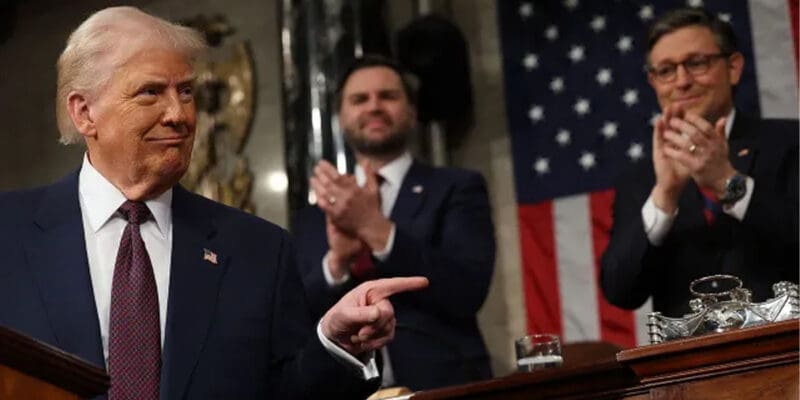
(by Philip Wegmann/RealClear Wire) – Breaking a record he set previously, President Trump delivered the longest State of the Union address in history at a moment when Americans increasingly disapprove of his handling of the economy, have soured on his immigration crackdown, and have threatened to throw congressional Republicans out of power.
Trump spoke for one hour and 47 minutes. He made the most of the moment, attempting to thread the needle between heralding accomplishments, while assuring a still jittery public – particularly when it comes to the economy – that better days are on the horizon.
Democrats, physically unmoved for most of the evening, may have unwillingly played into his plans. They remained seated for much of the speech, including conservative-coded applause lines on everything from securing the southern border to reducing the violent crime rate.
“The contrast could not be clearer,” said White House press secretary Karoline Leavitt, driving home the intended message in a social media post after the speech. “Democrats are crazy!”
The president began by painting a bleak picture of the nation his predecessor, Joe Biden, had left him, one defined by “crisis” at home and confronted with “chaos” abroad. After one year in office, however, Trump crowed that his administration had “achieved a transformation like no one has ever seen before and a turnaround for the ages.” Acknowledging lingering anxieties but still playing true to his nature as a salesman, he told the nation moments later, “You have seen nothing yet – we are going to do better and better.”
And at its core it was an upbeat sales pitch, one Republicans have been desperate for Trump to deliver.
When Vice President JD Vance and Speaker Mike Johnson stared out into the crowd from their seats directly behind the president, they saw a Congress, and political landscape, that could soon change. “If we don’t win the midterm,” Johnson told RCP last year, “he won’t have four years of a presidency. It will end at two.” Trump has received that message. If the GOP does not maintain its majority, he expects impeachment, his third.
And so the president stuck to the script on the teleprompter before him while delivering prepared remarks that still very much incorporated his trademark “weave” as he bounced between topics and called on honored guests in the galleries to punctuate his points.
Trump earned a standing ovation from Republicans when he promised to deliver justice for the mother of Iryna Zarutska, a Ukrainian immigrant brutally murdered in North Carolina last year. He erred when claiming that her assailant had come into the country as a result of Biden’s “open borders.” (The attacker is a U.S. citizen.) Trump still saw an opportunity to take a shot at Democrats. “How do you not stand,” he demanded as Zarutska’s mother wiped away tears in the overhead balcony and they remained unmoved. “How do you not stand?”
This was the designed theme of the evening. Even the most eloquent speeches in Congress are often forgotten; the White House leaned, instead, on the visual. At one point, the president baited Democrats by inviting anyone who agrees “with this statement, stand up and show your support: The first duty of the American government is to protect American citizens, not illegal aliens.”
Republicans leapt to their feet. Democrats remained seated. The president lectured the unmoved minority party that they “should be ashamed of yourself for not standing up.” The moment will almost certainly play on repeat in campaign ads for the remainder of the year.
It was the contrast that this White House most wanted as a partial government shutdown continues and Democrats refuse to fund the Department of Homeland Security unless Immigration and Customs Enforcement and Customs and Border Protection are reigned in.
But it wasn’t all red meat. White House speechwriters crafted the address to coincide with and celebrate the 250th anniversary of the nation. America “is winning again,” Trump said as he again declared the United States “the hottest country in the world.” Members of the U.S. men’s Olympic hockey team then entered the gallery at Trump’s invitation and to sustained, bipartisan applause.
With their gold medals around their neck, the squad stood in for the president as a visual representation of a nation ascendant. Trump announced that Connor Hellebuyck, the goaltender, will receive the highest of civilian honors, the Presidential Medal of Freedom. The goalie was just the first to receive recognition. Before the evening ended, Trump awarded five more commendations: two congressional Medals of Honor to war heroes, a Purple Heart to a West Virginia National Guardsman wounded in D.C. last year, and the Legion of Merit to a U.S. Coast Guard rescue swimmer.
The celebration comes at a critical time for the White House.
Trump returned to Congress Tuesday with some of the lowest approval ratings for any president in the modern era, and yet none of this is unfamiliar for the executive serving two non-consecutive terms. His current approval-disapproval numbers in the RealClearPolitics Average, 42.7% to 55.8%, are roughly the same, 40.3% to 55.6%, as they were the day he stepped to the dais in 2018 to deliver his first State of the Union address.
While illegal immigration and foreign policy crises have defined the first year of Trump’s second term in office, senior White House aides admit that if the public does not change its mind on the economy, and soon, heavy losses will inevitably follow. Before the speech, the outlook was bleak. More Americans now disapprove, 55.6%, than approve, 40.8%, of how Trump has handled the economy. This has led to a nagging challenge for the White House: How does Trump tout a booming economy without downplaying the financial anxiety of everyday Americans? Their answer: Blame Democrats.
Trump lambasted Biden not only for failing to check inflation but for facilitating economic malaise by signing legislation, like the Inflation Reduction Act which incorporated what he called “the Green New Scam,” into law.
“Now, the same people in this chamber who voted for those disasters suddenly use the word affordability,” he bellowed, “knowing full well that they caused and created the increased prices that all of our citizens had to endure. You caused that problem!”
Trump, as is his habit, presented himself as the solution. Gas prices are down. Inflation is waning. Mortgage rates are dropping. He called on Congress to codify his prescription drug reforms, vowed that tech companies would eat the cost of new data centers powering the artificial intelligence revolution, and floated a new retirement plan for those who do not qualify for an employer program. Most of all, the president encouraged the public to look forward to Tax Day, or more specifically, to the rebates and savings they would incur because of the tax cuts Republicans passed into law.
The Golden Age of America was made possible, Trump argued, when Congress followed his instructions and passed “the largest tax cuts in American history, and our Republican majorities delivered so beautifully. Thank you, Republicans.” He took care to note that it was a party-line vote: “Democrats, every single one of them, voted against these really important and very necessary massive tax cuts.”
Democrats expected that kind of taunting. Supreme Court justices, by comparison, filed into the chamber unsure of what to expect after they struck down his tariffs.
Trump is not the first president to clash with the Supreme Court. President Obama lectured the justices during his 2010 State of the Union after they ruled against his administration in Citizens United v. Federal Election Commission. The late Justice Scalia was caught on camera seeming to mouth the words, “Not true.” The episode drove headlines at the time; it now seems quaint in comparison.
After the court struck down his tariffs last week, Trump lashed out, calling the justices who ruled against them “unpatriotic and disloyal” as well as “fools and lapdogs.” He has accused the court of coming under the sway of undue foreign interest but offered no evidence of that allegation. In prime time, the president was suddenly subdued and only referenced what he called “the Supreme Court’s unfortunate involvement” in passing. A new tariff schedule, Trump said, was now in effect and would be implemented through authorities that can survive judicial scrutiny.
Trump called on Congress to restore funding to DHS, to outlaw so-called sanctuary cities, and to pass
“Dalilah’s Law,” legislation that would bar illegal immigrants from receiving commercial driver licenses. It is named for Dalilah Coleman, a little girl who was present in the audience and who suffered a traumatic brain injury after her family’s vehicle was struck by a semi driven by an illegal immigrant. He also pressed lawmakers to pass legislation requiring voters to show government-issued identification.
But most of all, Trump trolled. He received a standing ovation from both Democrats and Republicans when he endorsed a bill to ban members of Congress from trading stock. Going off script, he quipped, “Did Nancy Pelosi stand up?” referencing allegations that the former speaker of the House had improperly profited from her position. “Doubt it.”
After calling for a ban on sex-change surgery for minors, the president bemoaned the fact that no Democrat had endorsed that policy with their applause. “These people are crazy, I’m telling you,” he said to no one in particular other than the audience watching the remarks through their television screens. “They’re crazy.”
Occasionally Trump seemed to get the best of Democrats, and more than once, Congress felt more like the boisterous British Parliament than the normally staid House of Representatives. When the president announced a “war on fraud,” deputizing JD Vance to go after “the Somali pirates who ransacked Minnesota,” Rep. Ilhan Omar, a Democrat from Minneapolis, could be heard shouting that Trump was “a sycophant” who “should be ashamed.”
The overwhelming majority of the speech focused on domestic concerns, a notable decision given that two aircraft carriers, the USS Abraham Lincoln and USS Gerald Ford, are now anchored in the Mediterranean Sea. He said little about the ongoing standoff with Iran other than it was his “preference” that the problem be solved “through diplomacy” and that Tehran must never be allowed to develop nuclear weapons. His comments on foreign policy were limited to taking a victory lap over forcing members of NATO to honor their spending obligations and to celebrating the U.S. servicemembers who took part in the successful raid to capture Venezuelan dictator Nicolás Maduro.
The emphasis on the home front was an indication that, at least in prime time, Trump had heeded the pleas of his advisors to focus on the economy rather than the goings-on around the globe.
Meanwhile, the Democrats, alternatively heckling and sitting stone-faced in the audience, provided the contrast that the White House hopes will rescue Republican futures come November.
This article was originally published by RealClearPolitics and made available via RealClearWire.
Advertisement
Advertisement
