
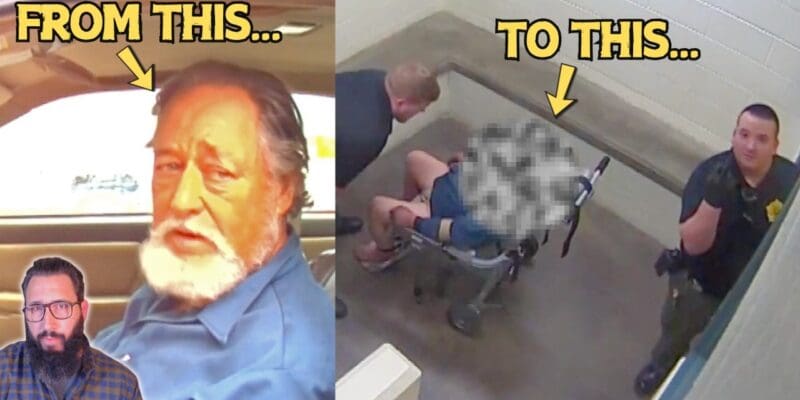
In Monroe County, Tennessee, man died in the custody of the sheriff’s department — when he arguably should never have been in custody at all. He should have been taken to a hospital.
As someone who believes deeply in the Constitution of the United States, this demands scrutiny.
See for yourself…
Let that sink in.
He was not running.
He was not fighting in the street.
He was not beyond the reach of help.
He was in custody.
And when someone is in custody, the responsibility is absolute.
But before we even reach the question of medical care, there is another constitutional issue that must be examined:
Was there lawful probable cause to arrest him in the first place?
The Fourth Amendment Comes First
The Fourth Amendment protects citizens from unreasonable searches and seizures. An arrest is the most serious form of seizure the government can impose short of post-conviction imprisonment.
The standard is clear: law enforcement must have probable cause — specific, articulable facts that a crime has been committed.
If probable cause was lacking, then the constitutional concern began the moment the handcuffs were applied.
And if the arrest itself was unlawful, everything that followed — including confinement and eventual death — becomes even more troubling.
The Fourth Amendment is not a technicality.
It is a guardrail against arbitrary government power.
Custody Means Control — And Control Means Responsibility
Once the state takes a person into custody — lawfully or unlawfully — it assumes responsibility for that person’s safety.
Under the Eighth Amendment, convicted prisoners are protected from cruel and unusual punishment, including deliberate indifference to serious medical needs.
Under the Fourteenth Amendment’s Due Process Clause, pretrial detainees are protected from objectively unreasonable denial of medical care.
In Estelle v. Gamble, the United States Supreme Court made clear that deliberate indifference to serious medical needs violates the Constitution.
In plain terms:
If someone in custody is visibly deteriorating and officials fail to respond reasonably, constitutional protections are implicated.
This was not a chaotic roadside encounter.
This was not a split-second use-of-force decision.
This was a controlled environment.
Time was available.
Observation was possible.
Intervention was an option.
Accountability Is Not Anti-Police
I support law enforcement. I believe in order. I believe in the rule of law.
But the rule of law applies to everyone — including those who enforce it.
When a man dies in custody:
- The probable cause for arrest must be examined.
- The timeline of medical distress must be reviewed.
- Supervisory oversight must be scrutinized.
- Policies must be measured against constitutional standards.
If the arrest was lawful, show the evidence.
If the medical response met constitutional standards, demonstrate it clearly.
If mistakes were made, acknowledge them.
Transparency protects the badge far more than silence ever will.
The Hard Question
If there was no probable cause, why was he arrested?
If medical distress was apparent, why was intervention delayed?
If constitutional duties were clear, why does the outcome raise such serious concern?
These are not anti-police questions.
They are constitutional questions.
Justice Requires Light
There must be:
- A fully independent investigation
- Public release of probable cause documentation
- Public release of all relevant video
- A clear medical timeline
- Transparent communication with the family
If constitutional standards were upheld, the evidence should show it.
If they were not, accountability must follow.
Because the Constitution does not bend for convenience.
The Fourth Amendment guards against unlawful seizure.
The Fourteenth Amendment guards against unlawful deprivation of life without due process.
The Eighth Amendment guards against deliberate indifference to suffering.
When the government restrains a man’s liberty, it assumes responsibility for his life.
Silence is not oversight.
Light is.
Robert H. Wright
Constable
Bossier Parish, Louisiana
Advertisement
Advertisement
