
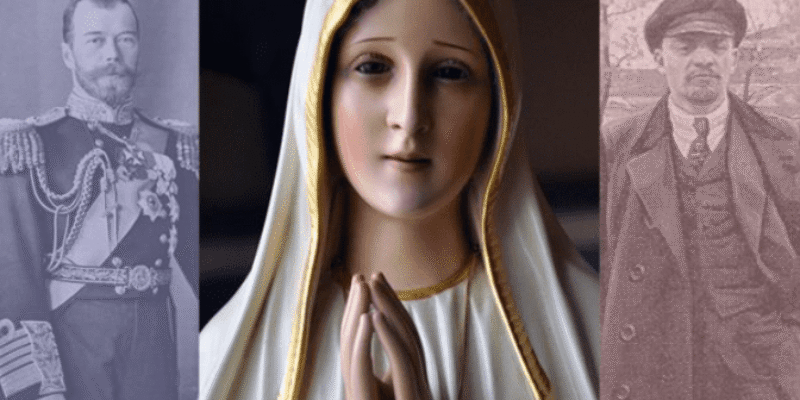
On March 25, 1984, on the Feast of the Annunciation, after already entrusting the world to Mary in an unofficial manner, John Paul II made a more solemn consecration before a statue of Our Lady of Fatima in St Peter’s Square. Several popes over the decades—including the pre-conciliar Pius XII whom even traditionalists and sedevacantists recognize—had consecrated the world to Our Lady as she commanded at Fatima, but never had they obeyed her specific request to say the word “Russia.” Even on this date in 1984, John Paul II did not say the specific word. He did, however, go one step further in asking her that she “enlighten especially the peoples of which you yourself are awaiting our consecration and confiding.”
Such a choice of words makes it clear, then, that the pope was toeing a line while still making it publicly obvious that he was aware of Mary’s specific request.
This is why Russia has been so intriguing to me my whole life. This is why I was working so hard for a long time in this digital space to make clear the connection between Vladimir Putin and Donald Trump—regardless of whether it proved good or bad.
All of this is precisely what makes today’s date on the calendar sting. The Annunciation is the feast of Mary’s yes. Not a yes with footnotes or asterisk, not a dialoguing yes with “in spirit” caveats. It is a yes that risks everything, because it is anchored in obedience and faith, not in public relations or journeying together while we figure it all out. And yet, over the last century or so, we’ve watched popes—regardless of their obedience and holiness in all other areas Catholic—tip-toe around this very detailed yet simple request of heaven like men who can’t quite bring themselves to say a single word. Mary’s fiat is clean. Rome’s “fiat” has avoided—puzzlingly so if you don’t know why—the word “Russia.” It has proven not concrete, but conditional, managerial, and, whether by fear, diplomacy, or constraint, openly allergic to clarity.
It, in a word, seems controlled. More on that at the very end with Leo XIII.
She Obeyed Him, So He Challenges Us to Obey Her
Before we make this only about geopolitics or only about papal temperament, it helps to remember what the Church herself has said about Mary’s role in the life of the faithful. Pius IX, in Magnae Dei Matris, puts it in a way that makes the stakes less academic and more familial:
- It pleased Christ to take upon Himself the Son of Man, and to become thereby our Brother, in order that His mercy to us might be shown most openly; for “it behooved him in all things to be made like unto his brethren that he might become a merciful and faithful high priest before God.” Likewise because Mary was chosen to be the Mother of Christ, our Lord and our Brother, the unique prerogative was given her above all other mothers to show her mercy to us and to pour it out upon us. Besides, as we are indebted to Christ for sharing in some way with us the right, which is peculiarly His own, of calling God our Father and possessing Him as such, we are in like manner indebted to Him for His loving generosity in sharing with us the right to call Mary our Mother and to cherish her as such.
That is not just sentiment or fluff. That is the Church asserting that Christ has willed a certain order of mercy—illustrated through his choice to come to us through the Woman—and that the Woman’s maternal office toward the faithful is not optional window dressing that only adds to some arbitrary common denominator of “all I need is Jesus.” No. God would never be so flippant or ambiguous—and that is clearly illustrated with the “Woman” of numerous interwoven books across both Testaments Old and New. This means that when heaven makes a request through the greatest daughter of the Father, the mother of the Son, and the spouse of the Spirit—and Rome answers with a half-yes—the issue is not simply whether a diplomatic line was held to keep world peace. The issue is whether the Church, in practice, is still willing to receive mercy in the way Christ himself has arranged it—in full and without measure.
This is why even the “conservative” Catholic faithful’s rejection of woke culture is not enough. It is why that woke culture was a trap in itself enacted by the enemy in the first place, specifically to dupe well-meaning Catholics into thinking they were choosing the right side.
All the while ignoring the fact that pope after pope has seemingly disobeyed the Virgin.
Christ notices when we honor and love his mother. He has given Mary great power, only by his divine will, of course. Her soul “magnifies the Lord,” as the Gospel of Luke states. The first question that must be asked, then, is what “Russia” was Mary talking about at Fatima?
Inside the seeming-reign of John Paul II, it had been decades since she had foretold of the Soviet regime that would rise to power through the Bolshevik Revolution—a revolution that began mere weeks after the final apparition at Fatima—a story I spotlighted last week on the feast of St Joseph. Many bishops dressed in white would not follow through on the requested consecration, and Russia had continued to spread its terror. Five years after John Paul’s solemn consecration to the Blessed Virgin, despite his use of the more general term “world” instead of “Russia,” the totalitarian terror appeared to collapse under Presidents Reagan and Bush.
Indeed, the situation there seemed to improve in the decades that have followed, but in some areas, especially political and religious ones, there are clear contradictions to that, contradictions that point to the dark magick and system of false dialectics I’ll address below. Could Mary in 1989 have been saying to the Church that yes, I heard your prayer, and I have granted some blessings accordingly, but the world will not experience God’s full blessing until my request is followed through in full? And worse, if it isn’t, the errors of Russia will again rear their ugly head and threaten the freedom of peoples everywhere? Are today’s troubles a sign that we are experiencing the reckoning of the Church’s disobedience on this issue?
Remember—and this is crucial—that communism wasn’t the “error” or “errors” of Russia. That is what most people think, and create an entire mythology around John Paul II because of it. It is a most sinister deception. No, the errors involve more than just the singular “communism.” Communism is only one side of the dialectic—a most evil one that fundamentally creates the blindness to the dialectic. It is hard not to wonder, especially in light of Fatima, whether this endless machine of dialectics is, in fact, what Mary meant by the “errors of Russia.” And again, which Russia, at that? Not merely communism as a political system, but the deeper spiritual method of which it is a part: the engineered inversion of pairs that fractures reality into competing camps, then promises salvation through what is called the Hegelian Dialectic—problem-reaction-solution—and perpetual revolution. It involves a dark magick that has moved from ritual in person to ritual through electronic screens that has completely wiped out our capacity to see it.
Without the understanding of Genesis 3:15 and the ancient enmity, none of this will make sense.
Any confusion or, better yet, rejection, of what I am writing here is fundamentally the point: modern “teaching” inspired by the slippery documents of Vatican II has taught Catholics to speak in careful fog, especially on questions that require clear supernatural obedience, while asking us to applaud “pastoral” ambiguity as prudence and peace. Anyone speaking otherwise, with more clarity, with more of an evangelizing spirit, while using nearly 2000-year-old Church teaching and Mary’s warnings at Fatima to do it, is stoned like an adulteress woman.
It is Barabbas that is chosen, not Christ.
Final Words: False Dialectics and Leo XIII
Fast forward to 2026 and Leo XIV, and so far, he looks less like a rupture from Francis and more like Francis’ trajectory continued, lockstep, only with a different voice and a calmer face. It startled me recently when I read a laywoman’s description of John Paul II as Leo’s current posture on ecumenism, only without the internet. This isn’t some new development. It is all the same soft vocabulary. The same “dialogue” instincts. The same reflex to treat doctrinal boundaries preached by the Church for almost 2000 years as obstacles to be managed rather than lines to be held—and the same expectation that the faithful will adjust their conscience to match the new tone–the new “teaching.”
And the faithful have indeed done that, despite the fact that newness and novelty are not at all Catholic. Distracted by so many bread and circuses in the secular world, they perpetually imprison themselves into going along with whatever flow seems safest.
The trap gets more insidious, still. It doesn’t only run top-down. It runs sideways through the pews. Catholics are being kept in a never-ending series of binaries, a whole litany of false choices that feel like clarity while functioning as a revolving door—always giving us the illusion that we are involved, active, wholly sovereign in our choices.
It isn’t just one binary. It is an entire machine. An entire many-headed monster….
Traditional Catholic Mass vs New Order Mass.
Rigid vs pastoral.
Blind obedience vs Biblical discernment.
Conspiracy-brained vs naïve.
Vigano vs trust the pope.
Francis is a break vs Francis is continuity.
Francis is a break vs the break started with Paul VI
John Paul II vs John Paul II. (read that again)
SSPX vs sedevacantism.
SSPX vs FSSP.
SSPX vs Rome.
SSPX vs SSPV.
Sedevacantists who insist on Baptism of Desire vs sedevacantists who deny it.
Popesplainers vs pope-resisters.
Catholics who have never even heard the story of Pope-elect Hildebrand vs the Catholics trying, often awkwardly and at personal cost, to stand by its truth.
Etc.
Do you get the picture? Do you understand why, no matter how nice or intelligent you are, if you don’t get serious about this, the Great Deception of 2 Thessalonians and Romans 1 will absolutely sweep you away?
Because there are so many dialectics—what many think are actually the “errors of Russia” (which Russia?)—each individual soul eventually compiles “enough evidence” to switch camps and think he has arrived.
They stay camped there for a while, confident—until the floor shifts again.
Then a new set of facts, a new headline, a new viral story, a new papal discovery from the past, a new curated scandal—something, anything—arrives, and the dark magick of the dialectic offers yet another “correct” path to take.
This is why I have been warning about this argument among the camps. This is why I have been preaching the Rosary and consecration to Our Lady instead—which she gave to us at Fatima as the final two weapons in this war in the latter times. None of this is growth. None of this is “arriving.” What this is most likely is a carefully curated system much like what we see in politics—specifically set up for us to always be wrong. The system wins, no matter which camp we choose, because we are still in the camp, still reacting, still “being right,” completely downstream from the script.
Listening to the voice of God and slowly and humbly taking the next step is one thing, yes. But this back-and-forth Catholicism, especially when made public, should alarm us. It is a tell-tale sign of that ancient trick: keep the people arguing about the surface while the foundations are swapped out. Keep them trapped in the false dialectic long enough that they stop asking the deeper question—
Where is the “yes” that doesn’t wobble?
Where would Mary’s fiat be?
Want to keep it political? Let’s do Marxism. Because at its root, Marxism is a worldview built on conflict, on class war, on contradiction as the engine that makes history hum, on tearing down what is ordered and just so that something man-made and tolerant can be rebuilt in its place.
It is the Hegelian Dialectic—problem-reaction-solution.
It is revolution.
If that spirit can be imported into politics, it can obviously be imported into the Church. And all signs—all signs—point to the reality that it has. That is why, when Mary’s yes confronts Rome’s hesitating half-yes, the issue is not merely whether a pope said a word in 1984. It is whether the Church, shepherds and sheep, can still step outside the hamster wheel of binary traps long enough to obey heaven without hesitation, without ambiguity.
And if all of that feels too conspiratorial, I’ll come back one more time to something older than tin-foil hats: the Church herself once spoke openly about infiltration. Not as an excuse, but as a warning….
In the long version of the St Michael prayer (1886), Pope Leo XIII includes the line: “In the Holy Place itself, where the See of Holy Peter and the Chair of Truth has been set up as the light of the world, they have raised the throne of their abominable impiety, with the iniquitous design that when the Pastor has been struck, the sheep may be scattered.”
Have you ever come across that line? Do clergymen discuss it with you? “Have raised” is not the future tense. It is an assertion that something has already happened. And if it is even remotely true that the Chair of Peter can be targeted, pressured, managed, or in some measure controlled, then the twentieth century’s recurring inability to give Mary a clean yes, on the very feast of the fiat today, stops looking like mere diplomacy and starts looking more like both the result of a darkness we cannot fathom and the harbinger of a chastisement needed to purify the earth again.
Advertisement
Advertisement
