
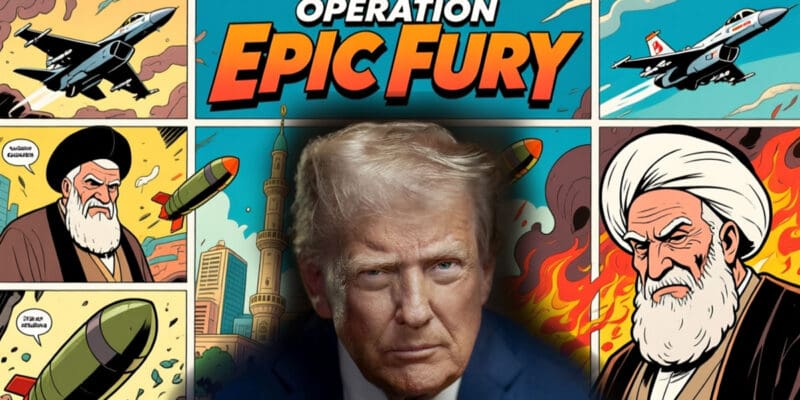
Various justifications for the Trump administration’s war against Iran have been given – Iran’s ballistic missile program, its nuclear energy technology, etc. But one has gone more or less unspoken: The Trump White House’s desire to deny the Chinese economy abundant supplies of cheap Iranian oil. Geopolitical analyst Andrew Korybko explains:
‘The goal is to obtain proxy control over Iran’s enormous oil and gas reserves so that they can be weaponized as leverage against China for coercing it into a lopsided trade deal that would derail its superpower rise and therefore restore US-led unipolarity.
‘ . . . It was explained here that Trump 2.0 “decided to gradually deprive China of access to markets and resources, ideally through a series of trade deals, in order to imbue the US with the indirect leverage required to peacefully derail China’s superpower rise.”
‘To elaborate, “The US’ trade deals with the EU and India could ultimately result in them curtailing China’s access to their markets under pain of punitive tariffs if they refuse. In parallel, the US’ special operation in Venezuela, pressure on Iran, and simultaneous attempts to subordinate Nigeria and other leading energy producers could curtail China’s access to the resources required for fueling its superpower rise.” The resource dimension that’s relevant to Iran is a major part of the US’ “Strategy of Denial”.
‘That’s the brainchild of Under Secretary of War for Policy Elbridge Colby, and it was expanded on in this analysis here from early January. As was written, “US influence over Venezuela’s and possibly soon Iran’s and Nigeria’s energy exports and trade ties with China could be weaponized via threats of curtailment or cut-offs in parallel with pressure upon its Gulf allies to do the same in pursuit of this goal”, which is to coerce China into indefinite junior partnership status vis-à-vis the US through a lopsided trade deal’ (‘The US Military Campaign Against Iran Is Part Of Trump’s Grand Strategy Against China,’ korybko.substack.com).
Perhaps there is some wisdom in those tactics vis-à-vis China, but there are also great risks. President Roosevelt tried a similar tactic with Japan during World War II, and it resulted not in the peaceful submission of Japan but in her attack on Pearl Harbor:
‘Most Americans are taught that World War II began for the United States when the evil Imperial Japanese just started unloading bombs on a sleepy Pearl Harbor the first Sunday in December in 1941. The Japanese were certainly no saints, attempting to achieve using military power what the Western great powers, including the United States, had achieved in prior times using the same bloody means—empires in East Asia and the Pacific. But, in this quest, the Japanese had already become bogged down in a gigantic quagmire in China. They then made the mistake of trying to further expand into Indochina. As a result, then-President Franklin Delano Roosevelt decided to impose economic sanctions on the Japanese. Eventually, this included a cut-off of oil supplies to Japan by the United States, which was then the world’s dominant oil producer. Many in the United States government were aware at the time that this would probably precipitate a war with a desperate Japan.
‘But Japan did not want war with the American colossus. The American economy was significantly larger than that of Japan, Italy, and Nazi Germany combined. The Japanese government tried to arrange a summit between its then-civilian prime minister and FDR, but the American president would have none of it. The failure of negotiations caused the more moderate civilian government to fall and be replaced by the more hawkish government of Hideki Tojo. Even after this substitution, the Japanese emperor directed Tojo to make efforts to avoid war. These were also unsuccessful.
‘The Japanese, faced with the existential threat of strangulation of their military and society from an oil cutoff, predictably decided to move their military even farther south to capture the oil supplies in the Dutch East Indies (now Indonesia). To do so, their military supply line would need to run near the Philippines, a now-fortified U.S. colony grabbed during the Spanish–American War of 1898. Thus the Japanese (and everyone else) realized that a desperate move to capture oil in the Dutch East Indies would mean certain war with the American behemoth. Their only hope was to strike first to try to severely debilitate the American fleet in Hawaii . . .’ (Ivan Eland, ‘Exploding the Idea That Trump’s Wars Can Handle China,’ theamericanconservative.com).
Many folks who are friendly toward President Trump are telling us that the Iran war will blow over quickly enough. But as we have seen, recent history does not necessarily agree. And then there is the prophecy of a recent saint of the Orthodox Church, the Holy Elder Paisios of Mount Athos (reposed in 1994), regarding China and the Middle East:
‘The Mid-East will become a theater of a war in which the Russians will take place. Much blood will be spilled. The Chinese, with an army of 200 million, will cross the Euphrates and go all the way to Jerusalem. The sign that this event is approaching will be the destruction of the Mosque of Omar, for its destruction will mark the beginning of work by the Jews to rebuild the Temple of Solomon, which was built on the same spot’ (holycrossyakima.org).
The war with Iran is not a time for the peoples of the States to engage in smug braggadocio. Things could turn much more deadly, very quickly.
This being the season of Lent, we should be praying, fasting, reading more spiritual books, repenting, attending more church services, trying to calm and heal our broken passions, rather than giving them free reign in an orgy of war fever. We should be focusing more intensely on our Lenten journey toward Christ’s suffering, death, and Bright Resurrection, not letting ourselves become distracted from those most wonderful works of God by the endless news feed about Iran. Fr Seraphim Aldea of the Mull and Iona monasteries in the Scottish Isles, has helpful words for us regarding this in his latest newsletter:
‘Lent has clearly begun! If you had any doubt it, just look at what is happening in the world. Look at it all, notice it, be aware of it, but don’t let yourself be consumed by it. When someone wants to distract our attention from something, they usually create a diversion of sorts – something noisier and brighter, a firework display intended to capture our attention and turn us away from the real thing.
‘In this, like in everything, this temporary world is an image of the spiritual world. The easiest way for the devil to fight against us is also by distraction, by somehow moving our focus away from following Christ to His Cross. And there are two millennia-old ways of doing that: either by distraction (the bright fireworks making us turn away from Christ) or by confusion (covering the Truth with countless veils, until it becomes difficult to discern where Christ is anymore).
‘Remain focused on Christ, remain focused on your personal relationship with Him. Don’t allow anything else to distract you from this simple image: you, carrying your cross and following Christ as He carries His. As this personal procession happens, the world will continue to throw at you all its brightly coloured fireworks. Make yourself blind to it all and remain focused on nothing else but you and Christ. Let the world do what the world has always done, and will always do – there was never life in this pathetic, empty show, and there never will be.’
Good struggles to you all, and may God help us to see calmer times!
Advertisement
Advertisement
