
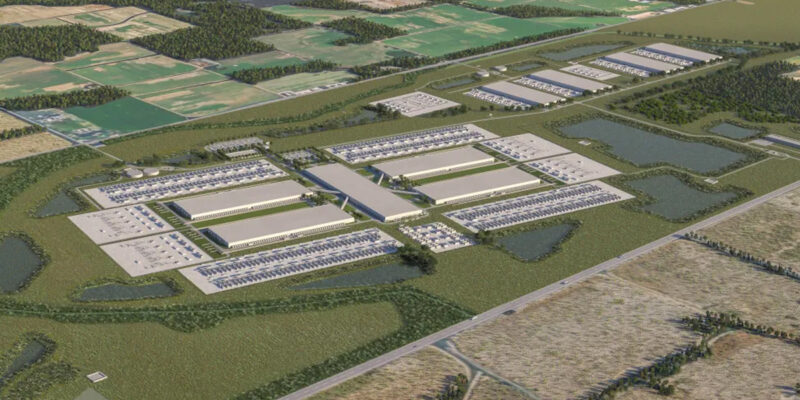
It’s a new world in northeast Louisiana, with Meta plopping down in rural Richland Parish what now may become the world’s largest data center, a project recently announced as expected to pump $50 billion into the economy over the next decade.
I experienced a symptom of that with this traffic jam at rush hour, with vehicles returning from the construction site along a road that never used to see anything close to that volume.
Anecdotal evidence like this now has empirical confirmation. The economic development group Grow NELA has inaugurated a website displaying data it collected on general sales taxation across the 10-parish region. In some cases, the numbers are astonishing.
Every parish showed sales tax growth from when Meta first announced the Hyperion project at the end of 2024. Only a couple had a pre-Meta quarter that was higher than any of the quarters in their Meta era. Ouachita’s sales tax collections from the first quarter of 2024 to the first quarter of this year were up 17 percent, compared to only 14 percent from the first quarter of 2021 to the same quarter in 2024. For all of 2026, sales tax growth is on track to reach 19 percent.
The most stunning numbers come from Richland. For the first quarter of 2026, it collected $38.7 million in sales taxes, over 2.5 times the amount collected in that quarter last year and over three times the amount collected two years ago in that quarter. It only collected $4.2 million in the first quarter of 2021. Sales tax revenue going to the Richland Parish School District exploded upward by 734 percent, first quarter over first quarter, leading it to distribute bonuses of $50,000 to certified teachers with four or more years of service. Even non-teachers on the job for just a year received over $4,000.
Hotel tax revenue numbers also show the tremendous impact the project is having on Ouachita, the headquarters area for Hyperion’s professional services. These revenues were up 68 percent, first quarter over first quarter.
Advertisement
Best of all, the scale of the project is so huge that the benefits will continue for many years to come. Normally, construction jobs last only a couple of years, and the permanent full-time jobs may number only in the dozens. Yet this is so huge that construction work will continue for a decade and leave a thousand high-paying jobs.
The extended period of near-guaranteed boom increases the latitude for local governments to decide wisely what to do with their newfound revenues and how to leverage them so that, when construction is complete, the bounty continues, but in other forms. Tax and regulatory policies can’t be such that they dampen enthusiasm for spinoff businesses that add more revenue. Spending can’t be all outdoors for new programs with ongoing commitments or Santa Claus capital outlay, but instead must focus on infrastructure to support the new economic growth or be socked away in savings to generate a future revenue stream or rainy-day fund.
What has happened in northeast Louisiana is generational and transformational, if government doesn’t get in the way. Let’s hope policy-makers have the good sense to understand that.
Advertisement
Advertisement
