
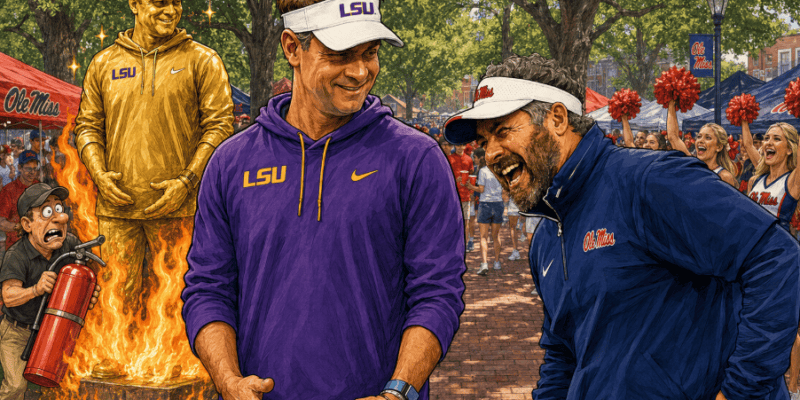
LSU will have to answer this narrative on the field.
According to new Ole Miss head coach Pete Golding, three days is all it takes to make it from statue to something, well, considerably less dignified.
While discussing the aftermath of Lane Kiffin’s departure for LSU at SEC Media Days, Golding chronicled how he persuaded quarterback Trinidad Chambliss and running back Kewan Lacy to remain in Oxford in the offseason. Both players had just helped produce the greatest season in Ole Miss history, both would have attracted enormous attention in the transfer portal, and both had every reason to wonder what life might look like dressed in purple and gold.
Golding did not attempt to answer by promising that nothing would change. Instead, he warned them about the people whose opinions unquestionably would.
“Google Lane Kiffin, the dude they’d have built a statue of here three days ago. Google his name right now. They wouldn’t piss on him if he was on fire.”
That’s what he said to them and that’s what he said to the SEC world yesterday in Tampa.
Golding’s point was not really about Kiffin… maybe. It was, at that point, more about Chambliss and Lacy, and the risk of not calculating a fan base’s temporary emotion to determine a permanent decision. Ole Miss loved Kiffin when he was winning games for Ole Miss. Once he chose LSU, the same coach who had just led the Rebels to their first 11-win regular season and first College Football Playoff appearance became Benedict Arnold.
If it could happen to Kiffin, Golding warned, it could happen to them. Transfer somewhere else, and the people building your statue today may be searching for gasoline tomorrow.
It was a cunning recruiting pitch, and apparently an effective one. It was also perhaps the most grounded hyperbole offered all week of what Kiffin has become since leaving Oxford.
Kiffin, frankly, is now college football’s villain. And if you followed the story as the media presented it, you can see exactly how powerful narrative warfare can be. It is truly absurd what happened, considering the objectively stupid timeline and schedule college football had in place.
But they gaslighted the sports world into oblivion, just like everything, and there’s nothing LSU can do about it now.
And by hiring him, the Tigers may have volunteered to become the villain with him.
SEC-KIFFIN MEDIA DAYS BEAT
TWO-LANE TRAFFIC: Orgeron and Smart Describe the LSU Coach Behind the Troll
ROCKY TOP MUSTARD: Heupel Welcomes Kiffin to LSU-Tenn Series—Where Strange Is Normal
The Ex Everybody Keeps Talking About
It seems every coach at SEC Media Days was asked about Kiffin. This is the third piece we’ve written and none has been focused on Kiffin’s time directly.
Funny, really.
Golding didn’t spend his time condemning his former boss. In fact, his broader remarks were considerably more measured than the statue quote might suggest.
Asked about LSU’s September 19 trip to Oxford, Golding called Kiffin “the ex,” reasoning that the history will always follow both programs because everyone else continues bringing it into the conversation.
“It’s the ex, right? There’s always going to be the history,” said Golding, who is married with three children. “Do you have an ex? Are you married? Well, if you do get married and you have an ex that your wife knows about, like, she doesn’t ever end; she’s never dead. She’s always going to get brought up, and so that’s kind of where it is right now. That’s always going to be there a little bit, which is fun to a certain degree.”
He said the two remain friends, still exchange text messages, and have no personal feud requiring resolution.
Golding even offered a remarkably practical assessment of the bargain Ole Miss received. Had someone told Rebel fans in 2021 that Kiffin would eventually produce an 11-1 season and a playoff berth before leaving for LSU, would they have accepted it?
“Hell yeah, you would,” Golding said. “Everybody won from it. It’s ok.”
Not just that, but in only his second year at Ole Miss, Kiffin took the program to their first-ever 10-win season, as well as an NY6 Bowl game.
Golding also added this, which I’ll add, because it says everything we’ve been writing lately about the comparison-contrast between the pre-NIL and NIL eras.
“By design it’s [the rule] put a lot of people in bad positions,” Golding said. “Let’s not act like recruiting in college football for the last 100 years is the most moral thing.”
His responses carry more gratitude and common sense than the media has made ever had.
Even Congress, right or wrong, legitimate or not legitimate, is in the news concerning this issue:
Congress included language in its proposed college sports regulatory legislation for a “Lane Kiffin Rule” within the Protect College Sports Act.
On Thursday, Kiffin said he didn’t know about it because “I don’t read anything” and has given up social media.
“Like, you just said that, and I didn’t know that until you said it,” Kiffin claimed. “You know, I guess in that I hope that some way for future coaches they’re not put in that situation. You know, the NFL, you’re never put in that situation because of the calendar and because of the rules of movement within seasons.
“I do hope for future people that’s fixed so that you’re not in that same predicament for players, for coaches, which really was a player issue, too. Then we fixed that with moving the portal date back. That was more of an issue earlier in the postseason, too, as you saw players having to leave teams to get into the portal during the season. Hopefully some way they fix it for coaches, too.”
And know this, as if you don’t know already: The media could have easily spun it in that direction from the very start in December, and they explicitly chose not to. It is why I sincerely hope Kiffin purposely left Rece Davis and College GameDay out to dry that Saturday he was supposed to fly in for an interview, but couldn’t because of all the work he was putting in that week and into late Friday night.
The complication in this whole thing was stoked by the media, which inflamed fans who conflate business transactions with breakups. And frankly, that’s their and our own fault. It is our decision to get so emotionally invested in something truly so meaningless compared to what is really going on in the world.
So the fans may not feel a part of “Everybody won from it,” but it is an objective fact that they did win from it, and it is a shame that even time likely won’t bring them to that point of peace. Golding is right that Ole Miss received substantial value from the relationship, and minus the aforementioned schedule—not to mention Ole Miss’s own decision not to keep Kiffin—would have continued receiving value until their final loss.
Advertisement
Or maybe even until they won it all.
The Kiffin Lane
Kiffin established a level of sustained excellence rarely reached in Oxford, and built the team Golding ultimately led to the national semifinal. Golding received his first head-coaching opportunity from the opening Kiffin created, while Chambliss and Lacy remained behind as foundational players for the 2026 charge.
Kiffin acknowledged Thursday that he mishandled part of the exit.
“I wish I would have gone in when I met with Keith [Carter, athletic director] and said, ‘I’ve made the decision to go,'” Kiffin said. “I wish I would have just said, ‘Hey, I’d like to coach the team,’ and he’d say, ‘No.’ And I’d say, ‘Hey, ok, I appreciate it.’ Move on [and] never even discussed it again.”
“I made a challenging decision in change,” he said. “I think as I look back to that, I thought I could find a way for everybody to understand. Now as I look back later on, that was never going to happen.”
But he did not apologize for choosing LSU.
Nor did he suggest that the national outrage, faux as it is, has damaged his ability to attract talent.
“I don’t deal with it at all,” Kiffin said when asked whether recruits and their parents question him about the Ole Miss departure. “I don’t ever get asked that by recruits or parents.
“I think for recruits and recruits’ parents, I don’t think any of them don’t see why I did what I did. I think they come and see LSU. They see what they are doing at LSU, the history at LSU, and the power of LSU.
“It doesn’t even come up.”
The distinction between LSU and Ole Miss is probably the irritant that keeps rubbing Rebel fans the wrong way. I get it. I didn’t want to hear similar albeit lesser things when the comparison was once LSU and Alabama.
It’s simple, really: The people furious with Kiffin are not necessarily the people he must persuade to come to Baton Rouge.
“They want to know how they are coached, how they fit into the program, what’s their NIL deal,” Kiffin said.
They see LSU’s championship history, the Louisiana recruiting base, and the university’s investment in football. They see dollars and championship rings. What Ole Miss fans interpret as treachery, many players probably interpret as an ambitious coach making the same upward move they would make if given the same chance.
The villain narrative can be fire, indeed, even when only a select few are stoking it. LSU’s problem is that motivation doesn’t have to rise from truth. It can grow from perceived grievance, myth, or even a single story repeated often enough that an entire stadium accepts it as fact. The Tigers will have to withstand both greater-than-normal hostility and considerable talent when they travel to Oxford, Knoxville, and everywhere else this fall.
And in the end, it brings us back to Golding’s recruiting pitch. His warning worked because the statue and the fire are not really opposites. They are products of the same irrational emotional investment by fans, only now separated by a single decision and, apparently, just three days. That’s the story.
But Kiffin didn’t suddenly become a different coach when he left Ole Miss. He merely changed the colors he was wearing, and the people judging him flipped on him just as they would have flipped him the finger had he gone 6-6 two straight seasons.
Are LSU fans prepared for his next dance with his next partner, if that off-season ever comes? It may not. It never did for Saban once he reached Alabama at 55.
Or it may.
It shouldn’t matter, and maybe witnessing all of this can aid in the emotional health of Tiger fans. Fans, myself included, have to stop being so damn emotional about it all.
Kiffin cannot extinguish any narrative in front of a microphone, and LSU cannot reason its way out of the villain’s role. The only appropriate answer will have to come on the field, where fires are stomped out with finality.
Advertisement
Advertisement
