
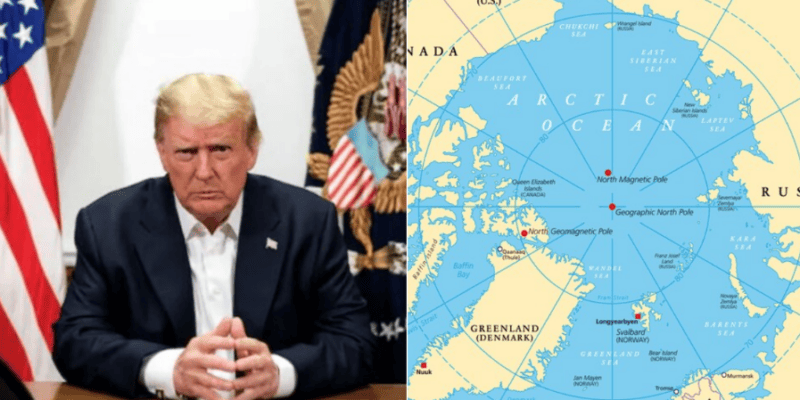
(Colton Overcash, Real Clear Wire) — Washington’s argument about Greenland has narrowed to familiar points: critical minerals, Arctic sea lanes and the early-warning mission at Pituffik Space Base. Each matters. Together, they still miss the larger problem.
Greenland is already a node in the defense of the American homeland. Pituffik provides missile warning, missile defense and space surveillance from a critical position in the Northern Hemisphere. Yet its ports, airspace and communications remain outside the sovereign structure responsible for defending the United States. America has integrated Greenland into the military detection layer of continental defense without integrating the territory that keeps that layer functioning.
That arrangement worked when Washington mainly needed base access. It is not sufficient in an era shaped by cyber intrusion, infrastructure sabotage and political warfare below the threshold of open conflict.
Denmark holds responsibility for Greenland’s defense, but it cannot independently provide the scale, persistence and integrated military-civilian capacity required to secure the island against sustained pressure from Russia or China. Its Arctic agreements committed major new funding to surveillance, additional vessels and a stronger permanent presence, including a North Atlantic cable and a new Joint Arctic Command headquarters in Nuuk. Those investments also reveal how much capability had to be built after the strategic environment had already changed.
NATO can reinforce Greenland, but it cannot replace sovereignty. Arctic Sentry, launched in February 2026 under Joint Force Command Norfolk, brings allied activities into a broader operational approach across the Arctic and High North. NATO still does not govern Greenland, administer its borders or direct its civilian response systems.
The Pentagon cannot fill the entire gap either. It can defend Pituffik, deploy forces and defeat an armed threat. It is not designed to exercise the permanent civilian authorities that secure territory every day. It does not ordinarily administer customs, regulate commercial ports or run long-term disaster recovery. Those missions belong to civilian institutions operating under domestic law.
That distinction is essential because an adversary would not need to destroy Pituffik’s radar to weaken North American defense. It could disrupt the systems around it.
A cyberattack could interrupt power or communications. Sabotage could damage a cable or port. Covert influence could slow a response or turn a security dispute into political paralysis. NATO describes hybrid threats as combinations of military and nonmilitary methods, including cyberattacks, disinformation and economic pressure, intended to blur the line between peace and war. Such actions can impose strategic costs without triggering an immediate military response.
Pituffik could continue detecting danger while the infrastructure needed to sustain its mission became less reliable. American commanders could understand the threat while lacking authority beyond the base perimeter. Washington could share intelligence and offer assistance, but final decisions would remain divided among American, Danish and Greenlandic institutions.
That is the missing node in homeland defense. The United States depends on Greenland militarily but lacks sovereign authority over the wider territory on which that military value depends.
This is where the Department of Homeland Security becomes indispensable. DHS does not replace military power. It supplies the domestic structure that operates before, below and after the threshold of war. Its components combine maritime security, border enforcement and infrastructure protection under federal law, recurring appropriations and congressional oversight.
The Coast Guard is both an armed service and a DHS component, combining national-defense responsibilities with maritime law enforcement and port security. Congress recently provided $4.3 billion for Polar Security Cutters and $3.5 billion for a new class of Arctic Security Cutters as part of a roughly $25 billion Coast Guard investment. The Coast Guard can already operate internationally, but Greenland’s waters are not a standing domestic operating area supported by the authorities and infrastructure that apply in Alaska.
Annexation, followed by implementing legislation, would allow a permanent Coast Guard posture around Greenland’s approaches. Maritime surveillance, port security and search-and-rescue could become continuing American responsibilities rather than missions dependent on foreign coordination.
Customs and Border Protection presents the same distinction in the air. Air and Marine Operations can monitor threats beyond U.S. territory and work with foreign partners. Visibility, however, is not jurisdiction. A shared sensor feed does not confer authority to patrol Greenlandic airspace, inspect incoming cargo or conduct enforcement under American law. Sovereignty would allow Congress to integrate Greenland into the border security system covering North America’s northern approaches.
Critical infrastructure is another exposed layer. Greenland’s communications, power systems and transportation facilities support civilian life and American military operations. Within the United States, CISA and other sector risk-management agencies maintain standing relationships with infrastructure operators, share threat information and coordinate incident response. CISA serves as the lead risk-management agency for eight of the sixteen critical-infrastructure sectors and one subsector.
Greenland remains outside that domestic structure. American officials may assist their Danish and Greenlandic counterparts, but they cannot assign permanent federal responsibility, guarantee recurring appropriations or direct a response under U.S. law. Annexation would let Congress place the infrastructure supporting Pituffik and the northern approaches inside the federal system charged with protecting it.
FEMA completes the architecture. Alaska is part of FEMA Region 10, which supports preparedness, response and recovery. Greenland belongs to no FEMA region because it is not American territory. Annexation would not automatically extend every program. Congress would have to determine Greenland’s constitutional status and apply the relevant statutes. That is precisely why sovereignty matters: it makes permanent institutional integration legally possible.
A federal Arctic preparedness structure could pre-position supplies, build redundant communications and rehearse civilian response before a crisis. The Pentagon could support those efforts, but support is not ownership of the mission.
The obvious objection is that Washington could secure the same benefits through a wider defense agreement, more infrastructure funding and deeper NATO cooperation. Each would improve security. None would eliminate the sovereign handoff.
Every agreement preserves divided authority. The Coast Guard can coordinate, but it cannot exercise domestic jurisdiction in Greenlandic waters. CBP can exchange information, but it does not control Greenland’s border. FEMA can assist, but it cannot treat the island as part of the national preparedness system.
Advertisement
Only a change in sovereignty can align strategic dependence, legal authority and political accountability. Annexation would replace recurring permission with permanent responsibility. Congress could extend federal authorities across Greenland, fund enduring facilities and hold agencies accountable for preventing a disruption before it reaches Pituffik or the continental United States.
It would also strengthen deterrence. Under the current arrangement, adversaries can probe the gaps among Danish capacity, NATO decision-making and American authority. American sovereignty would reduce that ambiguity. Interference with Greenland’s ports, cables or airspace would no longer be pressure against a distant part of the Danish Realm. It would be interference with the American homeland.
That is peace through strength applied to the Arctic. The objective is not to wait for an adversary to exploit Greenland’s exposure and then assemble a multinational response. It is to remove the exposure before an adversary decides it can be exploited.
Denmark’s weakness establishes the need for a more durable arrangement. It does not, by itself, establish an American right to sovereignty. That requires Greenlandic consent.
At present, Greenlanders have not chosen that course. The government formed after the 2025 election favors an eventual path to independence, and Greenland’s prime minister has rejected becoming part of the United States. The 2009 Self-Government Act recognizes Greenlanders’ right to self-determination and provides a legal route to independence.
Consent is not merely a diplomatic courtesy. It is necessary to make the security arrangement last. Annexation imposed over sustained opposition would create a permanent grievance inside the very perimeter Washington seeks to secure. Russia and China could exploit that fracture through disinformation, political influence or disputes over resources. The result could negate the gains of integration by raising the threat level from within.
A serious proposal must therefore proceed through a Greenlandic referendum and negotiations with Denmark. It must preserve meaningful home rule, establish federal representation and settle Greenland’s authority over its resources before accession. The United States must offer Greenlanders a political and economic arrangement they judge more secure and more advantageous than continued association with Denmark or full independence.
For decades, Washington has treated Greenland as a place where America needs access. Access is no longer enough.
Denmark holds sovereignty but lacks the independent power required to defend Greenland at the necessary scale. NATO can reinforce the island but cannot govern it. The Pentagon can defeat military threats but cannot replace the civilian institutions that secure territory below the threshold of war.
Only the United States can place military power, homeland security authority and durable federal responsibility under one sovereign structure.
Greenland already helps defend America. Built through consent and backed by American strength, annexation would finally give the United States responsibility for defending the entire node on which that protection depends.
It would close the institutional seam between Greenland’s military value and America’s authority to defend it.
Colton Overcash is the founder of Vertex Strategies. He served in two presidential appointments at the Department of Homeland Security, where he advised senior leadership on emerging technology and border security policy. He previously worked as a staffer in the U.S. Congress and frequently writes on national security and foreign policy issues.
This article was originally published by RealClearDefense and made available via RealClearWire.
Advertisement
Advertisement
