
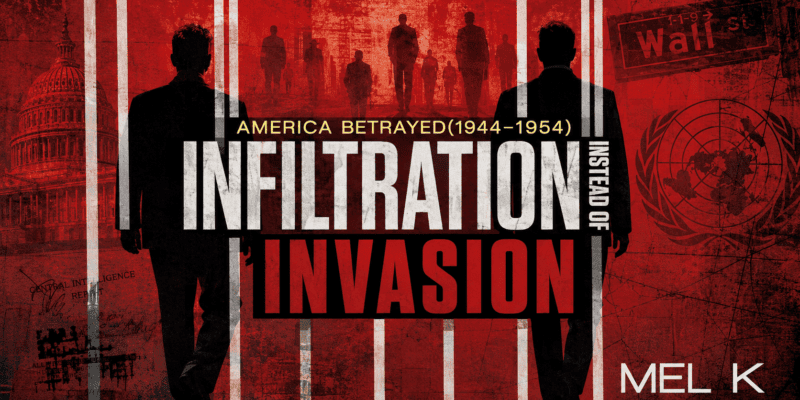
(Greg Young) — After six years of devastating global war, the guns went silent in 1945. Nazi Germany was defeated, Japan surrendered, Europe’s grand cities were in rubble, American soldiers came home and the United States emerged from World War II as the dominant power in the world.
This is usually where the story begins to sound like a triumphal history lesson. Author and podcast host, Mel K thinks we should ask what happened next, and why it matters today.
In her new book, Infiltration Instead of Invasion: America Betrayed (1944–1954), the investigative journalist and researcher goes back to the decade immediately after the war and examines the institutions, personalities and financial arrangements that helped construct the postwar order. During her appearance on Dangerous Laughter with AJ Rice, she follows the postwar trail forward, arguing that many of the battles over power and sovereignty today began taking shape nearly eight decades ago.
She starts with President John F. Kennedy. Mel K has long been interested in Kennedy’s 1961 warning about “infiltration instead of invasion,” and investigated exactly what the president was warning Americans against. She began digging through documents and historical records, following the people and institutions connected to the emerging postwar system. Her detective work led her to Switzerland, international finance and the activities of Allen and John Foster Dulles. The influential brothers served as the first CIA director and secretary of state respectively.
From there, the conversation moves through a remarkable period of American history: the 1947 National Security Act and creation of the CIA, the Bretton Woods conference, the United Nations, the rise of the national security establishment and the increasingly complicated relationship between American sovereignty and international institutions.
This isn’t the usual “deep state” conversation. Mel K considers that label inadequate. She focuses less on a secret cabal operating somewhere inside Washington and more on what she calls an international architecture: a network of institutions and relationships that developed above and across individual governments.
This raises a more complex question than whether somebody is secretly pulling the strings. What happens when institutions created for a particular historical emergency become permanent?
The postwar circumstances were hardly mysterious. Europe had been pulverized, terrifyingly powerful weapons were a reality, the international financial system was unstable, communism was expanding and the United States was trying to prevent another global conflict. Building intelligence capabilities, international financial institutions and new diplomatic structures was not inherently sinister. Much of it was arguably necessary.
The question is what happens after the emergency passes. Institutions develop budgets, bureaucracies, constituencies and interests of their own. Temporary arrangements can become permanent. Eventually, generations can inherit an enormous system without having much idea why its individual pieces were created in the first place.
That is where President Dwight Eisenhower enters the discussion. In his farewell address in 1961, Eisenhower warned Americans about the growing relationship between the military establishment and the arms industry. He wasn’t arguing against national defense. He was warning that a permanent military establishment of enormous size could develop influence that extends into America’s political and economic life. He specifically cautioned against the possibility of “misplaced power” threatening liberty and democratic processes.
Coming from a five-star general and former Supreme Allied Commander, his warning deserves to be remembered.
Mel K connects it to the larger postwar transformation she is examining: the creation of institutions that were understandable in their original context but potentially much more consequential as they accumulated power and permanence.
Advertisement
The conversation also moves beyond Washington. Mel K’s background studying Hollywood and cultural mythmaking leads into a discussion of how governments, media and popular culture can shape the stories societies tell about themselves. She doesn’t argue or believe that every movie is a government operation. But culture can establish assumptions about history and authority so effectively that people eventually stop questioning it.
This may be one of the more useful ways to approach the entire subject. You don’t have to accept all of Mel’s conclusions to recognize that the basic historical questions are legitimate. Who created these institutions? What powers were they given? What problem were they intended to solve? Which of those powers were supposed to be temporary, and which became permanent? And who, ultimately, was supposed to be accountable to the public?
Those questions aren’t conspiratorial. They’re the fundamentals of understanding government. Her answer is ultimately less dramatic than some of the claims discussed along the way. She wants people to know our institutions, study the history, follow the money and pay attention to what is happening in their own communities. In other words, don’t surrender your understanding of government simply because the machinery has become complicated or supposedly permanent.
During their conversation, Rice noted Mel K is sounding the alarm similar to a modern-day Paul Revere. He’s right. Mel K isn’t simply warning that some hidden force is coming over the horizon. She is pointing backward, toward a system that was being assembled while most Americans were understandably focused on winning a world war and rebuilding their lives.
The war ended in 1945. The machinery built around its aftermath did not. And if she is right that some of today’s biggest arguments over sovereignty, intelligence, international institutions and concentrated power have their roots in those postwar years, then understanding that history isn’t an exercise in nostalgia. It’s a prerequisite for understanding the present.
This is the real invitation in Infiltration Instead of Invasion: go back, look closely, and decide for yourself what was built, why it was built and what it became.
Greg Young is a disabled veteran and host of the nationally syndicated Chosen Generation Radio Show, which airs weekly on stations coast to coast. He served as a Russian linguist during the Cold War in the United States Air Force.
Advertisement
Advertisement
