
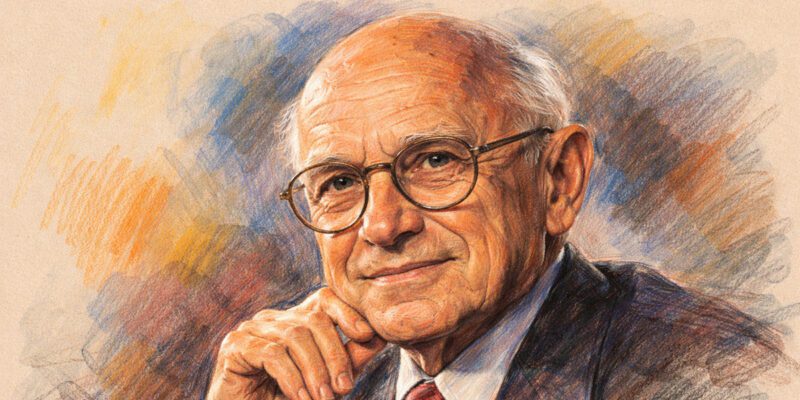
5o years ago, economist Milton Friedman was awarded the Nobel Prize in economics. Friedman distinguished himself with his belief in free-market capitalism with minimal government intervention. He strongly opposed fiscal policy that included heavy government regulation, price controls, and Keynesian fiscal policy (i.e., Keynesian economics advocates government manipulation of tax and spending policies to influence the economy). This is why, historically, Friedman, and John Maynard Keynes, the author of the Keynesian model, are often held up as two sides of the same coin. So, as noted above, Friedman advocated for free markets and minimal government interference, advocating for a largely hands-off approach to economic policy. He is considered to be an intellectual descendant of Adam Smith, the Scottish philosopher and economist widely regarded as the father of modern capitalism due to his pioneering work in economic theory and advocacy for free markets. Adam Smith and Friedman emphasized individual freedom, limited intervention from the government, and the promotion of free markets. In Smith’s foundational book, The Wealth of Nations, Adam Smith explains how “‘individuals pursuing their own self-interest, guided by the ‘invisible hand,’ would unintentionally promote the public good, and that market mechanisms, rather than central planning, are the most effective way to allocate resources.” Friedman agreed. In contrast, John Maynard Keynes believed in the need for government intervention but, it must be emphasized, only at times of economic crisis, in order to stabilize the economy and to cultivate growth. I believe Keynes gets a bum rap from those who argue he supported chronic, structural deficit spending. He did not. Keynes’ actual position was that ‘deficits should be used as a temporary, counter‑cyclical tool during economic downturns or emergencies, and that the government should aim to run surpluses in good times to offset earlier deficits.’ It is only fair to note that given Keynes’ strong support of balanced budgets, and his support of deficit spending only in times of war and economic collapse, we are currently far, far to the left of even Keynes. If today we could press a magic button and fully implement Keynes economic philosophy, even while on the merits it is far inferior to Friedman, our nation would nevertheless be in dramatically better economic shape. Friedman fundamentally believed that the free market is naturally self-correcting and efficient and that economic crises like the Great Depression are typically caused by policy mistakes by central banks, i.e., such as the Federal Reserve contracting the money supply, rather than failures of capitalism itself. (Many still adhere to this belief today which is one of the reasons there is a perennial call by U.S. Senator Rand Paul and others to “Audit the Fed” or even abolish it.) I remember studying both economic views in college. While I instinctively favored the free-market view of Friedman, I also thought the Keynes view that, in a downturn, government could step in and increase public spending while running temporary budget deficits to create jobs until demand was restored, made some sense. However, I have come to unequivocally support the Friedman view. The fundamental flaw with the Keynesian view, I respectfully submit, is that while government may be well-intentioned when it tries to correct for a recession or depression, the way it does so often worsens the problem. To summarize, the Friedman model allows the free market to correct for downturns in the market and that, to me, is a far better indicator of where supply and demand really are and to what and where capital will be attracted. When we allow the free market to correct for its own downturn, we are harnessing the brains, experience, and energy of every American consumer. I find that to be far more predictive of what ails the market and how to fix it than government bureaucrats crunching computer numbers in a room at the Fed in order to arbitrarily and artificially manipulate the economy. I think we should salute Friedman on the 50th anniversary of his Nobel Prize because the economic view he advanced has lifted millions out of poverty in America and the world. His economic theories championed individual choice and free markets over government intervention, which hews closely to the view many of us share, of a conservative, limited government that fosters the greatest amount of consumer choice and free markets possible. We are fortunate to have Friedman’s ideas available to us to refute the arguments of the rising Socialist movement in the U.S.
Advertisement
Advertisement
