
Over at The Spectacle Podcast, Melissa Mackenzie keeps saying that my Mike Holman novels are weirdly prophetic. I usually respond by saying I’m simply writing about things which are bound to happen, and those things usually happen in ways which were reasonably predictable.
For example, the latest novel The Necessary Men is about Cuba’s communist regime turning over and the people of that destitute nation having a shot at a whole lot better life than the one socialism has given them.
This is inevitable, though it won’t happen without a lot of pain. In my gaming-out of the regime’s collapse, there is an Elon Musk-style benefactor who heads up a consortium of investors to roll in and simply turn the lights back on, so to speak – bringing the capital assets and know-how to spark a private sector at the local level in communities across Cuba which are largely untouched by the regime.
Without that angel-investor presence, it’s harder, obviously. So in real life, attempting to make the change Cuba needs looks a bit different.
On Friday, Secretary of State Marco Rubio posted a message on X addressed to “those who seek to create positive change in Cuba.” Marco Rubio told them the time was now, and he urged them to pursue a “discrete partnership with the CIA.”
To those who seek to create positive change in Cuba – now is the time.
The disappointment of failed promises, corruption, and the privileged lives of only a few; seize this opportunity to create the change you desire through a discrete partnership with the CIA.
— Secretary Marco Rubio (@SecRubio) October 23, 2026
Within a day, the CIA followed with a Spanish-language video explaining how. If you have information and can safely reach a U.S. installation, go in person. If not, use a VPN, a private browser and a burner email address, and tell them your city, your job, your level of access and how to reach you.
“A aquellos que buscan crear un cambio positivo en Cuba – Este es el momento. La decepción de las promesas fallidas, la corrupción, y las vidas privilegiadas de unos pocos – Aprovecha esta oportunidad de crear el cambio que deseas a través de una asociación discreta con la CIA.” https://t.co/KYaksHGFLm
— CIA (@CIA) October 24, 2026
You don’t have to like the tradecraft of recruiting by social media to see what it means. The agency doesn’t publish a how-to for walk-ins from a country it expects to stay put. And for it to be this wide open, we’re really looking at blood in the water.
Havana’s reaction was predictable and revealing. Deputy Foreign Minister Carlos Fernández de Cossío called it public recruitment and said Washington must be in “desperation or misery,” mocking the agency for hawking its services “like a tube of toothpaste.” Foreign Minister Bruno Rodríguez warned that anyone landing on Cuba’s coast with hostile purposes would meet “razor-sharp limestone spikes.”
Mockery is what governments do when they would rather not discuss the substance. Not to mention the fact that when your people take home an average of $16 per month, there is electricity for no more than two or three hours a day in a lot of places in Cuba and people are on the verge of starvation, much less have no jobs and no hope for the future, and your population has declined from 11 million five years ago to closer to nine million now, the mockery from Cuban fatcats reads as hopelessly tone deaf.
The pressure is real, and it’s stacking up
Since January, Washington has maintained a de facto energy blockade, threatening sanctions on any country that supplies Cuba with fuel. On October 15, Rubio announced sanctions on the Cuban bank BICSA. On October 19, Florida’s attorney general secured a state arrest warrant for Raúl Castro, 95, on murder charges over the 1996 shootdown of two aircraft, on top of a federal indictment filed in May. Neither case has been tested in court. At a rally in Fort Myers on Friday, Trump said, “We’ll take care of Cuba on our way back from Iran.”
Rally talk is not a plan, and nobody has announced an operation. But taken together this is a government being squeezed on fuel, finance, law and legitimacy at once, and it is being squeezed publicly.
What the island looks like from inside
The December issue of The Atlantic opens in a tiny room at the top of a church in eastern Havana. A priest, Iván Guerra Álvarez, shows the author a yellow wall where someone sketched a map of the neighborhood’s streets. “They posted armed guards here, to watch over us,” he says.
The guards are gone now, along with the portraits of Fidel Castro. The church is reclaiming a cloister the state left in ruins. The priest believes history is approaching another turning point. “The Church will play a big role in the transition,” he says. “We are the biggest institution in Cuba outside the government.”
That is one priest’s prediction, not a finding, and I’d be careful about treating a single convent as the whole island. But a guard post that once watched a church is now empty, and that detail is hard to argue with.
Plus, that Atlantic piece has some pretty stark words showing that the Cuban people’s contempt for their government has become stronger than their fear of the regime.
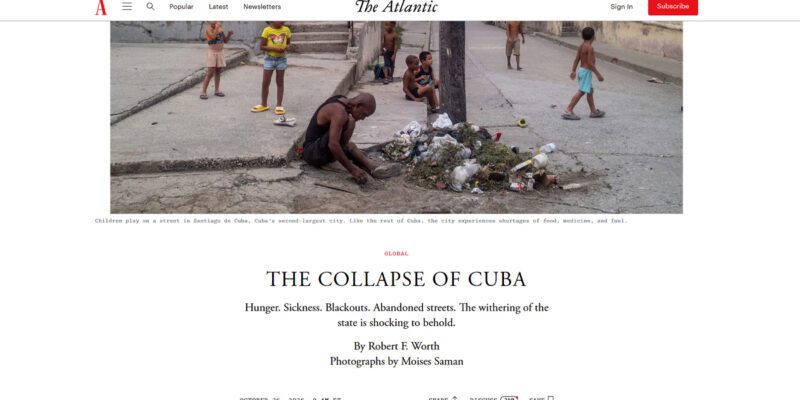
The Cuban regime has stifled any viable domestic opposition. But the withering of the state—a process that has been under way for decades—has accelerated, and is shocking to see up close. The ration cards that used to guarantee basic foodstuffs for every Cuban had been blank for weeks when I visited in August. Police and soldiers were once ubiquitous throughout the country, but I saw hardly any…
The government still purports—on faded billboards, in party speeches—to meet all of the material and spiritual needs of its citizens, but it is now bankrupt in every sense. Almost no one believes in the system anymore, and many, especially outside Havana, behave as if the government simply does not exist.
And…
Not long ago, the country bristled with informants working for the Committees for the Defense of the Revolution. But when I asked people about the CDR, some laughed, and few seemed worried about being overheard. One evening on a beach in Baracoa, a man in his 30s asked me what I thought about Communism. He was lying in a hammock talking with four other men, drinking cheap sugarcane rum from a plastic bottle; they had been complaining about the ever higher prices of rice, beans, and other basic foods. I told him I thought Communism was a lousy way to run a country.
He looked squarely at me and said, “I shit on Fidel Castro’s mother.” The other men laughed. He uttered a few more obscenities. Then, suddenly, all of the humor drained from the man’s face. His voice went taut with anger, and tears welled up in his eyes.
“Cuba is frozen in time!” he shouted. “There’s no hope. It’s a sad thing to be born a Cuban. That’s what I think, and I don’t care; they can send me to prison if they want.” The other men had gone silent.
A little more…
During nine days of travel around the island, I did not meet a single person who blamed Donald Trump or the United States for their situation…
“I don’t see any change since January,” a retired engineer named Guillermo Almeida told me. “That oil from Venezuela wasn’t reaching the people anyway.”
When The Atlantic sends a guy down to Cuba to find out what’s going on, and that guy comes back saying the Cubans don’t have a problem with Trump, you can take that to the bank.
And then there is this. Here the writer is talking to an ex-government official who he says has a tattoo of Che Guevara on his arm. You’d figure that’s a stalwart, and you’d be wrong…
I asked him what should be done to make things better. Cuba needed to be bombed, he told me. Specifically, Raúl Castro, Fidel’s brother and successor, should be bombed. And Raúl’s daughter Mariela. And the prime minister, Manuel Marrero Cruz.
Welp…
Where this leaves us
I can’t say that Cuba’s government has collapsed, which is literally the headline of the Atlantic piece, and nobody outside it can say with confidence how close it is. The Cubans don’t have guns and they haven’t had them for 67 years, so the means to violently overthrow that regime don’t exist without help. But what can be said is narrower and more useful.
Washington, after decades of wasting time with Cuba, has stopped pretending it is waiting for the regime to reform. Rubio and the CIA are openly recruiting inside the country for operatives to take it down. Havana’s response is to joke about it. And the institutions that outlast regimes, such as churches and families, are positioning themselves for what comes next.
Cuba has spent sixty-five years telling the world that the revolution cannot be reversed. This week the American government answered with a recruiting video.
All that remains is finding a few necessary men.
Advertisement
Advertisement
