
The National Popular Vote Compact (NPVC) is now easily achievable.
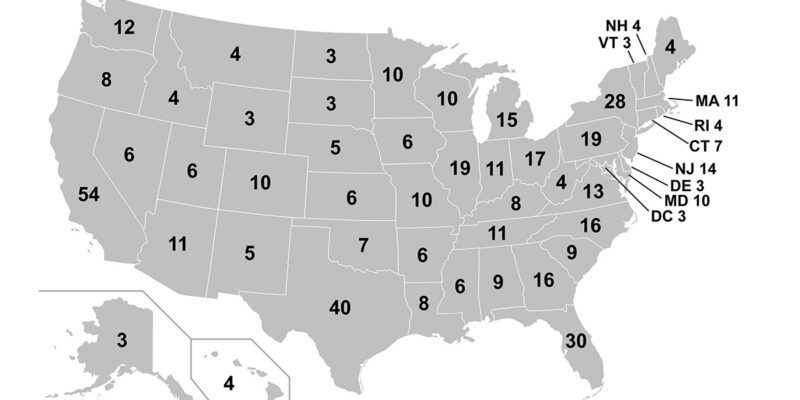
The NPVC is an agreement among states to assign their Electoral College votes to whoever wins the most votes nationwide in a presidential election, regardless of which candidate wins the most votes in the state. It goes into effect only if enough states join, through state legislation, to ensure the compact states will anoint the winner. Hence, the states in the compact must have collectively 270 or more Electoral College votes.
The compact is also a partisan issue—Democrats support it; Republicans oppose it.
Until the wee hours of Wednesday morning, the NPVC was stuck at 222 Electoral College votes.
However, with Democrats gaining lawmaking authority – i.e., control of both houses of the state legislature and governorship – in Arizona, Michigan, Pennsylvania, Wisconsin, and Nevada, the NPVC has a clear shot of controlling the outcome of the 2028 election.
If the five newly Democrat-controlled states pass compact legislation, the NPVC will reach 283 Electoral College votes. Any one of Arizona, Wisconsin, or Nevada could not pass NPVC legislation, and the compact will still go into effect.
I cannot understate the seismic shift that the NPVC will bring to presidential elections, nor ignore the significant constitutional questions it raises.
The NPVC will make every vote cast in every hamlet, town, and metropolis have equal influence in the final tally for president. Traditional swing-state-based electoral strategy will be useless – the goal for presidential campaigns will be to turn out every voter that they can everywhere in the country.
From a democracy perspective, it sounds great. “Every vote equal” is the rallying cry for the NPVC movement.
It’s not an unalloyed good, though. For folks skeptical of money in politics, the NPVC makes campaigning drastically more expensive.
Take, for example, the closest thing we’ve had to two parties competing on a national scale for every possible vote: the 2026 midterms. Democrats and Republicans actually tried to win every Senate contest, and the result was the most expensive election in American history: close to $12 billion spent.
The high for presidential elections, in 2020, is just over $6 billion, because whole swaths of the country –the South, the Northeast, the Pacific Coast – are uncontested. And the newly opened battlegrounds will be in some of the most expensive places to campaign: New York City, Los Angeles, Chicago, Dallas, and so on.
Presidential elections under the NPVC will look a lot more like midterms, and given the higher stakes, the country could easily see upwards of $20 billion spent for a single office. Presidential election spending will finally catch up with potato chip spending (about $25 billion per year).
In addition to spending, the NPVC raises some thorny legal questions.
Right now, the national popular vote is a fiction calculated by summing 51 separate jurisdictions’ final vote tallies. But each state gets to its final tally in a different way. Some are all mail ballots, others have longer or shorter early voting, and so on. So, a vote in Oregon doesn’t really mean the same thing as a vote in Florida.
That’s a significant, nationwide equality problem for the NPVC.
Additionally, since states shifted to awarding their Electoral College votes to the statewide winner in the 1830s, Americans expect their vote to translate to their state’s influence on the outcome. Under the NPVC, each state’s voters lose their unique impact on who becomes president.
For example, think of yourself as an Indian-American voter in California who had the opportunity to express, through California’s electoral votes, your preference for the first candidate of Indian descent, Kamala Harris. With the NPVC, you can’t do that anymore, because California’s Electoral College votes would have gone to Donald Trump in 2024.
So, the five states that have shifted to unified Democratic control should carefully consider whether they want to join the NPVC. While attractive from an abstract perspective, the compact has significant flaws and downsides.
If the states do join, though, 2028 will be an objectively historic election.
Advertisement
Advertisement
