
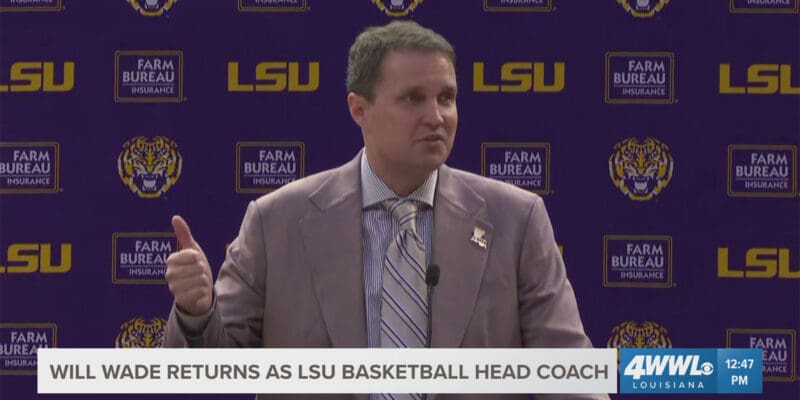
Yesterday, in front of a fired-up crowd at the Pete Maravich Assembly Center, LSU’s administration and new basketball coach made history.
Will Wade was announced as something of the Donald Trump of LSU basketball – he’ll be serving two non-consecutive terms, of sorts, as the head coach of the Tiger men’s hoops program, having been fired by former athletic director Scott Woodward amid the cloud of NCAA violations for recruiting activities which are no longer violations.
Wade never should have been fired, and Woodward’s chosen replacement Matt McMahon was an utter disaster who brought the program lower than it had been in modern history, but his return – a project that Gov. Jeff Landry, school president Dr. Wade Rousse, LSU Board of Supervisors chair Lee Mallett, athletic director Verge Ausberry and new deputy athletic director Heath Schroyer, who was the athletic director at McNeese State when Wade coached there, had come together to make happen – was perhaps all the sweeter.
Wade noted that this ride will be historical, one way or the other. “We’re coming back to try to hang a banner, win a national championship, or I’m going to be the first coach fired from the same school twice,” he said.
It’s possible neither will happen. LSU hasn’t won a men’s basketball national championship since the NCAA Tournament began, and most Tiger fans are happy if the team consistently makes the Big Dance more years than not and makes a run to the second weekend every now and again. Wade winning a national title would make for one of the most amazing redemption stories in the history of sports.
But watching that press conference, one couldn’t help but see that story has already begun.
North Carolina State fans and media covering that program are madder than hornets over Wade’s one-year stint. He lifted the Wolfpack off the bottom of the ACC in his first year – NC State went from 5-15 in conference play to 10-8, making the play-in round before dropping a game to Texas to finish 20-14. That was a pretty respectable turnaround; the problem was that NC State had been 18-6 and 9-2 in league play until an absolute swoon in their last 10 games.
There were rumors – and it was clear they were more than rumors by watching the team play late in the season – that NC State had some chemistry problems. Wade had gone big in the transfer portal for a few heavy hitters, particularly Derrion Williams from Texas Tech but also several transfers from high-major programs, and it just didn’t come together at the end.
It didn’t go unnoticed, though, that NC State’s swoon coincided with the rumors Wade was going to return to Baton Rouge.
The coach didn’t speak to that at the press conference, joking that the fans in Raleigh are pretty mad at a coach they didn’t think was very good at the end of the season. What he did say, though, was that LSU is home. And what he implied was that he never wanted to leave in the first place – so when the opportunity to come back was presented, wild horses couldn’t keep him away from LSU.
“I’ve never connected with a fan base and with people like I have with LSU and Louisiana,” he said. “I feel like we left the book open a little bit. We left some chapters out there, and we left some chapters unfinished.”
It’s interesting that legacy corporate media haven’t picked up on either redemption story or the loyalty – most of the hit pieces written about Wade have trashed him for leaving NC State after one year rather than recognizing his desire to come home to Baton Rouge even despite how his first stint ended – that this hire represents.
And none of the media wags seem to have any interest in the political story surrounding the hire, which is a bit of a shame seeing as though that’s probably the most fascinating item of all behind this. The Louisiana Policy Review blog had a post last week on the Landry-Wade connection which is well worth a read. An excerpt…
For more than two years, Landry was reportedly working behind the scenes to bring Will Wade back to LSU. He saw the direction college athletics was heading — the rise of NIL, the collapse of the old enforcement regime — and understood that Wade’s so-called violations were quickly becoming the norm across the sport.
Woodward didn’t just disagree. He blocked it.
At every turn, the return of Wade was stalled — not because it wasn’t good for LSU, but because Woodward made it a non-starter. His personal animosity toward Wade overrode what was best for the program.
That tension came to a head in what sources with intimate knowledge of the situation described as a shouting match between Jeff Landry and Woodward at the Governor’s Mansion — a clear reflection of just how strongly the governor believed LSU was making the wrong call.
And he was right.Woodward’s decision to push Wade out was always sold as principled. In reality, it now looks shortsighted and self-serving — a move rooted in ego, not strategy.
Because the timing couldn’t have been worse.
The so-called “boy genius” couldn’t see around the corner. He fired Wade at the exact moment the landscape of college basketball was shifting beneath his feet. The NIL era was emerging, the old enforcement model was collapsing, and the very allegations that were used to justify Wade’s removal were about to come out into the open and become normalized across the sport.
Landry saw that shift coming. Woodward didn’t.
Even as LSU basketball struggled through a subpar stretch under Matt McMahon, Woodward refused to reconsider. Bringing Wade back was never on the table. Winning took a backseat to personal preference.
That’s the part the insiders ignored.
It is now abundantly clear that Will Wade was never coming back to LSU as long as Woodward was in charge. That door was shut — locked by one man’s ego.
And that’s exactly why the recent shakeup mattered.
Without Landry acting decisively, this moment would not be possible. The reunification of LSU with a proven winner and fan favorite coach would still be dead on arrival.
Instead, LSU now has momentum. Football has direction. Basketball has a real path back to relevance.
And the person who saw it first — and fought for it the longest — was Jeff Landry.
Wade said his aim isn’t to build a program over the long haul. He promised LSU would win immediately. In the age of NIL and the transfer portal, that isn’t an empty promise – put together a team which is more than the sum of its parts and has some NBA talent to it, and a quick turnaround is more than doable even in the SEC.
There are reports which say Wade has two former SEC head coaches ready to join his LSU staff – one of them being Johnny Jones, whom Wade replaced at LSU; Jones has been the head coach at Texas Southern since his firing at LSU in 2017, and he has some key recruiting contacts which make his prospective hire quite interesting. The other is former Mississippi State and Western Kentucky head coach Rick Stansbury, known for a couple of things in his time as a head coach – a stifling 2-3 zone defense, and outstanding development of post players.
Wade’s LSU teams, and his other teams since, have generally been undersized, fast, athletic outfits which often struggled against size in the paint. The exception was his second team at LSU in 2019, keyed by Kavell Bigby-Williams and Naz Reid, which won the SEC in the regular season. Stansbury might be seen as an asset to insure that post play will be a strength as it was for that team.
And it’s foreseeable that Wade will make runs at two specific players who are weighing either transfer portal entry or the NBA Draft.
One is Houston’s 6-11 Chris Cenac, who’s originally from New Orleans. Cenac opted for Kelvin Sampson’s program last year over McMahon and LSU, and when he did it became obvious the former coach simply was never going to put LSU back on the map. He had a solid freshman year at Houston, averaging 9.5 points and 7.9 rebounds a game, and Cenac is being talked about as a late first round draft pick should he enter the draft.
LSU will have enough NIL budget to match a late first round slot value for Cenac if he’s available.
Another possible addition among post players is Santa Clara’s 6-9 freshman Allen Graves, who was Mr. Basketball in Louisiana while playing at Ponchatoula High School last year. Graves averaged 11.8 points and 6.5 rebounds per game on a 26-9 team this season, and like Cenac he’s being talked about as a potential late first round pick. Graves is the brother of Marshall Graves, who was a walkon player for Wade at LSU. Marshall Graves was spotted at yesterday’s press conference, in fact.
There is no guarantee either player is coming. It’s likely Wade will make a run at both.
LSU has four post players on the current roster – 6-10 junior Mike Nwoko, 6-11 sophomore Robert Miller, and 6-11 Matt Gilhool and 6-8 Marcus Vaughns, both of whom redshirted as freshman this season. None have entered the transfer portal yet.
Wade mentioned that he’d had individual meetings with “five or six” of the current players, and he indicated that those wanting to stay would have a spot on the roster. But it’s no longer about holding a scholarship spot for them – in modern college sports, there is an NIL number attached to that spot, and it might not be what the player wants to see.
Reports have surfaced about a major addition Wade is seeking – Georgia superstar 6-1 sophomore guard Jeremiah Wilkinson, who averaged 17.4 points per game this year in leading the Bulldogs to the NCAA Tournament. Wilkinson jumped to the portal, and currently he’s linked to LSU and Louisville.
Another guard who might very well figure into Wade’s plans is 6-4 freshman Larry Johnson, who was the star of McNeese State’s 28-win team this past year. Johnson led McNeese with 17.4 points and 5.5 rebounds per game in his first year of college basketball; Wade recruited him to Lake Charles, and he might well poach him for LSU. Another McNeese guard, 6-1 junior Tyshawn Archie, who averaged 14.3 points and 2.9 assists per game, could be a possibility.
The only guard on LSU’s roster likely to stick around is 6-1 freshman Jalen Reece, who only averaged 5.8 points a game off the bench this year but had a 3.6 assists-to-1.3 turnovers ratio, which indicates he could develop as a playmaker at point guard. But a commitment McMahon received before the coaching change, 6-2 Australian guard Owen Foxwell, could be interesting. Foxwell’s brother Joel is a freshman at Portland, the same school where Max McKinnon played last year before coming to LSU, and On3 ranks Joel Foxwell as the No. 15 transfer portal recruit (a ranking that won’t likely hold up when all of the portal entries are registered). Joel Foxwell averaged 15.6 points and 6.5 rebounds per game at Portland this season.
But Wade’s teams are usually built on athletic players who stand between 6-4 and 6-8 and can play multiple positions in combination. What will be worth watching is to see who his Trendon Watfords, Tori Easons, Darius Dayses and Emmitt Williamses are, because those are generally the guys who really make his teams go.
And it’s far too early to gauge who any of those targets will be.
We’re not discounting the possibility Wade could generate a big turnaround in the program’s fortunes. LSU will be a substantial factor in the transfer portal this year, much like Lane Kiffin’s football program was after he landed at LSU from Ole Miss in December. It’s likely to be a whole new team, and it’s definitely going to be a completely different atmosphere, charged with energy and urgency.
After all, he came back to Baton Rouge to make history, one way or the other.
Advertisement
Advertisement
