
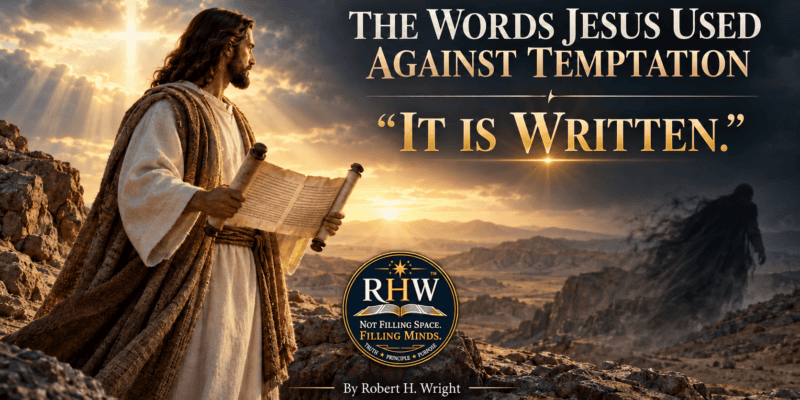
“It is written, Man shall not live by bread alone, but by every word that proceedeth out of the mouth of God.”
— Matthew 4:4
There are three simple words Jesus repeatedly used when He faced Satan in the wilderness:
“It is written.”
Jesus did not debate Satan. He did not attempt to outtalk him. He did not appeal to popular opinion, human philosophy, political power, or personal feelings.
He appealed to the Word of God.
Each time Satan tempted Him, Jesus answered with Scripture.
When Satan challenged Him to turn stones into bread, Jesus said:
“It is written, Man shall not live by bread alone, but by every word that proceedeth out of the mouth of God.”**
— Matthew 4:4
When Satan tempted Him to prove Himself by throwing Himself from the pinnacle of the temple, Jesus answered:
“It is written again, Thou shalt not tempt the Lord thy God.”**
— Matthew 4:7
And when Satan offered Him the kingdoms of the world in exchange for worship, Jesus declared:
“Get thee hence, Satan: for it is written, Thou shalt worship the Lord thy God, and him only shalt thou serve.”**
— Matthew 4:10
Three temptations.
Three answers.
“It is written.”
The Authority Was Already Settled
There is something powerful in those words.
When Jesus said, “It is written,” He was declaring that the matter had already been settled by God.
That is radically different from the way our culture often approaches truth today.
We hear:
“What do you feel?”
“What does society say?”
“What does the latest poll say?”
“What does the government say?”
“What does this expert say?”
But the Christian must eventually come to a more fundamental question:
What has God said?
Feelings change. Cultures change. Governments change. Popular opinions change. Even what society considers right and wrong can change dramatically from one generation to another.
But Jesus said:
“Heaven and earth shall pass away, but my words shall not pass away.”
— Matthew 24:35
God’s Word does not require the approval of the culture to remain true.
It is written.
Satan Even Used Scripture
There is another important lesson in Matthew 4 that we should not overlook.
Satan quoted Scripture too.
During the second temptation, Satan quoted from Psalm 91 in an attempt to persuade Jesus to throw Himself from the temple.
That should serve as a warning.
Simply quoting a Bible verse does not automatically mean someone is teaching biblical truth.
Scripture can be taken out of context. It can be twisted. It can be selectively quoted while other passages are ignored.
Satan’s strategy was essentially: God said He would protect You, so prove it.
Jesus answered Scripture with Scripture:
“It is written again, Thou shalt not tempt the Lord thy God.”
Jesus understood something we desperately need today:
The Bible must be understood as a whole.
We cannot build our theology around one convenient verse while ignoring everything else God has said.
Jesus Knew the Word Before the Battle Came
There is also a practical lesson here.
Jesus did not begin searching for Scripture after Satan appeared.
The Word was already within Him.
That raises an important question for every Christian:
How can we use God’s Word during temptation if we do not know God’s Word before temptation comes?
When fear comes, we need to know what is written.
When anger comes, we need to know what is written.
When lust comes, we need to know what is written.
When discouragement comes, we need to know what is written.
When the culture tells us that wrong is right and right is wrong, we need to know what is written.
When everyone around us seems to be walking in another direction, we need to know what is written.
The time to prepare for the storm is before the storm arrives.
“It Is Written” Must Apply to Us First
There is a danger, however, in using Scripture only as a weapon against everyone else.
It is easy to read the Bible and immediately think of someone who needs to hear a particular verse.
“My spouse needs this.”
“My children need this.”
“My church needs this.”
“My community needs this.”
“Our politicians need this.”
“America needs this.”
Perhaps they do.
But before we point the Word of God toward someone else, we should allow it to point toward us.
What is written about me?
Where am I disobedient?
Where have I compromised?
Where have I allowed pride, anger, bitterness, fear, selfishness, or worldly thinking to influence me?
The Word of God is not merely a sword we hold against the world. It is also a mirror in which we examine ourselves.
Before asking God to straighten out the nation, perhaps we should pray:
“Lord, show me where I need to be straightened out.”
Revival has always had to begin somewhere.
Why shouldn’t it begin with us?
The Battle Has Not Changed
The wilderness temptation occurred nearly two thousand years ago, but Satan’s basic strategy has not changed.
He still questions God’s Word.
He still distorts God’s Word.
He still appeals to human appetite.
He still appeals to pride.
He still promises power without obedience.
The setting has changed.
The temptation has not.
And neither has the answer.
It is written.
When Satan says happiness requires disobedience, it is written.
When society says morality can be rewritten, it is written.
When fear tells us God has abandoned us, it is written.
When pride tells us we do not need God, it is written.
When temptation whispers, “Just this once,” it is written.
When the world demands that Christians compromise what God has said in order to be accepted, it is written.
The Question Is Whether We Will Stand on It
The greatest problem may not be that the Bible has disappeared from America.
Millions of Bibles remain in our homes.
The greater question is whether God’s Word still governs our lives.
A Bible sitting unopened on a shelf cannot guide a family.
A Bible carried into church but ignored Monday through Saturday cannot transform a life.
A Scripture quoted publicly but disobeyed privately has not been given its rightful authority.
Jesus did more than quote Scripture.
He obeyed it.
That is the challenge.
Not merely to say, “It is written,” but to live as though what is written is actually true.
The Final Authority
Every generation faces the same fundamental choice.
Will God’s Word judge the culture, or will the culture judge God’s Word?
Will we change Scripture to accommodate ourselves, or will we allow Scripture to change us?
Jesus demonstrated the answer in the wilderness.
When confronted with deception:
It is written.
When confronted with temptation:
It is written.
When offered power through compromise:
It is written.
Those three words still carry enormous power—not because they are a magical formula, but because they point us back to the authority of the God who has spoken.
The world will continue changing.
Opinions will come and go.
Political movements will rise and fall.
Generations will pass.
But the Word of God remains.
And when the voices around us become confusing, when temptation becomes strong, and when we find ourselves standing at a crossroads wondering which direction to take, perhaps we need to return to the words Jesus Himself used:
“It is written.”
Advertisement
Advertisement
