
Texas Democrats made a play for public school supporters in their ultimately successful quest to end their exodus from state executive power that was going into a fourth decade.
Democrat strategsists artfully framed outgoing Republican Gov. Greg Abbott, U.S. Senate nominee Ken Paxton, legislators, and statewide officials for being wholly responsible for not only runaway property taxes but redirecting state revenue away from public schools to “vouchers.” Local candidates on their coat-tails followed suit, claiming to be the “pro-public education” slate in many locations. Their margins of victory Tuesday night largely flipped Texas and need not be repeated here. Power will be split at the Texas Capitol this spring as the legislative session begins.
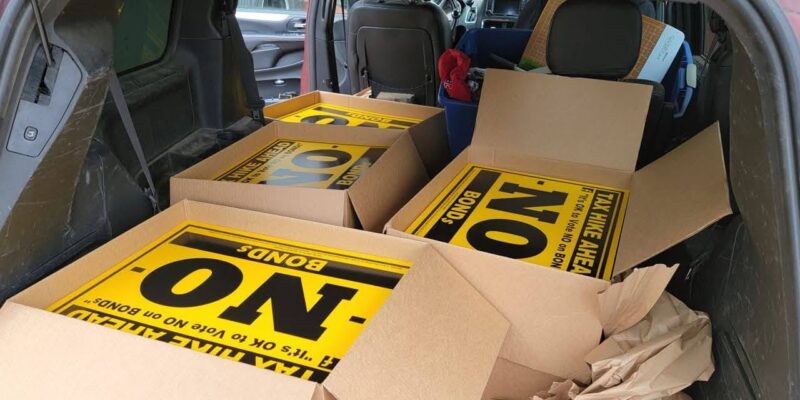
Yet it was this same wave of voters who killed school bonds and property tax hikes across the Lone Star State on Tuesday night. From Austin to San Antonio, and from Dallas to Houston, and many suburuban and rural areas in between, it was the same picture: Local Democrat candidate sweeps but tax proposal defeats.
You’d think it was a red wave looking at bonds and tax referenda alone. As two examples, Leander ISD and Round Rock ISD, sister districts in the Austin area, saw four-digit defeats of their tax increase proposals — even with conservative Trusstee canddiates losing by double-digits. Erin Anderson with Texas Scorecard took some electon night note here concerning other failed local tax increases:
Amy Teal, a City Council member for Whitney, Texas, who keeps up a master list of Texas local tax elections, expressed puzzlement at the overall picture.
“The astonishing results yesterday will be analyzed for years. But Democrats looking for evidence that voters have turned left should consider the bond measures that appeared across the state,” Teal said. “Those results also merit further analysis, but there is a clear pattern of bond measures, aka. tax increases, failing even where Republican candidates suffered most.”
Teal said she is still crunching the numbers to explain the disparity. But let’s look at what we know so far: Out of 9.8 million voters, known Democrats made up just 28% of those casting ballots. That means those who voted in the Democratic Primary or have a general history of voting blue. Republicans slightly edged out their counterparts at 29%, indicating a good share of the GOP may have sat this one out.
As for the rest? Voters with a history of mixed primary votes made up under 3% — so “swing” primary voters came in just as expected. A paltry sum.
Voters with no voting history whatsoever — may young — made up 8.5% of the total.
Now for the kicker: general-only voters (in other words, they don’t participate in a primary or vote in a third party nominating convention) came in at a whopping 31.7%.
Read: Around 40% of the electorate this fall were not married to the GOP or the Democratic Party this time. But as Williamson County Republican Chairman Michelle Evans wrote on a Facebook message board today it was not a matter of Texans shifting their beliefs or enough demographic change to turn Texas permanently blue.
Advertisement
“We didn’t center our message on economic populism this cycle, even though it was one of our winning messages in recent previous cycles; the Dems copied and pasted our campaign messaging from two years ago while we doubled down on some of the culture war issues that don’t resonate like they used to,” Evans wrote. “Like James Carville once said to Bill Clinton — ‘it’s the economy, stupid’. It worked for him, and it worked for 2026 Dems.”
“Not to mention the Dems talked more openly about their faith (regardless of how twisted it may have been) than our major Republican candidates.”
And where did those middle-ground voters go? What other choice did they have but to vote Democrat if they felt Republicans had failed them. But that does not mean they’re not feeling the pinch of an ongoing recession, rising taxes, fuel costs, and an uncertain economic environment (yes, even THC and CBD prohibitions played a role in that).
Sen. Ted Cruz pointed to Kansas, which is about as middle America as it gets for a reality check. Here’s what exit polling showed were the top issues in Kansas, Cruz pointed out:
- Number one, cost of living, energy, and groceries. 30.6%
- Corruption, 8.5%.
- Cost of the Iran war, 10.1%.
- Candidates are terrible, 7.9%.
- Canada trade war, 7.6%.
- GOP didn’t do enough to support Trump, 6.6%.
- Republicans didn’t pass the Save America Act, 5.6%.
- Trump’s focus on monuments, 5.5%,
- Data centers and AI, 3.8%.
“The top issue, cost of living, is very real,” Cruz said, who is likely the last Republican state official standing in Texas now. “Too many in politics dismissed it. They didn’t understand. They pointed to the macro numbers showing the stock markets soaring, median income at record highs, and poverty at record lows. Those data are true, but they don’t tell all of the story.”
Texas Democrats will soon no longer blame the GOP alone for school funding woes. Now that they get to wear the leadership hat, they will have to grapple with a top-heavy system that never seems to have enough revenue and that always seems to put teachers and classrooms last. But one thing’s for certain: the voters that put them there do NOT want more taxes in order to fix public ed. They made that very clear in “middle Texas” Tuesday night.
Advertisement
Advertisement
