
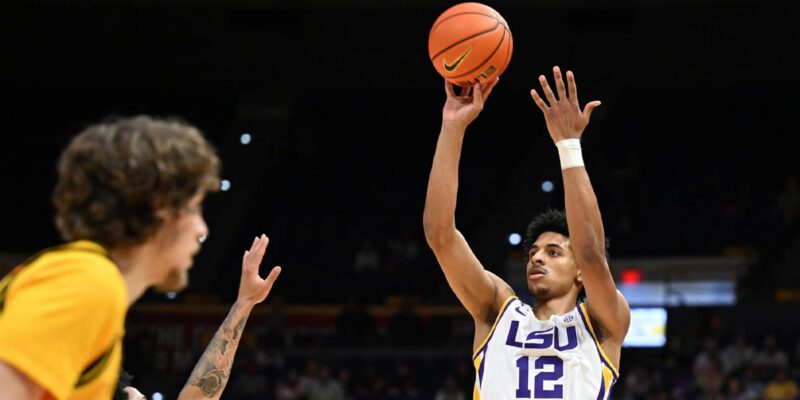
The game, an unimpressive 79-67 victory over a surprisingly competitive UL Monroe team, was nothing to write home about. Neither was his performance – 11 points and nine rebounds off the bench on some very so-so 3-for-9 shooting.
But R.J. Luis, who won the Big East’s Most Valuable Player trophy when last he played college basketball two years ago, took the floor for LSU Wednesday night and that fact alone seems to have set the college sports world on its ear.
They’re calling it a “controversial” debut, and X and other social media platforms have exploded with outrage, much of it performative, over Luis’ return to college basketball after spending last year in a bid to play professionally.
It’s a fair argument, to be sure. By any conventional metric, the 6-foot-7 Luis, who led St. John’s deep into the NCAA Tournament in the 2024-25 season, shouldn’t be eligible to play college hoops this year.
Except we stopped working in a conventional framework some time ago.
Here are the bad facts on Luis’ eligibility:
After the 2024-25 season, having played three years of college basketball, Luis declared for the NBA draft. He wasn’t selected, but the Utah Jazz signed him as a free agent. From there he ended up in the Boston Celtics’ organization, appearing in three preseason games. But the Celtics cut Luis and optioned him to their G-league team in Maine. Then he suffered a groin injury which kept him out of any regular season games last year.
And now he’s in what would be his fifth year of college eligibility, using either the new 5-for-5 eligibility rule or counting last year as a redshirt year, and Luis got an injunction from a court in Baton Rouge which he’s relying on to play.
Why the injunction? Under what justification is Luis able to get on the floor for LSU?
Well, let’s remember that there are dozens and dozens of players currently eligible for college basketball teams who have signed pro contracts around the world. LSU alone has four players – Brice Dessert, Saliou Niang, Gilad Levy and Michael Ruzic – who have played pro ball overseas.
The uniqueness of the American college athletic system, and its incompatibility with the club-and-pro-league system in, say, Europe, has created opportunities to push players into eligibility. But it’s even worse than that.
Because the NCAA and the college conferences have allowed foreign players to be eligible after playing large swaths of seasons, if not full seasons, in the G-league.
And given that, Luis has a pretty good case to make for the idea that denying him the opportunity to play college basketball – when other players who just as aggressively sought to play professionally and in fact have done so to a greater extent than he has are now eligible; Santa Clara, for example, had a player from France who’d been in the G-league for two seasons – is essentially discrimination against American kids.
Not to mention the fact that throughout college basketball are players who spent time in the NBA Summer League. Last Saturday LSU played Gonzaga, for example, and Chauncey Wiggins played 13 minutes in that game. Wiggins spent the summer in the NBA before getting cut and returning to college basketball.
The SEC has attempted to fold the R.J. Luis situation into a narrative of LSU as a “rogue” program, and given the running donnybrook between the league and LSU/Louisiana Attorney General Liz Murrill in a federal court in Birmingham, fireworks from which lit off earlier this week, Luis’ debut is only turning up the temperature.
But it’s interesting, because earlier this week the SEC’s lawyers said in an email to Luis’ attorneys that they would not fight the judicial injunction by which Luis is eligible. This after an appeal to the Louisiana Supreme Court was denied certiorari.
It was after the SEC had essentially thrown in the towel from a legal standpoint with respect to the Louisiana courts that LSU president Wade Rousse made the announcement that the university would put Luis on the roster.
And then the SEC threw a public-relations fit over that decision. Followed by Chris Carr, the Attorney General in the state of Georgia who is out of that job in January, making performative statements about LSU’s rogue status and renewing threats to kick LSU out of the SEC. National media then began sharing stories about a “boycott” of LSU’s games.
That’s what’s known as a forfeit in the real world, by the way, and it’s also very unlikely to happen.
So what’s real here?
The answer is “not much.” The SEC isn’t going to kick LSU out of the conference because R.J. Luis is playing on LSU’s basketball team, and the league doesn’t have much of a leg to stand on trying to single LSU out when most of the league’s teams have players who spent time in NBA camps and signed participation agreements if not contracts with pro teams.
But what’s happening in Birmingham is that the SEC is trying to create judicial precedent for getting its rules and compliance with them into the federal courts, essentially bootstrapping its rules into federal law.
Meaning that by suing LSU for breaking the league’s rules – LSU hasn’t actually broken the league’s rules, though; in the case of Zxavian Harris and Dae’Quon Wright, the two football players LSU considered putting on the roster who had been in NFL training camps, LSU ultimately declined to add them, and the Luis case was already live and an injunction in place before the SEC had any rule outlawing him – the SEC is looking to create a situation where it can use the federal courts to enforce compliance by its members.
This is not a conventional use of the federal courts, and it isn’t likely to work. The remedy that everyone recognizes for the SEC against a “rogue” school like LSU breaking its rules is expulsion.
Except that expulsion has severe costs. Like, for example, the SEC’s TV contract probably has to be renegotiated when LSU is no longer part of the league, and the chances are pretty good that a new contract without LSU is going to be less lucrative for the league. You can’t replace LSU with another program of the same size and fan interest; the only one likely on the market would be Notre Dame, and if Notre Dame isn’t interested in joining the Big Ten they certainly aren’t going to join the SEC.
So the SEC wants something other than expulsion, and court orders seem to be their chosen lever.
The problem is that the rules the SEC is trying to enforce actually run against court orders. Attempting to pick and choose which pro players you’re going to allow into your “amateur” league where players routinely take home seven-figure NIL payments turns out to be an impossible task.
And that’s the 50,000-foot problem with the R.J. Luis outrage.
Namely, that college basketball is pro basketball. Everybody knows this. They’re trying to delineate a difference between college and pro players when everybody in college ball is already a pro. So what difference does it make what pro league college teams recruit players from?
Advertisement
Advertisement
