
Jeff Sadow makes some important observations at the end of one of his recent essays:
‘The larger question about the deployment is its duration. Sure, it can reduce crime, but unless it goes on indefinitely, its benefits will have to be reaped another way that can be implemented while using the Guard as a bridge to achieving that end state. And this is policy action that really must emanate from the local level. Policy made by Landry and/or the Legislature . . . only can go so far.
‘State policy-makers also can address ancillary environmental conditions that can discourage crime, such as reduced government control of economic relations that would encourage opportunity and policies to improve educational attainment, such as greater choice and more rigor in schooling. But as with public safety policy, it will take a similar commitment by local officials to bring about a permanent reduction in crime.
‘Unfortunately, that doesn’t seem forthcoming from a number of such officials. Until that changes – and perhaps this change starts at the voting booth – the benefits of guard deployment for crime reduction will last only as long as the deployment’ (‘Guard Deployment Must Fit Larger Commitment,’ thehayride.com).
The reduction in crime resulting from National Guard deployments won’t last much longer than the deployments themselves. Larger societal changes will be necessary. Mr. Sadow mentions improving opportunities for education and economic advancement, but these oft-touted tools of the post-Christian Enlightenment will fail if there is no religious change in the city-dwellers themselves. That is the main ‘environmental condition that can discourage crime’ and get cities on a better path.
Fallen, sinful mankind generally doesn’t want to work too hard to get the money and possessions he desires. He will most often take the path of least resistance. Hence the proliferation of crime. But when the Grace of God touches the soul of fallen men, they will undertake many difficulties for the sake of drawing near to God and serving their neighbors. St Moses the Black is an excellent example of this. He was a notorious criminal but with God’s help he changed completely:
‘Saint Moses lived in Egypt during the fourth century. He was an Ethiopian, and since he was black of skin he was called “Murin” (meaning “like an Ethiopian”). In his youth he was the slave of an important man, but after he committed a murder, his master banished him, and he joined a band of robbers.
‘Because of his bad character and great physical strength, they chose him as their leader. Moses and his band of brigands were feared because of their many evil exploits, including murders and robberies. People trembled at the mere mention of his name.
‘Moses the brigand spent several years leading a sinful life, but through the great mercy of God he repented, left his band of robbers and went to one of the desert monasteries. Here he wept for a long time, begging to be admitted as one of the brethren’ (‘Venerable Moses the Ethiopian of Scete,’ oca.org).
After his admission to the monastery, he who had once robbed and pillaged and murdered in order to avoid honest work became one of the greatest ascetics and hardest and most generous workers amongst the monks:
‘Saint Moses was completely obedient to the hegoumen and the brethren, and he poured forth many tears of sorrow for his sinful life. After a certain while Saint Moses withdrew to a solitary cell, where he spent his time in prayer and the strictest fasting.
‘ . . . Saint Moses was not quickly freed from the passions. He went often to the hegoumen, Abba Isidore, seeking advice on how to be delivered from the passions of profligacy. Being experienced in the spiritual struggle, the Elder taught him never to eat too much food, to remain partly hungry while observing the strictest restraint.
‘ . . . Then Abba Isidore taught him the all-night vigil. The monk stood the whole night at prayer, so he would not fall asleep.
‘ . . . Saint Moses drove himself to additional labors. Making the rounds of the wilderness cells at night, he carried water from the well to each brother. He did this especially for the Elders, who lived far from the well and who were not easily able to carry their own water’ (Ibid).
For his humility and ascetic deeds, he was granted remarkable spiritual insights and powers. His sayings, found in St John Cassian’s Conferences, the Philokalia, and elsewhere, continue to be cherished by those seeking spiritual refreshment and guidance.
Thus, we see how work, education, and sanctity all rise and fall together.
The English people provide another good example of this truth. The Anglo-Saxons, prior to their baptism in Christ, were rather ungovernable, much like the inhabitants of our inner cities:
‘In the first century Tacitus described the Germanic tribes as “wild, blue-eyed, reddish-haired and large-framed . . . courageous fighters, but impatient of hard work”. They seem to have been easily bored and used to wander off in search of adventure’ (John Finney, Recovering the Past: Celtic and Roman Mission, Darton, Longman, and Todd, London, 1998, p. 94).
But, once again, their union with Christ through His Body and Bride the Church worked a spectacular transformation.
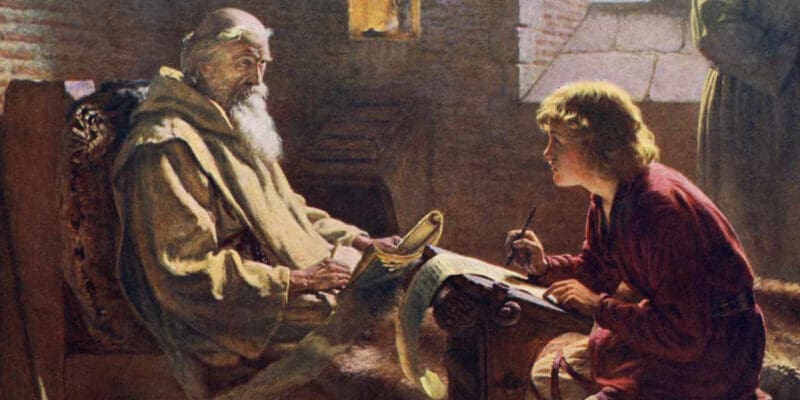
The life of St Bede the Venerable of Wearmouth-Jarrow Monastery in England (+7th century) is representative of the extent of the change that came upon the English people. Far from the roving bands of bored, ignorant people they once were, many of them settled into monasteries for most of their lives and built up sacred and secular wisdom:
‘St. Bede the Venerable (also called The Venerable Bede), was an Anglo-Saxon monk, biblical exegete, hagiographer, and historian. He was the foremost and most influential scholar of Anglo-Saxon England. St. Bede was famous for his prodigious learning, and even more so for the holiness of his life.
‘In the early Middle Ages, it was common for families to dedicate a child to a monastery at a young age and place him there to be raised and educated. So, at the age of seven, St. Bede’s family placed him at the monastery of SS. Peter and Paul at Monkwearmouth-Jarrow in Northumbria, England under St. Benedict Biscop (12th January). He was ordained to the deaconate at the age of 19 and to the priesthood by St. John of Beverley (7th May) at the age of 30. Aside from brief excursions to Lindisfarne and York, Bede spent the remainder of his life at Jarrow, devoting himself to prayer and scholarship, reading, teaching, and Scriptural exegesis.
‘Although his best-known work is Historia Ecclesiastica Gentis Anglorum (The Ecclesiastical History of the English People), which gained him the title “The Father of English History”, St. Bede wrote on many other topics, from music and musical metrics to scripture commentaries. It is thought that during St. Bede’s time the library at Wearmouth-Jarrow was one of the largest in England, and it is clear from his work that St. Bede had an in-depth knowledge of all the library contained. His proficiency in patristics, as well as his knowledge of the great classical writers was unrivalled. St. Bede’s writings provide rare insight into the religious and secular life of early Britain’ (Dr John Hutchison-Hall, ‘25th May,’ drjohnhutchisonhall.com).
After recounting some of St Bede’s other literary achievements, Dr John adds,
‘St. Bede accomplished all of this whilst teaching all day, spending a good part of the night in prayer, and fulfilling his monastic obediences. St. Bede also had a great love for the services of the Church, and believed that since the angels were present at the services, he should always be there as well, asking “What if they do not find me among the brethren when they assemble? Will they not say, ‘Where is Bede?’”’ (Ibid.)
This is the kind of change that we could have in our woe-begotten cities. But in order for it to happen, our political leaders must make a strategic choice: They must send Christian missionaries into the cities after the National Guard, police, etc., have pacified them enough that they can safely share the Gospel with their citizens. No conversions by force; but the extra guards should stay until the Good News of salvation in Jesus Christ has had time to take firm root amongst them (Yes, that is in violation of current federal and State constitutional arrangements; those should be changed without delay to favor Christianity. Government neutrality toward religion is another Enlightenment farce that ought to be roundly rejected).
Once that has happened, then we will see the educational and economic advancements Mr Sadow spoke of. They will not happen merely through laws and ordinances, or through appeals to the rational mind. Non-Christians, i.e., people under the influence of Satan and the demons, do not care much for laws, nor are they able to reason all that well.
But the presence of Christ and His Cross, as St Nikolai Velimirovich (+20th century) recounts, is able to smash the rule and influence of the devil and his hordes of dark spirits:
‘The enemy of the human race . . . stretches his webs everywhere, like a spider, with the sole purpose of ensnaring some human soul and entrapping it in his foul kingdom. Pagan peoples were his cities. Until the coming of Christ, he ruled untroubled and absolutely in them. When they served idols, they served him; the practices of soothsaying and fortune-telling served him; he protected, directed and enhanced men’s unbridled licentiousness; human sacrifice, fiery passions, discord, war, evildoings of all descriptions—this was all pleasure for him. But in the end, no weapons remained in him; his “cities” were destroyed and his memorial is perished with a roar. This “end” of which the prophet speaks is the coming of Jesus Christ the Lord into the world. The Lord manifested His power over the devil when He overcame his temptations on the mountain. He manifested His authority in driving demons out of men, commanding them to go this way or that; He manifested His invincible lordship over sin and death by His suffering and Resurrection. And, what is perhaps most important, He harrowed hell and scattered the demonic power.
‘ . . . He freed the people from their domination; and even more importantly, He gave men authority over the demons, such that they can drive the demons out by the power of His name. Do you see how the Lord linked His victory over the demons with His mercy toward men? He so weakened and broke them, He so confused and dispersed them, that He placed them under the authority of men. Even so, the Lord did not grant authority over demons to all men, but only to those who believe in Him and who follow His commandments. He gave them authority, and He also gave them a weapon. That weapon is the Cross’ (The Prologue of Ochrid, ‘October 8,’ ochrid.org).
Will we grant those trapped in the inner cities the weapons and tools needed to break free from their prisons and transform them – faith in Christ, the power of His Holy Name, the Sign of the Cross, etc.? That is the long-term solution to inner city decay. Everything else is wishful thinking.
Advertisement
Advertisement
