
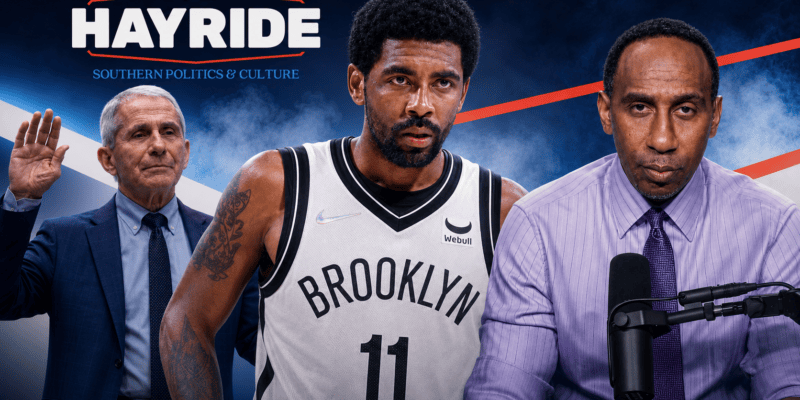
Anthony Fauci’s performance yesterday is finally showing the tardies what plenty of voices were saying a long time ago.
And were mocked, scolded, and cancelled for it.
Millions of Americans paid for what happened during the COVID years, losing jobs, reputations, and relationships, while those refusing to be silenced by the bystander effect—including the very site you are reading now—endured mass censorship for refusing to vomit the state-sanctioned story. Many of us are still paying, yours truly included as a writer, and will continue to pay long after those who levied the cost have renamed their abject failure—both as commentators and as simple, decent human beings—“reflection.”
Justice requires more than reflection and apology, and we aim to show that today and in a follow-up piece next week.
On “Reflection” and “Apology”
After watching Dr Anthony Fauci invoke the Fifth Amendment throughout Wednesday’s Senate hearing, Stephen A Smith—puppet following his marching orders always, just like Fauci (let’s not overstate any autonomy here)—did something on his show yesterday that very few prominent people have done concerning the COVID years: He admitted plainly that the people ridiculed for refusing the vaccine deserved better.
Smith said the person who kept coming to mind was Kyrie Irving. He revisited the punishment Irving took after New York City’s mandate made him ineligible for Brooklyn Nets home games:
I watched Dr Fauci on Capitol Hill yesterday, and the person I thought about most was Kyrie Irving. Kyrie Irving stood out in my mind because of the heat that he was taking… He refused the vaccine. New York City’s mandate made him ineligible for home games, and he linked his stance to people losing jobs over vaccine mandates. In my opinion, particularly hindsight-wise, it didn’t make him stubborn or selfish. It made him brave. His willingness to stand up and say, ‘Nah, I’m not doing that.’ It’s just a time for reflection—to look at things differently.
Smith went further. “Kyrie Irving did nobody wrong. We did him wrong,” he said, naming himself among those responsible. He acknowledged that the suspicion now surrounding the official COVID story vindicates at least some of the skepticism voiced by Irving, Aaron Rodgers, and Novak Djokovic.
“They weren’t as wrong as we thought they were.”
Then he ended where a genuine apology should begin.
“I’m responsible for me. I need to do better.” One report on the full remarks also recalls what Smith said when dissent still carried a price. He called Irving “flat-out stupid” and demanded that Brooklyn trade him.
“Trade him! If he ain’t gonna take the vaccine and can’t play half your home games, trade him!”
We’ve used both Djokovic and Rodgers in our work against the Deep State, by the way, and long before Smith arrived at yesterday’s conclusion.
World’s Best Is Firm in His View on Vaccines and No. 1 Ranking (RVIVR, 7-11-22)
Carlson, Rodgers Talk Epstein, Blackmail, and Israel’s Mossad (RVIVR, 5-16-24)
Smith (maybe) deserves credit for the reflection and apology. Many won’t even do that. Still, this is not a time to make Smith or any late apologizer a knight on a white horse. Too often we make into heroes those who admit their wrongs, but never demand of them reparation or justice on behalf of those they wronged. People weren’t just disagreed with; they were held in absolute contempt, and the same ones beating the alarum then are beating the alarum now on other issues—and getting hammered there too.
Liberals and conservatives both are doing it. We cannot limit this spotlight on Smith simply because he appears to be liberal and works for Disney. Some conservative pundits are doing it as we speak.
That’s celebrity culture, and it’s arrogant tribal brazenness. It’s the electronic screen. We cannot allow this moment to make heroes out of people with microphones and a stage, who facilitated the very assaults that never had to happen—and that will happen again if the powers that be have their way.
We cannot allow this moment to pass without training ourselves to see it in real time and not five years later.
That is the lesson for the future on a societal scale. So yes, taking Smith’s words as his own for a moment, outside the ever-shifting wiles of Mockingbird media, we accept his apology for what it is. It at least represents the voice of many we will never hear through a microphone.
But it isn’t nearly enough, not by a long shot. There is one older lesson here, and American society as a whole has largely abandoned it.
The Old Christian Lesson
One of Smith’s lines is maybe the most important, even though it isn’t a zinger. Yes, every one of us errs, sins, sometimes badly. That standard applies to me too. I remain in constant reflection upon my own sins, performing acts of penance and reparation to Christ and to my fellow man. I cannot demand from others a moral standard I refuse to apply to myself. I make myself suffer through intense fasting and other mortifications to in some way make up for the pain I’ve caused others. Thus the adequate Christian response includes more than changing your opinion after the social cost of dissent has disappeared. It asks what can be repaired and what the person responsible is willing to surrender in order to repair it.
This is why Yardbarker’s conclusion, while recognizing something rare in public media, remains incomplete:
It simply reflects how one of sports media’s recognizable voices now views his own role in it. By ending his monologue with “Peace and love,” followed by “I need to do better,” Smith shifted the focus away from Kyrie Irving and toward himself. It marked a rare moment of self-reflection from someone who has frequently faced criticism from athletes over his commentary.
Let’s not dismiss all of this simply because professional athletes make millions, or because they may be puppets playing out a most insidious script themselves. Take their cases at face value, if nothing else, as visible stand-ins for the people whose names will never be known. Irving gave up games and income. Djokovic risked championships, ranking points, entry into other countries, and his opportunity to finish as the statistically greatest men’s tennis player ever. They can stand in for the Everymen who gave up their livelihoods at far greater cost by proportion.
The question is what the people who caused that cost are willing to give up now. Smith’s admission is certainly more serious than the evasions still offered elsewhere, but an apology that costs nothing cannot balance the scales after so egregious an offense against souls and against God Himself—the Way, the Truth, and the Life.
The truth…
The Eighth Commandment, very clearly, was broken en masse. That commandment doesn’t stop with the direct utterance of a lie; it also forbids calumny, detraction (look them up!), and their results—the unjust destruction of a neighbor’s good name, his God-given dignity and reputation. These things were violated—murdered in a sense—therefore breaking the Fifth Commandment as well. The layers continue with the Fifth—a most different pleading of the Fifth, shall we say—wherever coercion and ostracism inflicted bodily harm through the needle, drove people toward despair through isolation, or objectified human life as a mere instrument of policy.
Reputations were destroyed. Livelihoods and relationships were destroyed. Even if every death and injury cannot be laid at the feet of every commentator, nobody who helped create the coercive climate gets to pretend the human consequences were merely rhetorical and safely in the past now. “Errors” are one thing, but when you really sit there and reflect on how much what happened affected souls and not just statistics, you’ll see the sin of it.
You’ll see the great number of sinS of it.
That is what you might not see talked about anywhere else.
(The full PDF of the Catechism of the Council of Trent is linked in yesterday’s post).
Some Publications Were Already There
Long before Smith reached this conclusion, The Hayride was out in front.
In addition to many other articles, on July 11, 2022, at our own sister publication RVIVR, this space argued that Djokovic’s refusal of the jab deserved respect. That article didn’t wait for a Senate spectacle in 2026 to recognize what Smith now calls bravery. It focused on the price Djokovic was willing to pay when doing so could still cost him the records he had spent his life pursuing.
“The principles of decision-making on my body are more important than any title or anything else,” he told the BBC. Missing tournaments was, as he said it, “the price that I am willing to pay.”
“Based on all the information that I got, I decided not to take the vaccine.”
A great number of people had access to that same information, information that people like Stephen A Smith somehow missed back then—or refused to bring to the light.
Our 2022 article understood one crucial point: Djokovic was not demanding immunity from consequences. He accepted them, and saw value in self-sacrifice. And whether readers agreed with every one of his medical or religious ideas was beside the point. He had decided that conscience transcended professional glory, and he proved it by surrendering something he loved.
That is why The Hayride’s early position deserves emphasis now. We were not claiming to be prophetic, and we did not need every scientific controversy resolved in our favor. But the burden of proof didn’t belong to the those questioning “the science.” It belonged to those using economic and social coercion against people of goodwill who were declining a medical intervention upon their very own bodies—in a country that is ostensibly “free.”
Instead, the general consensus did reverse that burden onto the dissenters, requiring them instead to prove false those claims—made by the very institutions they don’t trust in other arenas—before permitting them to do the simplest of things, like keep their jobs or enter buildings or merely breathe.
Smith has now arrived where this publication stood when taking that position cost it the one thing it cannot thrive without—being seen.
Louisiana’s people were ahead of much of the country too, although we should state that carefully. An April 2021 survey placed Louisiana’s stated vaccine hesitancy at 20 percent, second only to Wyoming. Polls do not become gospel merely because one helps our thesis, and reluctance to receive a shot can reflect other conditions besides distrust. The behavioral evidence nevertheless points in the same direction. An April 2022 study ranked Louisiana 48th among states in residents who had received at least one COVID dose. A newer University of Louisiana at Lafayette-led study of vaccine attitudes reports that only 56 percent of Louisiana’s population was vaccinated against COVID in 2022, the fourth-lowest rate nationally.
I have read other material pointing in the same direction over the past year, although I cannot responsibly bring it forward here without having it in hand. I sincerely hope these studies and polls are right, considering how little I typically trust them. The defensible conclusion is strong enough, though: Louisiana was among the country’s most resistant populations, and a substantial number of its people declined to treat “the science” as an adequate substitute for personal judgment.
And The Hayride applauds you for that.
Final Thoughts
Every one of these people said what the graphic attributes to them. Some of the lines are shortened, but none is fabricated or fundamentally distorted. What I don’t know is if or where any of them changed course.
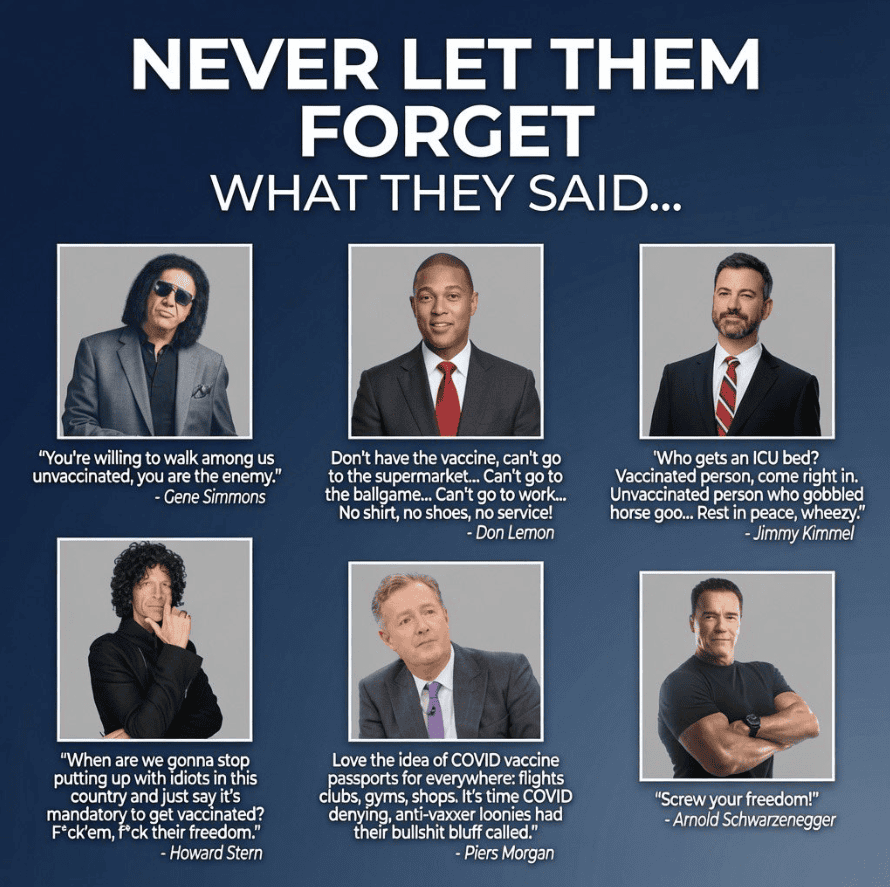
We add this only to remind you of the 2020-21 picture.
The Hayride did not need Fauci’s Fifth Amendment or celebrity permission through a microphone to recognize the truth. We might not even call it courage—it just, I don’t know, was. We said it while saying so meant disappearing from social media feeds, losing reach, and surrendering much of the growth that determines whether an online publication thrives, and more importantly, whether the truth gets out to people trusting those like Stephen A Smith.
Now that the subject has become safe enough for celebrities to approach, “reflection” must not become an escape from accountability. The older Christian order and emphasis on not just the Commandments, but the many layers of each, has plain words for what should follow grave wrongdoing: sincere sorrow, confession, reparation, and authentic amendment of life. Remember that next time Smith is yelling about some other issue or some other person he deems stupid.
Still, charity requires us to recognize that Smith did not work alone and that we must take his words at face value for now. So that’s what at least this space will do: Stephen A says he needs to do better. Good. Let him and all the others begin. We sincerely hope they do.
But mercy is not distinct from justice. The account will not be settled by a monologue ending in “peace and love.” Millions paid the price. Until those who helped impose that cost are willing to surrender something to repair it, and do so as publicly as they participated in the original assault, the debt remains exactly where they left it—with the people they made pay.
Thank you for reading The Hayride!
Advertisement
Advertisement
