
Most of the closely watched contests on Tuesday night were in reliably blue areas — places where a Republican or conservative win would be an upset.
That hasn’t stopped liberal pundits from claiming “victory over MAGA” ahead of the 2026 primary or voices on the right from bemoaning the losses. From Zohran Mamdani in New York to Abigail Spanberger in Virginia, and from Mikie Sherill in New Jersey to Prop. 50 in California, an alleged “Democrat energy” comeback is a major topic this week.
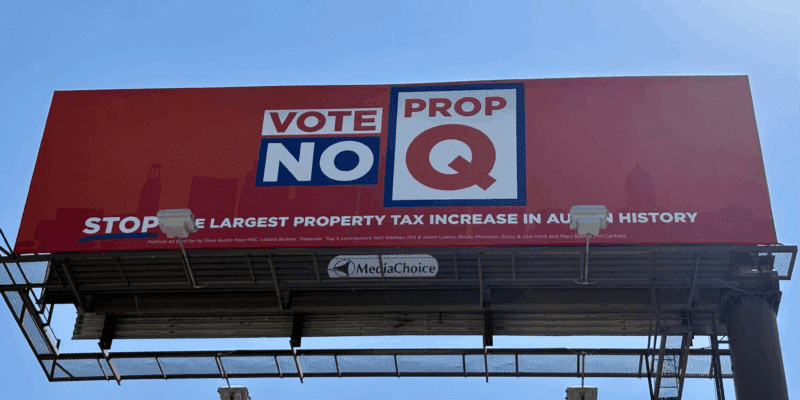
Yet one victory in a major, blue city on Tuesday deserves some extra attention: That of the defeat of Proposition Q in Austin, Texas.
The proposed tax hike, which would have raised taxes just over 20% (making the average resident pay an estimated $300-$1,200 extra per year, depending who you talk to and however you stack it with other already approved local tax hikes), was shot down 63-37% with roughly 170,000 voters casting a ballot — high turnout for what is usually a sleepy state referendum and local election date.
Opponents called the defeat, rare while not completely unexpected, a potential turnaround point for the Leftist-dominated city, as well as a “taxpayer revolt” in the words of Matt Mackowiak of Save Austin Now, a former county GOP chair. Numerous organizations including the local Republican Party came together from across the political spectrum to defeat the tax hike, which many feared woud be the final straw for small businesses as well as those living on federal and state assistance.
Mayor Kirk Watson, a former state Senator, immediately responded that the city would have to “assess and optimize” how services are rendered. “Voters prioritized affordability. They’re worried about their finances, their grocery and utility bills, their property taxes and more,” Watson said, conceding defeat. He said the City Council would have to re-do the budget to reflect what is known as the No New Revenue rate.
Councilman Marc Duchen, who represents a large share of North Central and West Austin, voted against the proposed city budget initially, claiming there were ways to rearrange items to achieve most of the same goals without raising taxes. He called for a “top-to-botom efficiency study to address our citys structural deficit and ensure we spend as wisely as possible.” Austin voters have voted down city audit proposals in previous year.
By “deficit,” Duchen referred to a $33 million gap in the budget, allegedly left open for Prop. Q to fund homelessness initiatives, parks improvements, and public safety.
Opponents pointed to other taxes being levied for next year, including an “emergency” disaster tax by Travis County, as well as a health district tax hike. This is on top of previous tax hikes that have been approved by voters over the last several years — one of which was Project Connect, a delay-ridden network of rail lines and other public transportation infrastructure that raised taxes by 20% circa 2020. Last November, voters okayed tax increases for school districts and the county.
Council member Vanessa Fuentes, who voted for the budget and to put Prop. Q on the ballot, estimated the city will have to find $110 million to cut, which may include paramedic services.
Advertisement
Critics have pointed out there is plenty of room for cuts and pointed out a spending problem with the city — most notoriously, a million-dollar new logo “branding system” for all city departments to replace use of the city seal. Supporters distributed flyers door-to-door blaming the Trump Administration and DOGE for cuts to social services — something the Leftists in charge of the city hoped to make up for on the local level.
“Too many workers, seniors, and families are struggling just to make ends meet. We owe it to them to be part of the solution, not part of the problem,” said Council member Ryan Alter, a Democrat in support of Prop. Q. “Austin has made real progress in reducing housing costs, but we must go further. Every decision we make should start with one question: How will this help those who are struggling to get by?”
From the hip
“A surprising backlash in the deep blue city” is how the New York Times framed the outlook on Prop. Q in a feature story.
“Opponents fear sharply increasing property taxes will add to a crisis of affordability and have suggested the City Council is beholden to developers,” the Times article read. “Some, particularly among Austin’s vocal conservatives, have accused local homeless service nonprofits — which support the measure — of grifting from taxpayers as part of a ‘homeless-industrial complex.'”
This is national news. Let’s not forget this upset in one of America’s largest metro areas as we finish our analyses of the November 2025 election.
Whether you’re in Austin or New York City, everyone is pointing to “affordability” as the primary reason things turned out the way they did on Tuesday night. Mandami calling for free stuff and rent control, and Austinites demanding tax relief. Consultants please take notice.
Advertisement
Advertisement
