
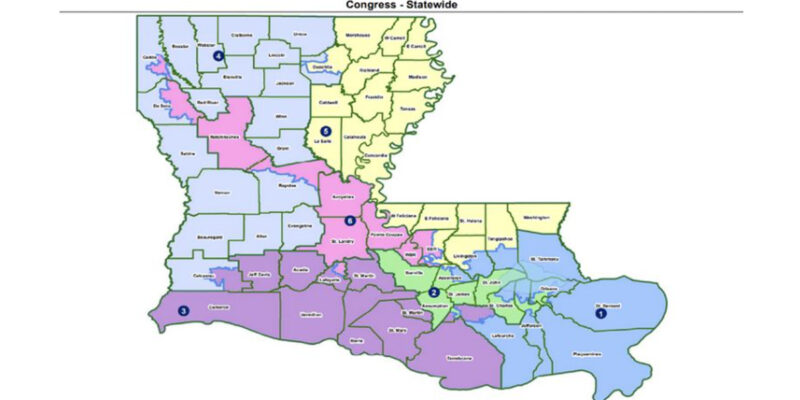
(By Andy Jackson/RealClear Wire) – There has been quite a bit of pearl-clutching over Louisiana v. Callais, a Supreme Court case about a second majority-black congressional district in Louisiana. Drawn last year, Louisiana’s Sixth District stretches from Baton Rouge, in the southeastern portion of Louisiana, all the way to the northwestern corner of the state.
A group of Louisiana voters challenged the drawing of the Sixth District, claiming that race was the sole reason for its creation.
The Legal Defense Fund said the lawsuit was an attempt to “once again undermine Black Louisianians’ political power.” The Southern Poverty Law Center claimed the case could “undo long-standing rules about how mapmakers ensure racial minorities get the opportunity to elect leaders of their own choosing.” Not to be outdone in the hyperbole department, the Center for American Progress questioned whether the case was “the end of the Voting Rights Act.”
Their stated fears are based on the high court’s order to rehear the case to answer the question of whether the “intentional creation of a second majority-minority congressional district violates the Fourteenth or Fifteenth Amendments to the U. S. Constitution.”
Those fears are based on misunderstandings, perhaps willful, of the Voting Rights Act (VRA) and the 14th and 15th Amendments.
The first misunderstanding is their belief that the VRA requires racial proportionality. Louisiana’s population is 27% black, so the thinking is that having two majority-black districts would be better than one (33% of districts versus 17%), regardless of how the districts are drawn. That is simply not true. Section 2 of the VRA states, “… nothing in this section establishes a right to have members of a protected class elected in numbers equal to their proportion in the population.”
The second misunderstanding is that the “protected class” in question is “black.” It is not. The protected class is “race.” To be sure, the 14th and 15th Amendments (along with the VRA) were put in place to ensure that black Americans had the same voting rights as white Americans. Those rights are not exclusive to black voters, however. The dozen “non-African American voters” who filed the lawsuit have just as much right to appeal to those amendments for protection when the state intentionally diminishes their voting power based on their race.
Which leads us to the third misunderstanding: that Louisiana v. Callais represents a new line of judicial attack against the VRA. In reality, the challenge to the district is backed by decades of case law. A series of cases in the 1990s established that map makers cannot use the VRA as an excuse to make race the predominant factor when drawing legislative districts.
In a pair of cases, Shaw v. Reno and Shaw v. Hunt, the high court found that the North Carolina legislature created a congressional map “so irrational on its face that it can be understood only as an effort to segregate voters into separate voting districts because of their race, and that the separation lacks sufficient justification.” One of those districts had a serpentine shape similar to the district being challenged in Callais.
Around the same time, the court also struck down a majority-black district in Georgia. The justices found that race was the “predominant, overriding factor” behind the district’s highly irregular shape, which could survive a challenge based on the Equal Protection Clause of the 14th Amendment only if it were “narrowly tailored” to achieve a compelling state interest. Again, complying with the VRA was not such a compelling interest because the law does not require racial proportionality.
You do not need to look to other states to see how Louisiana’s attempt to use race as the predominant factor in drawing a second majority-black district is erroneous. The state attempted to do so twice in the 1990s. Federal courts struck down both maps as racial gerrymanders violating the 14th Amendment’s Equal Protection Clause. In the second of those cases, a district court threw out a cross-state “backslash” district very similar to the one being challenged in Callais.
The common thread in all those cases was an attempt by legislators to draw together dispersed groups of black voters with nothing in common other than the color of their skin. As the U.S. District Court for the Western District of Louisiana affirmed when striking down one of that state’s previous attempts to draw districts predominantly based on race, doing so violates the “right to equal protection as guaranteed by the United States Constitution, and must be stricken as unconstitutional.”
Three decades later, Louisiana has again drawn together dispersed groups of black voters with nothing in common other than the color of their skin. This racial gerrymander should meet the same fate as those the courts struck down in the 1990s. Pearl-clutching aside, the Equal Protection Clause demands it.
Advertisement
Advertisement
