
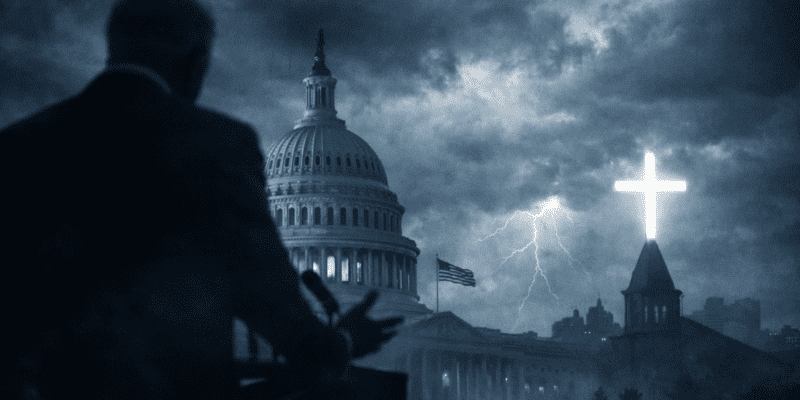
Corrupted times demand that we widen the lens.
One of the most difficult lessons for Christians living in a political age like ours is learning that the spiritual usefulness of an event does not depend on the purity of the person through whom it comes. A politician, even a president, may be vain, ambitious, manipulative, compromised, or driven by motives known only to himself and those who control him, and yet God may still permit that politician, and the disorder surrounding him, to become a most sweet occasion of grace for those who sincerely seek him.
That is not because the politician is righteous.
It is because God is sovereign and the ultimate embodiment of mercy and justice both.
St Paul writes in Romans that “to them that love God, all things work together unto good.” The verse does not say that all things are good, nor does it flatten clear moral distinctions, excuse political corruption, or invite us to sanction the conduct of public men simply because they occasionally throw Christians a bone or because God may use the moment for some larger purpose. Rather, St Paul insists on something more demanding and yet more consoling too—that God is able to cull real good even out of dire circumstances.
The distinction matters.
For Christians, the “good” promised in Romans is not first political victory, social comfort, historical vindication, or even life, liberty, and the pursuit of happiness. Americans might scoff at that, but it’s the truth. “Good” here is sanctification, purification, a deeper conformity to Christ. And oftentimes that involves suffering. Once that becomes clear, the believer is freed from a great many false choices and rescues himself from a great many false dilemmas. He need not decide that a politician is admirable in order to recognize that God may use the politician’s actions, words, exposures, failures, manipulations, concupiscence, vanity or even intentional malice as instruments for the good of those who love him—those who really, truly love him.
Pattern, Politics, and the Operation of Error
The Passion we remember this week itself provides the clearest pattern. The men who moved against Our Lord did not cease to be responsible moral agents simply because Providence stood above them. They still had free will. The priests still plotted. Judas still betrayed. Pilate still yielded. The crowd still cried out in defense of Barabbas. None of them were excused, and none of their actions became good in themselves. What St Paul’s words say is that their wickedness did not escape the rule of God. It was permitted, bounded, and mysteriously taken up into a design far greater than any of them could understand.
The Cross remains the great proof that God is not defeated by the evil he alone permits.
Indeed, the Cross shows something even more, perhaps, troubling, for some: that the worst moral evil in history—the rejection and killing of the Son of God—became, by divine wisdom, the occasion of the world’s redemption. This does not make the evil less evil or even remotely forgivable. It simply makes God Almighty more awesome.
This fact has real consequences for the way Christians should think about political life.
Too often, believers are tempted into one of two errors—which ultimately form the false dilemma or binary trap we so often explore here. The first is naive trust: the hope that this or that public figure will finally embody the clarity, courage, or moral steadiness so often absent in public affairs. The second is a kind of brittle cynicism: the assumption that if the figure is compromised, then nothing spiritually useful can come of the situation at all.
Donald Trump, of course, is the perfect illustration of this, a real lightning rod for everything we are presenting here today.
The fact is that both errors grant too much to the politician. Both assume that the decisive meaning of events rests finally in the man on the stage, in the main character of the narrative.
It does not. Christians know that in theory, but it proves difficult to live.
There is another danger as well, and it is more common than many would like to admit. Politics can become a replacement religion—one that well-meaning people co-opt into their version of Christianity. Slogans become creeds greater than the ones established in Church Councils. Media rituals become liturgies in which we worship. Candidates become redeemers we swear are implementing the teachings of Christ himself. And once that inversion is concretized, as it has been in America, judgment is often found not only in what a people chooses, but in what God permits them to become through their choosing.
Read that again—what God permits them to become through their own choosing.
RELATED: Minneapolis, the ‘Revelation of the Method’, and a Potentially Good Psyop
A February piece including the teaching of Pope Leo XIII on America should provide authority behind the warning. Here is a piece of it:
Prophet personalities are all around us, both in the present and the past. And long before iPhones, Pope Leo XIII warned Catholics not to treat the American arrangement as the ideal model for the Church’s life in the modern world. In Testem Benevolentiae Nostrae (1899), he cautioned that the “spirit of the age” would not merely pressure Christians to relax discipline, but to soften doctrine itself under the pretext of attracting modern man….
“The underlying principle of these new opinions is that, in order to more easily attract those who differ from her, the Church should shape her teachings more in accord with the spirit of the age and relax some of her ancient severity and make some concessions to new opinions. Many think that these concessions should be made not only in regard to ways of living, but even in regard to doctrines which belong to the deposit of the faith. They contend that it would be opportune, in order to gain those who differ from us, to omit certain points of her teaching which are of lesser importance, and to tone down the meaning which the Church has always attached to them. It does not need many words, beloved son, to prove the falsity of these ideas if the nature and origin of the doctrine which the Church proposes are recalled to mind….
[We] are not able to give approval to those views which, in their collective sense, are called by some “Americanism.” …For it would give rise to the suspicion that there are among you some who conceive and would have the Church in America to be different from what it is in the rest of the world.”
Some in Leo’s time dismissed Americanism as a “phantom heresy.” That is the truth, and that is precisely the danger.
The physics of American politics feels like freedom, but is actually a slow sleeper-hold not unlike the fake and embarrassing move made popular in the wrestling ring. Self-propping good Christians don’t recognize the sleeper, because the State isn’t openly hostile, so we assume the terrain is safe and we can do our thing worship-wise and others can do theirs. We confuse the lack of persecution the very saints we honor endured with the presence of order, which directly contradicts what Christ said about the necessity of the Cross. We mistake peace, house, boats, trucks, and accolades for the only blessings worth posting.
Leo’s warning collides with the language of St Paul elsewhere in a most disarming way. In Romans 1, St Paul writes that God “gave them up” to the desires they had insisted on serving. In 2 Thessalonians, he speaks of an “operation of error” permitted upon those who refuse the love of truth. In both cases, judgment comes not only as punishment imposed from outside, but as a kind of terrible permission—to follow our free will, to go along our own sinful way. Men demand idols, and when that idol is not God, we are allowed by that very God to choke on them. We prefer illusion and images over reality, and thus we are handed over to the logic that makes sense only inside the world of illusion. We insist on worshipping power, tribe, pleasure, or self, and God allows the spiritual consequences of that worship to ripen.
He allows us to fail specifically because we’re too spiritually numb to see it when we’re mired in lukewarmth, and so he allows the rock bottom to break us back to him.
That is not merely an ancient pattern or a Biblical moral understanding.
It is a political one in the here and now.
Final Words
When a people makes politics ultimate, they should not be surprised when public life becomes more theatrical, more deceptive, more punitive, more irrational, and more enslaving. If men will not receive truth as truth, they will eventually receive spectacle in its place. We will not have God, so we will be given over to our substitutes. Everything coming through that electronic screen is treated as gospel.
Substitutes never stay the path of truth. What begins as enthusiasm hardens into delusion—despite the facts. What begins as tribal loyalty decays into moral blindness—despite the facts. What begins as political hope becomes a parody of religion, complete with its own sacraments of outrage and absolutions for one’s own side.
Despite the facts.
That is one way to understand public corruption without sentimentalism and without despair. God may permit a manipulative ruler not only as a trial for the faithful, but also as a chastisement for a people increasingly determined to seek in politics what can only be found in God. A society that wants saviors in suits will eventually be ruled by men who know how to dress the part.
A corrupt or manipulative politician, then, may still become useful to the Christian, though not in the way the world imagines. He may become useful as a revealer. He may expose our own appetite for saviors who are not Christ. He may uncover our willingness to excuse grave defects when they come clothed in the language of our preferred tribe. He may force us to ask whether our peace rests in God and eternal life, or in the management and safety of this one. He may, by his very instability, by the very Providence of God, teach us again the absurdity of building too much on the shoulders of men.
Advertisement
Advertisement
