
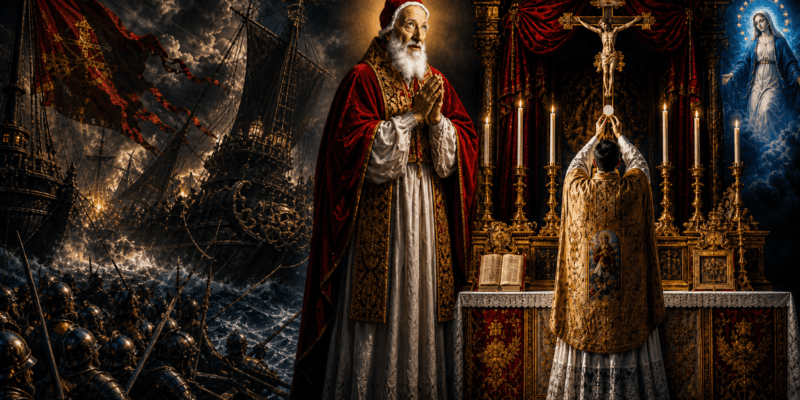
Today, on the feast of Pope St Pius V, the Church remembers a pope whose legacy was directly responsible for the restoration of age-old truths and practices inside Catholicism.
He was a reforming pope, a seeming throwback, a man formed in the long shadow of Paul IV and the catastrophe of the Protestant Revolution. For Pius, reform was an act of recovery. Christendom was already bleeding, and he meant to stop it—after so many saints, popes, and martyrs had preserved it for centuries.
Nowhere is that more obvious than at the altar and the Mass.
The Altar and the Catholic Inheritance
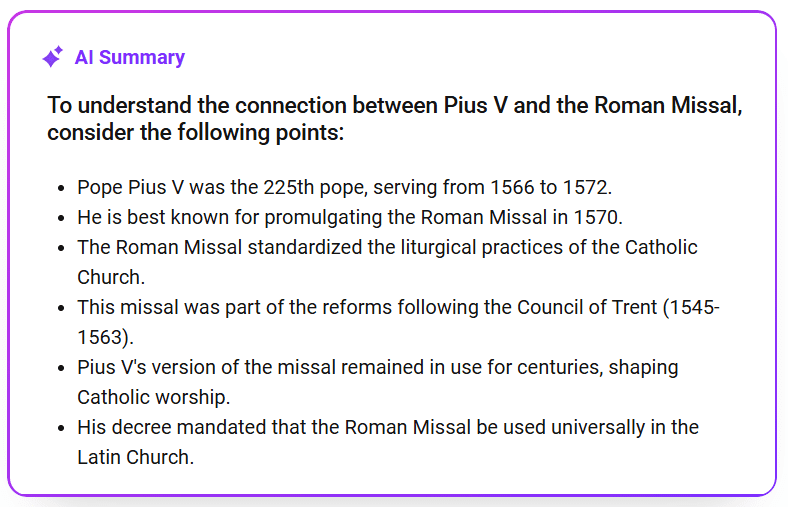
Pius V is perhaps most remembered for Quo Primum, the 1570 apostolic constitution by which he promulgated the Roman Missal after the Council of Trent, establishing it as the standard liturgical text for the Latin Church, mandating its use in all Masses with only very specific, reasonable, and codified exceptions.
So many go here, so here’s a quick snapshot of what you might find:
Religious rupture had already destabilized Catholic worship. Pius taught that the Mass, the altar, was the place where the Church forms souls. A scattered flock cannot long remain strong if the Church’s liturgical worship becomes scattered too, or even obliterated.
I’ve read much of this book:

Pius V’s instinct was a Biblical one, going well beyond the “Traditional Catholic” label made cliche by today’s Trad Inc podcasters. The Book of Jeremias is filled with God’s anger toward shepherds who scatter the flock, prophets who speak falsely in His name, and priests who profane what they were ordained to guard. Such profanity would result in their punitive exile to Babylon, a historical development we are still suffering from today.
Jeremias is not alone. Read the Pentateuch in order and you will see the exactness of the mind of God: images of sacrifice, priesthood, vessels, vestments, blood, fire, offering, purification, obedience—and so much more we don’t even consider today. The Old Testament rites prepared the raw material of the future Mass—recognized by the Apostles and first disciples who had lived by Old Testament Law before Christ—and they teach a lesson the modern Catholic soul can so easily forget: God has never demanded worship as an aesthetic preference of the priest, or as an opportunity to present something fresh and fun so the people will stay interested.
When ordained shepherds and consecrated hands corrupt liturgical worship and lead souls astray, God doesn’t just shrug His shoulders and change to fit the times. He speaks in thunder, and we are already hearing certain rumblings in the sky because of what they and we have done.
By itself that makes Pius V sound closer to Nicholas II and Paul IV than to the churchmen of our own deranged therapeutic age, because the very thing he resisted—worship reduced to what amounts to a first cousin to Modernism—is precisely the kind of sentimental drift that has disfigured so much of the Church in our own time.
Nicholas II guarded the Church against simony and political corruption; Paul IV guarded her against similar corruption, compromise, and the danger of false shepherds; Pius V guarded her worship because he knew that once the Christianity—and in this example the Mass—becomes a free-for-all, once it turns into an exercise in sacred feng shui, everything else will collapse.
The modern Church’s rejection of Pius V tells us what it would likely do to Nicholas II or Paul IV.
Christ told us to judge the fruit, and the last seventy years have given us enough to taste.
Some “Old Catholics” go back even further than that.
This is why, for Catholics who have been forced by the crisis to ask terrible questions no Catholic should want to ask, the hope surrounding one Pope Hildebrand is not some abstract curiosity, tribal chess match as it may seem in the world of strict politics. It is bound up with the altar itself. If Hildebrand is, in fact, the true pope, then the hope is not merely that a hidden claimant will emerge safe and unscathed from those who would certainly want him “removed.” A deeper hope is that the Church would be brought back to the simple sanity Pius V is guarding in Quo Primum: the Mass and the Missal, the old discipline, the old clarity, the old understanding that worship is received and offered back up through Christ’s eternal sacrifice and through consecrated hands only, not managed by laymen as a performance to be complimented or an opportunity to be seen by the crowd.
The Missal Pius V gave to the Latin Church wasn’t something shiny and new. It was a guard, an inheritance. The action he took was heroic, because a Church that forgets how to worship will also lose the will to fight, to fight the way Catholics have always fought when they’re in trouble—with doctrine, penance, sacrifice, and prayer.
That is where Lepanto—and Christ’s Blessed Mother—come in.
The Rosary and the Right Gaze
In this hoped-for restoration by a hoped-for Catholic pope, perhaps Hildebrand, one may also pray that the recent assault by Mater populi fidelis upon long-loved Marian teaching would be undone, by clearly teaching that Mary is only Mary for Catholics because of Christ—because of God. We pray for a Catholic pope who will restore the Catholic treasure that places Our Lady beside and beneath her Son.
Mary is not a rival to Christ.
She is the one who teaches the Church how to keep looking at Him, and how to do it with more and more adoration—since she herself was graced to do it for thirty years.
Think about that, how beautiful.
The same pope who guarded the Mass is also remembered for the Battle of Lepanto in 1571, when the Ottoman threat pressed hard against Christian Europe and the Holy League sailed into waters that were not merely military, but spiritual. Pius V called the faithful to pray the Rosary as the weapon of intercession.
The prayer in unison called down the thunder from Heaven by which Christendom would be preserved against the Ottoman force.
October 7 has its own special place for Catholics, both historically and in the Feast of the Holy Rosary, in thanksgiving to God and Our Lady of Victory’s maternal intercession. The Rosary, in other words, transcends Marian sentimentality, transcends the vague jingle wrapped in vain repetition. In its traditional form, the fifteen mysteries are a school of Christ, the “Bible on Beads,” as it is affectionately called by some.
The Joyful Mysteries contemplate His Incarnation and hidden life.
The Sorrowful Mysteries bring the soul before His Passion and Sacrifice.
The Glorious Mysteries lift the mind to His Resurrection, Ascension, and heavenly reign.
Pius V recognized this most magnificent prayer as the path to victory.
Mary’s instruction is already present in the Magnificat, that all-telling passage in the Gospel of Luke, where Our Lady does not magnify herself, but God: “My soul doth magnify the Lord. And my spirit hath rejoiced in God my Saviour.” Mary’s song is the hymn of a creature so full of grace that everything in her becomes transparent to God. It is also, as anyone praying the Divine Office begins to notice, deeply Psalmic. Our Lady rejoices in His mercy, His strength, His holiness, His overthrow of the proud, His lifting up of the humble, His feeding of the hungry, and His fidelity to Israel—whom she embodies with a most pivotal “yes” after centuries of catastrophic “no’s.”
Mary is the antitype not only of Eve, but of Israel. She proclaims what the Chosen People should have sung all along. The more often I read the Magnificat, and pray it again, and then keep praying it, the clearer this Marian paradox becomes, including its implications for those who identify the modern State of Israel with the Israel of the Old Testament.
The more deeply Catholic devotion honors Mary, the more fiercely it is ordered toward Christ, turning Israel and now the whole Church outward and upward toward the Lord who “hath regarded the humility of his handmaid.”
It is why the Rosary belongs so inherently beside the altar of the Mass. The Mass makes present the one eternal Sacrifice of Christ; the Rosary trains the heart to contemplate His life, death, and triumph as soul-level preparation. One is the sacramental re-presentation of Calvary; the other is the meditative procession through the mysteries that lead to Calvary and flow from it. And in both, the Catholic soul is being reoriented—through the senses, through habit, through the deeper discipline of natural law. The gaze is fixed away from self, away from Modernism, away from the spectacle of the age, and toward Our Lord.
It is our own Magnificat, feeble as it may be, following in her footsteps.
It is also the spirit behind ad orientem worship. The priest and the people face together toward God, because the point is not the personality of the priest or the emotional pulse of the room. The point is Christ.
And once that orientation is recovered, the deeper Marian logic begins to come into focus. Mary is not simply a figure at the beginning of the Gospel story, remembered tenderly in December and then left behind as the “real mission” begins. She is included, by God’s good design, inside the story of Christ’s coming, because God chose to enter the world through her humility, her consent, her hiddenness, and her obedience. If the first coming of Christ was not detached from Mary, then one might wonder whether His final coming will also bear the mark of her maternal mission.
St Louis de Montfort and True Devotion to Our Lady
St Louis de Montfort gives the Church a profound way to understand the beautiful order of God. If Christ came the first time through Mary in mercy, it is fitting to consider that, when He comes again in judgment, His triumph will also be preceded by her. God is not random. Read the Bible in order and not just thematically, and you’ll see it. He closes circles. He writes with an order that feels almost mathematical. He delights in patterns that reveal His providence without reducing it to a cold hard equation.
He does this to build fortified expectation inside us. It is one more reason modern randomness is not merely ugly. It is un-Catholic.
Catholics face east at Mass waiting for the Lord who came once and will come again. The first Advent came through Our Lady’s hidden humility; the final Advent may well be heralded by her maternal triumph, because she prepares His children as any good mother does to meet Him.
It is why Lepanto belongs with Quo Primum in this discussion and celebration of Pius V. The pope who guarded the altar also called for the people to pray. He knew that Catholic civilization is defended by more than military strategy alone, but by worship rightly ordered, doctrine clearly guarded, and prayer offered with confidence to God through His queen.
When victory came, Pius V credited Our Lady.
Modern man may scoff at that. Catholic man should not.
Final Words
Pius V saw what we often forget—history is moved by grace, judgment, sin, repentance, sacrifice, and prayer. Lepanto was fought in the physical realm, yes, with ships, banners, oars, and blood. But it was also fought bead by bead by a faithful who understood that God did not will Christendom to be defended by ships alone.
On this feast, then, we remember a pope of clarity.
A pope of the Mass.
A pope of the Rosary.
And maybe that is the lesson we need most: When the Mass is guarded, when the Rosary is prayed, and when Our Lady is honored in the right order, Catholics remember how to live.
—
I provided no hot links to previous articles that will offer context to difficult concepts, as I have done in the past. If interested, simply click on my author name at the top of this article for recent work.
Advertisement
Advertisement
