
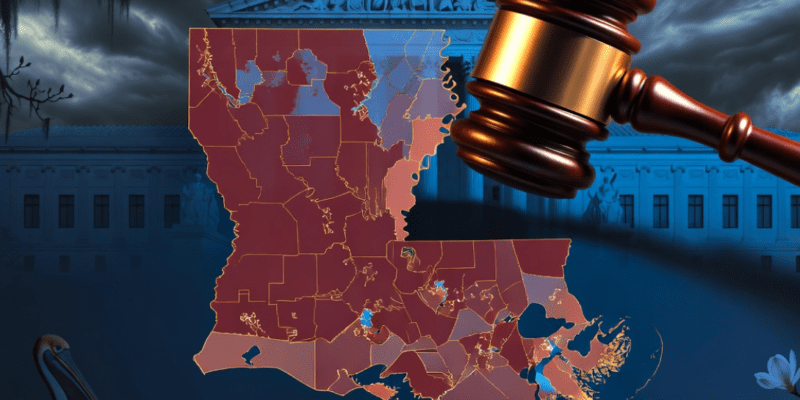
If you are reading this during the first weekend of May, chances are that, right this very second, certain elected officials of Louisiana government and their staff or contractors are huddled up, trying to get an already-delayed set of congressional elections pushed back further while putting together a new congressional map that stays one step ahead of opponents and remains congruent with the law and the U.S. Constitution.
In the wake of last week’s U.S. Supreme Court decision that ratified a lower court panel ruling declaring the state’s latest version of the map unconstitutional, Republican Gov. Jeff Landry issued an executive order declaring a state of emergency, as allowed by statute. Also by statute, GOP Sec. of State Nancy Landry certified the contents of the order, and thus early next week the House and Governmental Affairs Committee and the Senate and Governmental Affairs Committee will convene jointly and almost certainly approve that certification, with the governor’s agreement.
The current map contains two majority-minority (M/M) districts out of six, but the decision likely makes it impossible to draw one with that many. As two Democrats hold those seats and Republicans are highly likely to win any districts that are not M/M, the left has gone ballistic over this turn of events and will try anything to stop the GOP pickup of a seat. As things stand, it cannot do so through any legal maneuvering. Louisiana’s Constitution and its statutes do not define an “emergency,” and it can be argued that, under powers to ensure the “integrity” of elections, an emergency use may justify implementing these procedures.
The next step would be a rapid passage of a new map, which is where things could get trickier. Already, bills sit in both legislative chambers that would produce a 5-1 map, but they have to be double-checked and potentially adjusted in light of the decision. That’s going on as noted above, but it should not be too difficult (for example, this or this easily could be a starting point with little or no alteration).
The thing is, it would have to be fast. Assuming new districts mean new slates of candidates filing, under state law for closed primaries, filing for a party primary has to occur three months in advance of the election, although this could be adjusted on a one-time basis. But the law also provides for petitioning that opens before this, by several months, which also could be adjusted. And, as there is to be a primary election runoff, that legally happens six weeks later, although that as well could be shortened a bit (but not much, given administrative deadlines).
The order intends for the general election to occur at the regularly-scheduled Nov. 3 date, which because of federal law thereby sets a deadline for the runoff around the second Saturday in September and the primary itself in very early August. That means to adhere to current law means qualifying by fee would start in early May and leave no time for petitioning.
This leaves two options: either make major adjustments to qualifying by shortening both periods – several states leave two months for qualifying by fee and filing by petition could tack on another month – or make relatively minor adjustments by scrapping the closed in favor of a blanket primary as has been the case over the past half-century except for 2008 and 2010. Having a blanket primary contested on Nov. 3 would require only a minor shortening of the petitioning process, but would alter the dynamics of the contests, not really in giving Democrats a chance to win outside of the M/M district but in which Republican candidates might do better or worse.
Leaving sufficient time for these activities is paramount, because failing to do so would be the easiest way for leftists to challenge a new map by way of the Purcell Principle, which the Court has adopted. That principle dictates that election administration changes made too close to the election date create too much confusion and may be enjoined if challenged. If given the chance, leftists will ask the Court essentially to salvage the unconstitutional map.
Had the Court decided a month ago, perhaps no changes would have had to be made (rumor has it that a Democrat appointee slow-walked the decision, hoping to prevent some states from using the ruling—although others already had plans in the works, some even already executed. As long as Louisiana’s case remained undecided, the Court would not allow the judiciary to entertain challenges to those maps, which are now validated). Yet a carefully considered plan and targeted legal changes can allow Louisiana to contest with a 5–1 map.
It’s all legal and constitutional. And if the left doesn’t like that, then it can adopt an agenda that will win elections that would give it majorities in the Legislature and officeholders on the Capitol’s fourth floor and on Archives Avenue that wouldn’t be making the attempt to change the rules just under the wire.
Advertisement
Advertisement
