
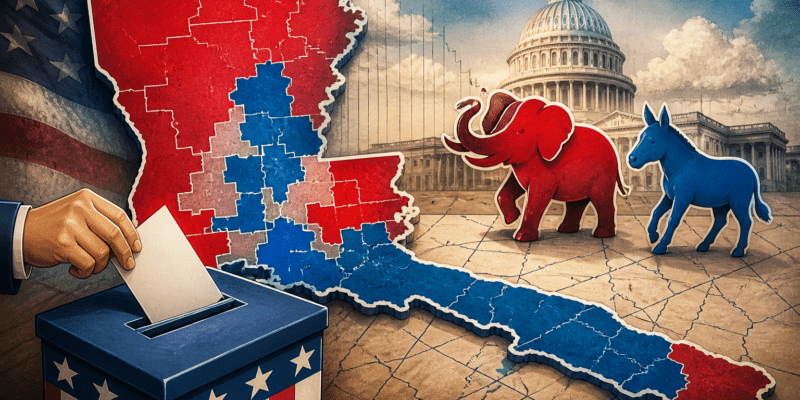
Republican candidates for Louisiana’s Fifth Congressional District, perhaps appropriately given the job for which they are auditioning (at least as it stands now), had to hop around its elongated boundaries last week in about 24 hours to participate in a couple of forums, which perhaps turned more on presentations of competence and knowledge than on policy.
Thursday before last, all seven, including the main four – Board of Regents head Misti Cordell, state Rep. Mike Echols, and state Sens. Rick Edmonds and Blake Miguez – appeared at one sponsored by Livingston Parish GOP women’s clubs. Last Friday, all but Edmonds, who is from the southern terminus in Baton Rouge and begged off because of dealing with the shooting tragedy there, participated in another sponsored by Monroe’s public radio station KEDM, the University of Louisiana Monroe, and two local chambers of commerce. Cordell and Echols are from Monroe, while Miguez is domiciled outside the district about 75 miles south of it.
Edmonds might have used the opportunity, as the only independent poll to date of the contest has him behind second-place Echols by ten points, who trails leader Miguez by three, and Cordell is way back in single digits. However, almost half of respondents didn’t name a preference, leaving plenty of opportunity for candidates to collect voters through performance in settings like these.
Listening to the field, one could ascertain that they had little in the way of ideological divergence from consistent conservatism, so they leaned into experience to demonstrate themselves as quality potential congressmen. The three legislators made reference to bills they had helped sponsor and/or pass, and Echols and Miguez added information about their business experience. Cordell, who ran one in her past, added her experience in appointive government posts.
As it was, referring to accomplishments in government perhaps came a little too freely, because the questions often muddied the waters between what a member of Congress could do and what are state and local responsibilities. Echols and Miguez did the most to infuse their answers not only with how federal government policy could affect the various issue areas but with specifics about those policies.
Two other differentiating factors came up, although subtly. Miguez made sure at each forum to throw in a couple of reminders that he carried the endorsement of Republican Pres. Donald Trump, while others also emphasized that they were long-time residents of the district—a dig at Miguez’s alienation from it that Echols, in campaign literature, says makes Miguez a “carpetbagger.”
Fine distinctions were made on a very few issues. On flood control, Echols pointed more toward reform of the current federal flood insurance risk rating system that he said inappropriately raised Louisianans’ rates while Miguez emphasized guiding federal dollars to the district for more spending on infrastructure. They also advocated for more innovative uses of existing federal dollars to sustain rural hospitals while Edmonds called for more spending on Medicaid reimbursements and Cordell tied the issue to insurance reform.
Echols and Edmonds called for ditching federal tax credits that encouraged carbon capture and sequestration, a position about which Cordell and Miguez stopped short of articulating. Echols also suggested allowing Social Security trust dollars to be invested in the market as a solution to a looming shortfall, while Miguez focused on eliminating fraud, although that seems unlikely to be the only solution needed, and Edmonds stumped for balancing the federal budget, which is unrelated to the trust fund.
As for the three minor candidates who have never held state elective or appointive office, Michael Mebrauer articulated the most considered conservatism, while Austin Magee’s conservatism seemed more instinctual. The least impressive of all at the forums was Sammy Wyatt, who didn’t come off as much more than a one-trick pony who kept steering answers toward blaming experienced politicians at troughs.
Without much daylight among the GOP hopefuls on the issues, party voters may choose the nominee mainly on assessments of how forcefully and skillfully that person can carry his or her stated agenda in Washington and connection to the crazily cobbled-together district.
Advertisement
Advertisement
