
Yesterday we explored how doctrinal warfare functions by narrowing populations into controlled binaries. Here is an outline for convenience’s sake:
- Doctrinal warfare (as we’ve written on before)
- Triangulation (brand new concept, and attached to the old—the binary trap)
- Approved opposition (as we wrote on extensively in 2025 in the way of Con Inc)
- Algorithmic steering (as we’ve been focusing on directly since September 2025)
- The modern “acceptable conspiracy theory” (relatively new but touched on before)
Today we apply that framework directly to the curious emergence of the Pope Hildebrand question itself.
Also for convenience’s sake, because we know how large this topic is, we provide a roadmap for today’s Part II:
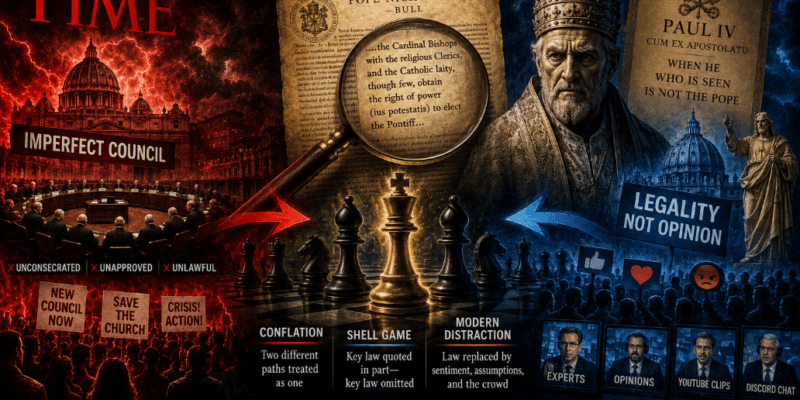
- Conflation of two fringe Catholic stories
- The shell game with an ancient papal bull by Nicholas II
- Paul IV on when the pope we see is not the pope
- Cold legality vs Modernist sentiment and assumption
- The law vs the crowd
While we’ve touched on all of these items indirectly over the months, we have direct articles on Nicholas II, Paul IV, and Christ vs Barabbas (law vs crowd) in our archives.
All of that said, we present to you Part II….
Three Distortions
Within the current discussion, three distortions have begun to take shape. Each of them, on its own, can be explained. Together, they form a pattern that is difficult to ignore.
Distortion 1: The Conflation of Hildebrand with the “Imperfect Council”
There are, at present, at least two distinct lines of thought emerging that are completely divergent from your run-of-the-mill squabbles involving the Novus Ordo, various traditional groups in line with Leo XIV, the SSPX (1 and 2), and any of the different faces of sedevacantism. Know just that much, and you can understand why so many Catholics will be duped—within that list is enough potential binaries for anyone to get their head spinning and their emotions exhausted.
Surely one of these camps is for me, one might think.
But two outliers have emerged, with the one (more popular despite only materializing proper in April) bringing the other older one into the light in a most curious way. The latter, the one much less known, concerns the claim—however controversial—that a man has already been elected under the name Hildebrand, and that it occurred in November of 2025. The other, representing the April 10 report, concerns the proposal to convene an imperfect council in order to determine the status of the Apostolic See and potentially elect a pope.
One of these concerns an alleged act that has already taken place. The other concerns a proposed process that has yet to occur. One seems to stand pretty solidly on legal ground, that necessary legal conditions were met. The other attempts to justify the creation of a new mechanism that is not even legal but acceptable because of extraordinary circumstances.
And yet, these two are being treated as though they belong together, as though they represent variations of the same illegal impulse. Already you see users reading on these topics assuming the two threads are the same. It isn’t a bad guess that this is part of the mind control, particularly if Hildebrand is in fact the real deal and the enemy fears losing control of the plot.
Regardless of my theories, that is the first distortion, and it is happening in real time online as we speak—a false conflation of two diametrically opposite possibilities.
By conflating the two, both are weakened—with the precise intent to weaken and destroy only the true one. The more structured, legal question is absorbed into the more speculative, conspiratorial, seemingly schismatic one. The schismatic one is given a veneer of structure to imply late night prayer vigils as preparation for such a move, while the idea that there is already a legitimate pope—but one who has not been consecrated and won’t reveal himself yet—is absurd and bordering on insane.
Do you see the binary trap potentially being contrived here? If Hildebrand is in fact the rightful claimant to the Chair of St Peter and the powers that be are concerned about itchy, rebellious Catholics discovering the truth, it is absolutely part of the program to inject an alternative story into the bloodstream in order to keep people off the scent.
If you’ve ever known a narcissist, you know the play exactly. The narcissist never allows the victim to circle back around to the actual issue at hand and the crime.
And in this case, the legal question and a potentially rightful claim based on law is never allowed to fully separate itself from the schismatic noise of some “imperfect council.”
Thus both are treated as noise, and both go down in flames.
Distortion 2: The Shell Game with Nicholas II
If there is a single document that should anchor any serious discussion of papal legitimacy under conditions of crisis, it is the bull In Nomine Domini of Pope Nicholas II.
This is not a matter of opinion or personality preference as some will invariably assume. It is a matter of law. And yet, rather than being placed at the center of the discussion as common sense says it should, something else transpired entirely.
In a recent video, at the 12:32-mark, Bishop Sanborn mentioned that he had received an invitation to the proposed “imperfect council” scheduled for Argentina in December of 2026. During the discussion, the topic of Hildebrand also emerged, with Sanborn dismissing outright the idea that anyone outside the college of cardinals could possess the right to elect a pope. The claim was treated not merely as wrong, but as “absurd.”
That response only works if Pope Nicholas II’s eleventh century bull In Nomine Domini is either ignored, misunderstood, or quietly brushed aside altogether— because Nicholas II explicitly addresses extraordinary circumstances involving corruption and invalid elections surrounding the Roman Pontiff, even granting the right of election under certain crisis conditions to “religious clerics and Catholic laity, though few” when the normal mechanisms of Rome have been compromised—including if the college forfeits their right.
In other words, there is actual papal law here. Real law. Not internet theorizing, not mere emotional reaction to the modern crisis while comparing Taylor Marshall to Pints with Aquinas.
And that is where our radar is triggered.
Note how the conversation unfolded—the legal question itself was never seriously examined. No sustained attention was given to Nicholas II. No effort was made to walk listeners carefully through the text. Instead, the entire matter was quickly folded into the broader and more chaotic discussion surrounding the “imperfect council,” as though the two ideas were naturally related.
One of my own questions concerning Nicholas II and Hildebrand was whether some later law existed that superseded the eleventh-century bull. That uncertainty was one reason I’ve hesitated for so long with the subject itself.
But I never called it “absurd.” It is not at all that, even if it is wrong. There is real papal precedence here.
But Sanborn does not present a competing law at all. Instead, he, whether intentionally or not, plays a shell game with Nicholas II’s—certain to pull the wool over most Catholics who won’t read the brief document for themselves and have been trained to trust the screen. In fact, this entire council idea is advocacy for the option of breaking the law in order to save the Church, where Nicholas II provides an easy, clear, legal way out.
Here is the part Sanborn references:
§ 1. Wherefore, if it please thy Brotherhood, We ought, with God assisting, take care prudently for future cases and this by Ecclesiastical statute, provide in the hereafter that (these) evils, revived, not prevail. On which account, having been instructed by Our predecessor and by the authority of the other Holy Fathers, We decree, and establish, that with the passing of the Pontiff of this universal Roman Church, first of all, the Cardinal Bishops, treating (the election) together with the most diligent consideration, summon immediately the Cardinal Clerics to themselves; and in this manner let the rest of the Clergy, and the People, approach to consent to the new election, so that, lest the deadly disease of venality insinuate itself by occasion, the most religious men be the chief leaders in the election of the Pontiff to be promoted, but the rest be their followers.
And here is the part he excludes:
§ 3. Wherefore, if the perversity of depraved and iniquitous men, so prevail, that a pure, sincere and free election cannot be held in the City, let the Cardinal Bishops with the religious Clerics, and the Catholic laity, though few, obtain the right of power (ius potestatis) to elect the Pontiff of the Apostolic See, where they might judge it to be more fitting. Plainly, after the election has been completed, if there be a bellicose conflict, and/or if the struggle of any kind of men resists by the earnestness of wickedness, such that he, who has been elected, cannot prevail to be enthroned in the Apostolic See according to the custom, nevertheless, let the elect obtain as Pope the authority to rule the Roman Church and to dispose of all Her faculties, which Blessed Gregory, We know, did, before his own consecration.
Be especially clear that “Roman Church” here is not the Roman Catholic Church, but the more provincial Church of Rome. Also be clear that the “Cardinal Bishops” mentioned here had, according to the Hildebrand contention, forfeited their right to elect a new pope, thus passing the responsibility and right on to the rest.
The questions asked in the interview, and the way they were answered, beg us to ask some questions. Why did they not first discuss who Hildebrand is and how he was elected? They speak about him as if they know all about him but never explain who he is. And why does the interviewer lump the imperfect council with the election of Hildebrand? Shouldn’t they have done some research and provided it before deciding for their trusting viewers whether Hildebrand has a legitimate claim to the papacy?
Instead, we see the form of rejection that evades any of these organic questions. It is the form of rejection played cunningly by the narcissist as well. It is the form of rejection that is an absolute tell as one studies the tactics of the manipulator more and more.
The moment Nicholas II is allowed to speak clearly and in full, then, the entire conversation changes. The concept of narrative warfare on the Catholic mind emerges. The question is no longer what solution seems reasonable to the most people, nor what path appears viable to cause as few tremors as possible.
The question is simply on the law.
Here another pope becomes unavoidable, Paul IV, because he takes Nicholas II’s juridical foundation and applies it directly to the real-world inevitability of a false claimant occupying the papacy. In Cum ex Apostolatus Officio, written in the wake of the Protestant Revolution and the chaos it unleashed inside Christendom, Paul IV explicitly warns that even a universally recognized Roman Pontiff may in fact be “null, invalid, and void” if a prior defect from the Faith existed before his elevation. Most striking of all is that Paul IV specifically denies that such a defect can be healed “through the obedience accorded him by all, or through any lapse of time.” In other words, visibility, consensus, peaceful acceptance, the mere passage of years, or a totally-not-contrived online squabble with Trump do not create legitimacy where legitimacy was absent from the start. That is not the opinion of a blogger or a fringe internet personality. That is the language of a pope piggy-backing on top of another to legislate against exactly the sort of cognitive captivity modern Catholics have been trained to believe impossible.
Nicholas II and Paul IV create a robust legal framework. The question becomes, then, once again, as basic as it gets: What does the Church’s own law require?
And if there is no other law as I’ve been seeking, and all Sanborn can do is mock a claimant based on an apparent strawman of an official papal bull, then does that indeed suggest that Hildebrand and Church unity are the very thing the enemy is trying to destroy?
What does the Church’s own law require?
Despite the simplicity, and despite millions of Catholics’ call to law and order in the political world, it is a question that will not be acceptable even to the most well-meaning of them. It does not yield to the sentiments and comforts of Modernism. It is not as comfortable as the cave. It does not bend to what everybody thinks on Facebook. It is not even on Facebook in the first place.
Truth is truth, though. It demands to be answered on its own terms—on its own legal terms. Those terms are inconvenient, indeed, and the patterns suggest that they could be dangerous to the bad-willed.
MORE ON NICHOLAS II AND PAUL IV
Nicholas II & the Papal Election Crisis—When All Appearances Collide with Catholic Law
Paul IV’s Teaching on When the Pope Is Not the Pope
Distortion 3 and Final Words: The Turn to the Crowd
Doctrinal warfare does not always deny the truth outright, but surrounds it with enough noise, novelty, and competing narratives that the average person loses the will to separate one claim from another, thus making the default position held by everyone else feel safer.
That is why I’ve evolved my work here into a sort-of “counter-navigation” strategy.
When simple law becomes terrifyingly difficult, even to people who crave law and order, and when clarity and a solution to the Church crisis threaten to send an earthquake through the Catholic world, another distortion emerges.
The crowd.
Read the report. The language of the Church shifts, notice, away from time-honored authority, but to the absolute anathema warned against by many popes. It becomes a matter of universality, of representation, of gathering voices from around the world. The solution is no longer located in the hierarchical conditions established by the Church, but in the collective will of those who recognize the crisis. In essence, it is democracy.
It is a good guess that if this report gets legs, it will work like a charm on the modern Catholic, who has been programmed into thinking life, liberty, the pursuit of happiness, and the ability to have every and any opinion desired on Facebook are the greatest of all virtues. The will of the people replaces juridical legitimacy, turning the truth into a popularity contest. Participation becomes the authority—the mob—just as it did that day they shouted down Jesus Christ for the life of the criminal Barabbas.
But Catholic truth is not arrived at by consensus.
The Church has never operated on that principle. The election of a pope is not a democratic act. It is a juridical one. It is governed by conditions that do not change simply because those conditions become difficult to satisfy or forgotten or never even learned in the first place.
The appeal to the crowd feels natural because it mirrors the political structures people inhabit. It feels empowering because it offers a role to those who feel excluded. And it feels urgent because it promises action in the face of the modern paralytical crisis.
This April 10 report teases to the apprehensive Catholic that action.
But the bottom line is that it does not answer the question of legality, Nicholas and Paul, and the case for Hildebrand. It avoids it altogether, thus serving up the opinion of the crowd as the only viable solution.
And that may ultimately be the greatest tell of all.
Once legality disappears, only visibility and crowd psychology remain. The crowd is simply herded. The Catholic mind, once grounded in law, hierarchy, and continuity, becomes just another political demographic to be steered by fear and Facebook.
That is precisely why the Hildebrand question matters, regardless of where one finds himself landing on the issue from day to day, the more and more it emerges.
Tomorrow, we turn directly to Hildebrand himself—and to the deeper psychological patterns surrounding the attempt to make certain questions feel “absurd” before Catholics are even allowed the dignity of examining them.
Advertisement
Advertisement
