
As we draw nearer to the day of the States’ 250th anniversary, the scale of the celebrations is growing larger. New announcements about some of the biggest events have rolled out in the press:
‘America250, the non-partisan commission tasked with preparing celebrations for the nation’s 250th, has announced several of the musical acts that will be performing at its “America’s Block Party” concert in Los Angeles.
‘This “Block Party” concert has also been scheduled for July 4 — the same day that Freedom 250, a Trump-backed commission organizing semiquincentennial celebrations of its own, is hosting a “Salute to America” that Trump has described as “the most spectacular TRUMP RALLY of them all.”
‘The two celebrations, however, will be taking place on opposite ends of the country. (The Freedom 250 event is happening in D.C.) The events seem to differ in tone, as well, with Freedom 250’s Salute to America featuring parades, military demonstrations and “patriotic performances,” while America250’s Block Party concert in Los Angeles appears to be more of a benefit show to raise awareness for charitable nonprofit initiatives.
‘Both events will honor our nation’s military and first responders, with America250 giving away 5,000 tickets to first responders, veterans and service members, and Freedom 250 organizing “tributes to service members and American heroes.”
‘Both shows will culminate in fireworks displays. America250’s will also feature a “drone spectacular.”
‘ . . . Other “Block Party” locations on July 4 include: Charleston, South Carolina, where a waterfront celebration will feature local musical acts and fireworks; Fort Campbell, Kentucky, where a Charlie Daniels tribute performance is scheduled to take place; and Milwaukee, Wisconsin, where Jelly Roll is one of the acts scheduled to perform at a celebration sponsored by Harley Davidson.
‘Musical acts scheduled to perform at the Los Angeles Veterans Memorial Coliseum on July 4 include Chris Stapleton, Smashing Pumpkins and Queen Latifah. Queen Latifah is also hosting the event, according to America’s Block Party’ (Michael Bartiromo, ‘America250 is planning its own July 4 concert: Who’s playing?,’ thehill.com).
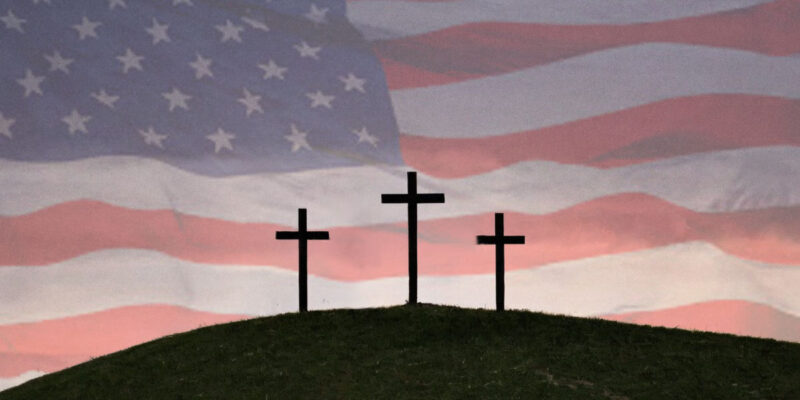
This is a big anniversary; a certain amount of exuberance is expected, but, as is often the case in the public life of the United States, a deep connection to Christianity is absent from these events. We are left with shows that will be big on shallow spectacle but short on any significant spiritual meaning. As a result, the 250th anniversary of our independence risks becoming a marker of hastening decline rather than a restoration and ascent (remembering the words of Christ, that ‘apart from me you can do nothing’, St John’s Gospel 15:5).
The little Christian country of Georgia gives us some hints of how the States could approach their big anniversary. Georgia recently celebrated the 1,700th anniversary of her Christian statehood, and the commemorations looked a lot different from what is being proposed for the US:
‘Orthodox clergy and faithful in central Georgia have completed a five-day prayer pilgrimage commemorating the 1,700th anniversary of Christianity’s proclamation as the state religion of Georgia, marking one of the most significant milestones in the nation’s religious history.
‘The procession began June 15 at the Church of St. George the Great Martyr in Gorijvari, where Metr. Andria of Gori and Ateni celebrated a lesser blessing of water and offered prayers for the participants. He also blessed the pilgrims before they embarked on their journey toward Mount Tkhoti, a site closely associated with the Christianization of Georgia.
‘Over the course of the pilgrimage, clergy and representatives from the dioceses of Gori and Ateni and Samtavisi and Kaspi traveled through numerous communities . . . . Along the route, participants took part in divine liturgies, prayer services, and village blessing ceremonies.
‘The event also drew local government officials . . . . Organizers said the pilgrimage was intended both as a spiritual observance and as a way to commemorate Georgia’s centuries-old Christian heritage’ (Tobias Straney, ‘Georgian Pilgrimage Marks 1,700 Years of Christianity,’ uoj.news).
Granted, there have been and will be Christian observances here and there in the States to commemorate the 250th. But they are not the main focus. Most people will be drawn more towards fireworks, hot dogs, and snow cones for their celebrations than towards hymns, prayers, and the Eucharist.
As we said above, this is unfortunately typical of the United States. Some of the most profound days on the Christian calendar are often ignored, while newfangled civic holidays receive an inordinate amount of attention. June 19th is a perfect example. It is celebrated as Juneteenth on the American calendar (a rather flimsy and dubious holiday, as slavery in the States did not end on June 19, 1865, which is the purported reason for the celebration), but on the Christian calendar it is the Feast Day of the Holy Apostle Jude (also called Thaddaeus or Labbaeus). Thus, the lesser (the holiday given to us by Americanism) attains far more prominence than the greater (the Feast Day of one of the 12 Apostles of Christ given to us by the Church). Should we not prefer Judeteenth to Juneteenth? Yet we do not.
That is tragic, but it is the truth. However, big events can also foster introspection in people as they reflect on the sweep of history, the lives of great men and women, and God’s Providence in the lives of individuals and whole countries. It is a good opportunity, then, for us in the States to consider how we may deepen our connection to Christianity, to look more like Christ-honoring countries like Georgia and less like atheistic, Enlightenment France of the last decade of the 18th century or the technocratic United Kingdom of recent years.
Overcoming our old habits will be difficult, but God will help us, if we sincerely seek Him.
Advertisement
Advertisement
