
Openly socialist candidates are gaining in popularity with Democrat voters. Zohran Mamdani’s election to the mayoralty of New York City helped catalyze this change, and now Democrat socialist candidates are winning elections in places like Seattle, DC, and Los Angeles, with more waiting in the wings (Fortinsky and Mueller, ‘Democratic socialists roar back into spotlight with LA, DC races,’ thehill.com).
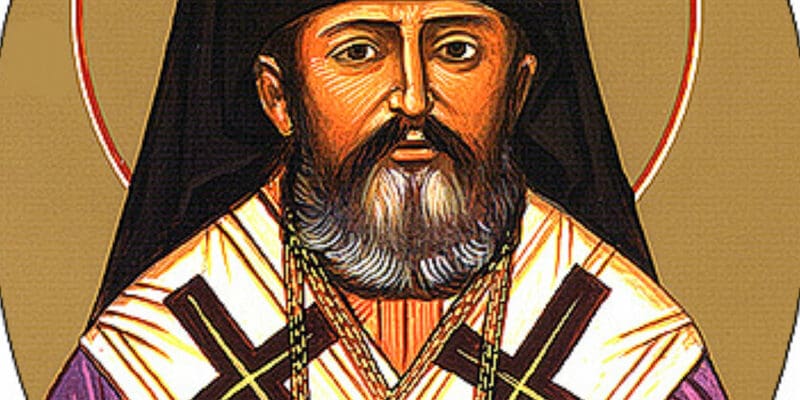
God has providentially provided an answer to this, however, in the person of St Raphael Hawaweeny of Brooklyn (1860-1915), who preceded Mamdani in New York City by more than 100 years. As we shall see, he is the polar opposite of Mayor Mamdani in significant ways.
One of the few ways they are alike is the foreign birth of both of them – Mamdani in Uganda and St Raphael in Syria. But the similarities mostly end there. While Mamdani received a Leftist education in Manhattan (social justice warrior non-sense, etc. – Nick Tabor, ‘Zohran Mamdani,’ britannica.com), St Raphael received his education within the Church in ancient Christian cities such as Damascus and Antioch, eventually becoming a monk, a priest, and then a bishop. The seat of his diocese was in the St Nicholas Cathedral in Brooklyn (‘Repose of Saint Raphael, Bishop of Brooklyn,’ oca.org).
Mamdani spent his younger years stirring up strife between Israelis and Palestinians (Tabor); St Raphael worked tirelessly throughout his life to uplift the Orthodox parishes in North America and in the other places he served, to bring stability and harmony to them (oca.org).
Mamdani, memorably, campaigned on the usual socialist tropes of affordability through redistribution of wealth:
‘“They can’t afford their rent. They can’t afford their childcare. They can’t afford transit. They can’t afford their groceries.” The policy priorities he ran on were freezing rents for tenants of rent-stabilized apartments, making public buses fast and fare-free, and launching a pilot program that would open a city-owned grocery store in each borough’ (Tabor).
It is on this issue, the socialist ideal of forced equality, that St Raphael is a particularly strong opponent for Mamdani. He wrote in the early months of 1907 a series of essays combating the false and harmful teachings of the socialists vis-à-vis their new trinity of liberty, equality, and fraternity – the one on equality being the longest of the three. In it, he disposes rather handily of some of the inconsistencies and errors that are part and parcel of socialist dogma:
-The contradiction between liberty and equality: ‘The meaning of equality is contrary to the meaning of liberty. A sound mind must accept one of two things: either that man is free and therefore able, whenever he wishes to distinguish himself from others in some way, that is, to be unequal to them, or that he must be equal to others in all things and therefore not free to act as he wishes in all things’ (Against Socialism, Uncut Mountain Press, Florence, Ariz., 2026, p. 32).
-The absence of full equality anywhere in nature: ‘ . . . we observe that across all genera, species, and individuals, they are subject to natural laws that are contrary to the principle of strict equality. In other words, we observe that nature does not produce anything, whether a species, type, or individual, that is completely equal to another. Rather, its main law is subordination, interdependence, and the distinction of things from one another in countless forms and differences’ (pgs. 32-3).
-Competition is natural to mankind: ‘The principle of equality is contrary to man’s instinctive tendency toward competition, rivalry, and striving to improve his condition. If we were to impose the impossible and force man to act according to the principle of equality, we would be depriving him of his human rights, which is the pursuit of improvement over his peers, even if only slightly, and thus we would reduce him to the level of dumb animals, without honor or personal freedom’ (p. 33).
-The Holy Scriptures affirm the right to own, use, and sell private property, such as St Luke’s Gospel 18:22 and Acts 5:1-4 (pgs. 38-9).
There are certainly injustices in the world, but they will not be corrected by the atheistic, coercive policies of the socialists like Mamdani, which only stoke hatred and envy between the rich and the poor, the diligent and the lazy. Christianity, as St Raphael emphasizes at the end of his essays on equality, is what will bring about lasting harmony between the various classes and characters of society:
‘ . . . Scriptures teach us that true equality among human beings is not achieved by coercing the freedom of the rich man or the active worker and forcing him to give half of his money and the fruits of his labor to the poor or the lazy, as the socialist leaders claim and desire. Rather, it is achieved by spreading the teachings of the Gospel about Christian acts of mercy, which joins the rich with the poor, the strong with the weak, superiors with subordinates, masters with slaves, and all people with one another through the strongest bonds of love, gratitude, and peace. For those who do good, by their own choice and of their own accord, do so out of love and a desire to alleviate the suffering of their poor or oppressed neighbors. Those who receive kindness cannot help but feel gratitude, appreciation, and love toward those who have shown them goodness. If all people, especially the rich, powerful, and influential, acted according to Christian teachings of voluntary acts of love and mercy, the kingdom of love and peace would reign in the world, and all hatred, envy, and strife would disappear.
‘True happiness, then, does not lie in following the principle of equality according to the doctrine of socialism, but in acting according to the commandments of the Bible regarding Christian acts of love and mercy’ (pgs. 40-1).
St Raphael is a shining example of the love of Christ that he taught others to practice. He literally wore his heart out in his efforts to serve the Christians of North America:
‘Toward the end of 1912, Bishop Raphael became ill while working in his office. Doctors diagnosed him with a heart ailment that eventually caused his death. After two weeks he felt strong enough to celebrate the Liturgy in his cathedral.
‘In 1913-1914 this missionary bishop continued to make pastoral visitations to various cities. In 1915 he fell ill again and spent two months at home, bearing his illness with patience. At 12:40 AM on February 14/27 he rested from his labors. They called him, but he did not answer. They shook him, but he was gone.
‘From his youth, Saint Raphael’s greatest joy was to serve the Church. When he came to America, he found his people scattered abroad, and he called them to unity. He never neglected his flock, but traveled throughout America, Canada, and Mexico in search of them so that he might care for them. . . . During twenty years of faithful ministry he nurtured them and helped them to grow’ (oca.org).
Such is the blessed legacy of a man that will last for generations here on the earth and for eternity in the age to come. As for the socialists like Mamdani, the only memory of them in this world will be of the inglorious suffering and disorder and misery that they caused, and torment for themselves and for the followers whom they deceived in the next life.
The socialists have their operational guidebooks such as Rules for Radicals by Saul Alinsky. Now Christians have one of their own in St Raphael’s Against Socialism from Uncut Mountain Press to counter the socialist agitation. Let us make abundant use of it.
‘History is the greatest witness to the inability to function according to them [socialist principles]’ (St Raphael, Against Socialism, p. 18).
Advertisement
Advertisement
