

“I don’t know how fast it’s going to happen, but we’re going to win a national championship. We’re going to have the teams and the rosters back to the way they were playing when they were great. I don’t know how fast. It might not be today, but it’s going to happen.”
-Lane Kiffin, “In the Bayou with Tyrann Mathieu”
The Tigers’ recent recruiting raze is not as meaningless as even the pessimist inside me wants to think, but it is also not a reason to assume the fax machine just spit out a national title.
In yesterday’s piece, the point was that LSU’s new cutting-edge football front office was not just window dressing to the same old program dynamics. It was LSU owning what it and college football have long become: a professional roster-management operation still moving under the façade of college athletics.
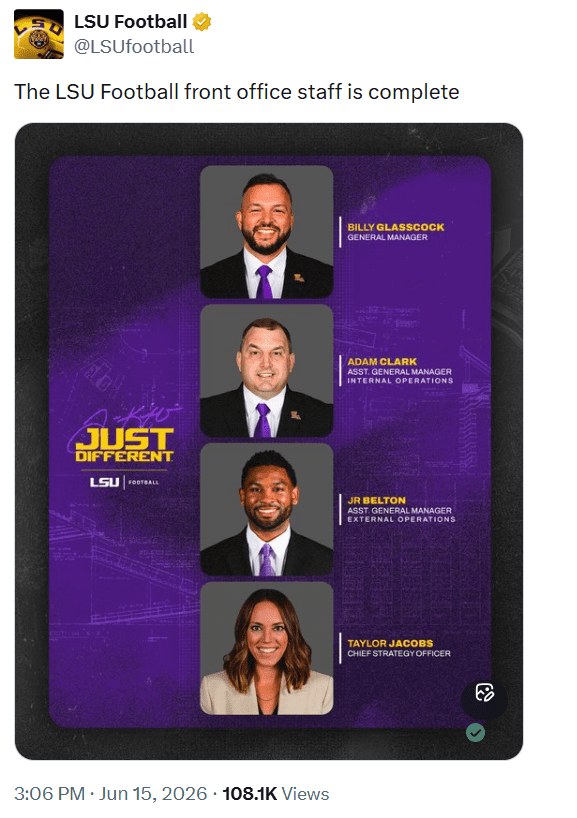
On the heels of a powerful haul in the transfer portal earlier in the spring, the next proof of this new “alignment” much different from the previous administration may be starting to show up in a place that still holds diehard college football fans captive—the recruiting trail.
Coach Kiffin landed five-star defensive end Chris Whitehead yesterday, giving the Tigers another top edge prospect in the 2027 class and the top-ranked player in Virginia. Whitehead, if he sticks, is a serious pickup, the sort of national defensive prospect, along with fellow five-star end KJ Green, that can make an SEC quarterback’s Saturday miserable.
It feels like forever since the Virginia Tech Hokies landed the No. 1 overall player from the state of Virginia. That didn’t used to be the case. However, in recent years, Virginia Tech has seen Penn State, Florida State, Georgia, Florida, and others raid the state’s top talent.
It felt different this year. Chris Whitehead, an edge from L.C. Bird High School in Richmond, is the consensus No. 1 player in the state and a five-star prospect. The Hokies felt confident in landing Whitehead.
On Wednesday, Whitehead broke the hearts of Hokie Nation, choosing LSU over Virginia Tech and others. It remains to be seen if the Hokies were the runner-up, but losing this one stings.
That “felt different” may be hitting different since Kiffin coined the phrase earlier this year. Whitehead and Green are a part of an absolute tear in June by Kiffin and company, which includes five-star tight end Ahmad Hudson and the commitments of a trio of highly regarded running backs, including the top-ranked back in Louisiana and an absolute stud from South Carolina.
But it is also where a little restraint is useful—if not adult.
In one great understatement, college football commitments do not mean what they used to mean. Over the last decade, perhaps even longer, the word “commitment” has often become little more than a temporary public-relations event, an opportunity for a player to flex on social media while leaving the door open to flex once again later in another team’s uniform. A player commits, decommits, recommits somewhere else, posts a graphic, asks everybody to “respect his decision,” then changes yet again the very decision everyone was told to respect. That is not a judgment on the young man’s soul, of course, just a cold observation of the current state of the sport and society in general.
So LSU fans can like the Whitehead news and this June hot streak without pretending the matter is finished. It won’t even be finished when he signs. Not even when he plays on Saturdays. Not with NIL and the transfer portal.
At the same time, this is exactly why the front-office structure has been put in place. The hope is that this hot streak is an early sign of a more robust operation underneath it, that Kiffin, General Manager Billy Glasscock, and the larger football operation we discussed yesterday are organizing themselves around the inescapable reality of modern roster construction and doing it with high school recruits that have the integrity to stick.
All of it has been important in the past, but now there is a spotlight on each individual spark plug—evaluation, NIL discipline, retention, player development, depth-chart planning, transfer-portal awareness, and booster alignment.
It is also understanding the human being behind the star-studded recruiting profile.
That last part has become increasingly important with Kiffin. On Tyrann Mathieu’s “In the Bayou” podcast this week, Kiffin discussed the importance of evaluating and developing the whole person, including how a player handles money. His point was simple: How driven will a young player remain if he realizes many of his financial dreams years before the NFL, especially after growing up with very little?
It is hardly a throwaway point in this era, one I’ve personally made in conversations in the beginning of NIL. Kiffin recognizes that a staff that cannot help young players deal with sudden attention, sudden money, and sudden leverage over the coach will eventually watch some of those same players drift into bad decisions, bad advice, or another program’s depth chart.
He knows the last one is a given—the reason he said programs will no longer be able to stockpile five-star talent that is willing to wait their turn.
Multiple five-stars and a run of highly regarded backs are fun to talk about, sure. And yes the recent recruiting run is important to fans because LSU needed visible momentum it didn’t have before June. But the deeper story is whether LSU’s new structure can turn summer commitments into durable roster construction.
The head coach still has to sell the program and his vision. Kiffin’s playbook and pitch can do that. LSU as a whole still has to sell. Baton Rouge, at least little corners of it, can do that. The better question is whether Kiffin’s new front office model can evaluate a player properly, sign him, keep him, develop him, manage the financial side, and make sure the program is not constantly starting over every December and April. Perpetual scramble mode is not the goal.
That is the part fans should watch.
There is reason for cautious optimism here. Blind excitement is imprudent. So is recruiting board doom-scrolling.
LSU is not just trying to win the Twitter player commitment flex race. It is trying to actually build the system behind the colorful commitment graphics and the eventual signatures themselves. That is the only way a front office of this complexity makes sense in a sport where teenage athletes now have more leverage than ever, where loyalty is wholly conditional now, and where a coach who fails to understand the whole person may lose the player before he ever really has him.
No, LSU has not locked down the future with a June recruiting run. Nobody locks down the future in this version of college football. But because Kiffin and LSU appear to understand that better than most right now, they may have at least given themselves a fighting chance to do what the sport now makes nearly impossible: check the boxes necessary to keep enough players long enough for all this front-office machinery to matter.
Advertisement
Advertisement
