
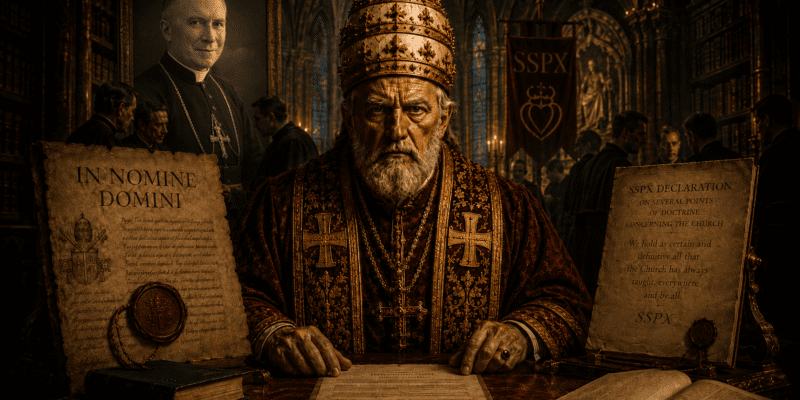
After examining why Catholics may recoil from the restoration they claim to want, we now turn to the SSPX Declaration itself, and to the uncomfortable question of whether its own Catholic principles point less toward continued resistance than toward a serious and charitable investigation of Pope Hildebrand.
For that initial examination, read here, but know that this article can be a stand-alone. To any newcomers, there is a wealth of information and topic building in the archive under this writer’s name. I have not yet pledged my allegiance to Hildebrand; I am simply investigating and sharing right now, not to mention doing some heavy lifting in prayer, so that if this does turn out to be true, we can be ready mentally.
The Society’s Declaration
On its surface, the Society of Saint Pius X (SSPX) has fought this battle for a long time, at least if one considers the spirit of Archbishop Lefebvre and the parts of his public work that plainly line up with Catholic teaching. The Society’s early-year announcement of its coming consecration of bishops on July 1, the Feast of the Precious Blood, already suggested that the crisis is not merely theoretical.
Then came its document on May 14, 2026, the Feast of the Ascension, issued as a “Declaration of Catholic Faith” addressed to Leo XIV. In that Declaration, the SSPX states that it wishes to set before the Holy See its devotion to the Catholic Faith and what it considers the “minimum indispensable” for true communion with the Church. In other words, the Society appears to be doing everything it can to hold the line for the Catholic faithful and the salvation of souls while the disaster inside the Church gets rectified.
With even a scan of the document without reading it with intent, the reader will find something, unless I’ve missed it, beyond the ambiguity by which we’ve become exhausted.
It is unapologetically Catholic.
That does not mean every legitimate question surrounding the SSPX disappears with the incense on the altar. It does not mean their history, practical choices, bishops, and ongoing strategy are suddenly beyond discernment. Catholics are not obligated to pretend complicated things are simple merely because the simple things are true.
But the document itself is striking because it does not spend its energy in the therapeutic babble of Modernism. It simply declares traditional Catholic teaching, point by point, and the bullets chosen are not random. They read like positive doctrinal refutations to the negative doctrinal confusions that have followed the Vatican II Revolution for over seventy years.
The Declaration does not need to name every modern error for the intelligent reader to know what it is answering.
It begins with Our Lord Jesus Christ, “Who willed one sole religion, Who rendered the Old Covenant definitively null and void, Who founded one sole Church, Who triumphed over Satan, Who conquered the world, Who remains with us until the end of time and Who shall come again to judge the living and the dead.” It speaks of Christ as the sole Redeemer, the sole Saviour, the sole Mediator, and the only way to the Father. It then affirms that the Blessed Virgin Mary was directly and intimately associated with the whole work of Redemption, and that to deny this association, according to the terms received from Tradition, is to alter the very notion of Redemption.
That one section alone elucidates where the battle is.
It continues, confirming that there is “only one Faith and one Church by which we may be saved. Outside the Roman Catholic Church, and without the profession of Faith that she has always taught, there is neither salvation nor remission of sins.” It says the Apostolic mandate to preach the Gospel and convert every man to the Catholic Faith remains binding until the end of time. It says the Catholic Church cannot be treated as equal to false worship or false religions.
This is the kind of thing that is clashing with the synodal Church, where everyone gets along.
If Christ founded one Church, then the Church does not dialogue with error as though error were that misunderstood uncle mentioned above. She teaches correctly. She warns charitably. She pleads persistently. She commands gently. She baptizes uncompromisingly. She absolves mercifully. And she excommunicates when necessary, not because she despises the individual, but because she knows souls can be lost and must often be shaken out of their stupor.
The Declaration then moves into where traditional Catholicism has long gone. It speaks of the Holy Mass as the perpetuation in time of the Sacrifice of the Cross, “essentially expiatory and propitiatory,” not a mere communal meal celebrated by the people. “No other form of worship offers perfect adoration. No other form of worship that is not ordered to it is pleasing to God. No other means is sufficient for the sanctification of souls.”
In the end it speaks of nations and institutions owing public submission to Christ the King, which means secularism is not neutral ground but a denial of His rights over men and societies.
Again, it is a wholly Catholic document.
Still, the modern disease is not merely confusion about liturgy, or episcopal appointments, or whether the true Mass should be tolerated. The sum of the Declaration is much bigger than its parts, as sound as they are. Dare I say it is the compartmentalization of all of this that has been the most effective and sinister trick of the enemy.
The modern disease is deeper and must be discussed where it lives. This is a war against the core definition of Catholicism itself, against the Catholic habit of saying what things are, what things are not, and what follows once God has spoken.
And God spoke when He commanded that Peter lead his brethren. God spoke when Peter appointed his successor. God spoke every time the Holy Ghost moved in the One, Holy, Catholic, and Apostolic Church. This is why this line tucked away in the middle of the document is more important than it appears:
“The Roman Pontiff, the Vicar of Christ, is the sole possessor of supreme authority over the whole Church. He alone directly confers on the other members of the Catholic hierarchy jurisdiction over souls.”
It is this piece that makes Catholicism more than just an opportunity to get dressed up on Sundays or decorations for our socials. It is a piece the SSPX and even resisters inside the Novus Ordo must start living out.
If Hildebrand Is Legal and Lawful…
In other words, if all of those things in the Declaration are true, then there must be a binding force, however quiet as he should be, however patient as he must be, however bruised by the sins of men as he will be, holding it all together. Doctrine does not float in the air as a set of admirable fragments. The Mass, the Kingship of Christ, the conversion of nations, the condemnation of false worship, the necessity of the Church, and the salvation of souls all require government, law, hierarchy, and judgment.
And that means a true Vicar of Christ on Earth is not ornamental.
He is necessary.
A truly Catholic Pope.
Certainly not a rock star or celebrity figure as the explosion of the TV in family’s living rooms in the 1950s and ‘60s has reconditioned us to think. But also, and more pertinent to the SSPX, not merely one we recognize while disobeying as a permanent strategy. That may have seemed like the only path decades ago, but enough time has passed now for Catholics to ask whether stagnation has become its own kind of surrender to the enemy. Such half-heartedness falls directly into the enemy’s hands because it creates the false appearance that we are getting somewhere just because a shepherd here or there says one Catholic sentence before the machinery resumes its march—and all of it still seems new to each successive generation, especially right now with this new and growing season of the Traditional Latin Mass.
We have grown content with crumbs from the table, and it is sickening to realize how long many of us learned to call that Catholic.
This is why the Hildebrand question has us at a crossroads that was inevitable—from the very beginning of all of this in the ‘60s and ‘70s.
Not a soul should be bullied into instant assent, no. Not every Catholic-sounding agenda settles every inevitable nuance that will invariably flower from such a spiritual and hierarchical earthquake. The crisis won’t be solved by enthusiasm of lay bloggers who are out-writing Trad Inc or Integrity Magazine or Pelican Plus or any other titles we’ve accumulated across the internet. The shift will occur, a holy and approved one, if there is a legal path to Pope Hildebrand and the clerical recognition of it.
The people will then follow.
Laymen, in my estimation, will absolutely not trust this leap unless their trusted pastors move first. And rightly so, perhaps, since it is both laymen and shepherds that God condemns through Jeremias the prophet, but especially the latter because of their responsibility, and it is high time those shepherds practice what they preach so we bloggers can go back to simpler topics like the month of the Sacred Heart of Jesus.
And so here is what needs to happen….
If there is a legal path to Pope Hildebrand, the SSPX and other Catholic groups must investigate it sincerely, quickly, and publicly. Total transparency and consistency of purpose are paramount. If Hildebrand is false, such an authorized investigation will expose it. If he is true, it will, admittedly, further separate—by God’s good Providence—the wheat from the tares.
If there is no legal rebuttal, let’s say after three months, then the SSPX—or any priest courageous enough—should recognize him, because its own May 14 Declaration sounds far more like Hildebrand’s program than the Vatican II line it continues to “resist,” when really it seems only to be religious language describing the double-minded oscillation of obeying while disobeying.
For if Hildebrand—drawing from the same legal memory that brings Nicholas II back into view—has a lawful case, in addition to the exposure of the illegality of Leo (and perhaps others)—drawing on the memory of Benedict X—and priests and Trad Inc alike don’t recognize him, even after an entire Church history of like-events occurring, then men of goodwill will know—to an even greater degree—who were the sheep and who were the wolves the entire time.
God isn’t done with his sifting. There are still tares that look like wheat.
Indeed, the Psalms return to this separation again and again. The wicked prosper for a season. The faithful cry out. God appears delayed. Then He rises, seemingly at the wits’ end of the soul, and the distinction between faith and performance becomes impossible to hide. If manna is falling and men still prefer to monetize hunger instead of simply eating, they will show who they really are.
“Will the Son of man find any faith left when He returns?”
There’s a reason that is in Scripture. There’s a reason the elect are so few. There is a reason God is still sifting. It is why I am working out my salvation (and writing on such potentially damning eternal topics) with the “fear and trembling” of St Paul.
Such a targeted plan applies to every Catholic group, including all varieties of sedevacantism. In fact, sedevacantists of goodwill should emerge out of inspiration from the first move of the SSPX, since the bulk of their separation involves papal authority. If I use the SSPX and its “Declaration of Catholic Faith” here seemingly exclusively, it is only to manage the language in my delivery more cleanly.
The Pope, then, is the key here, perhaps where “Trads” once thought the Mass was the key. This isn’t just a political or administrative theory—it is an Apostolic truth commanded by Christ. He holds the keys to a true unification of the clans, as one popular YouTuber terms it. And this shouldn’t surprise us, considering we’re coming up on the 2000-year anniversary of Christ’s mission on Earth and His and the Bible’s insistence on Peter being chief among the Apostles.
The TLM was a good start, but as we have posited in this space, God often restores men in single steps. We cannot stop at the rite if the rite itself points us back to the whole Catholic order: Pope, hierarchy, doctrine, discipline, nations, altar, and kingship. The Mass was never meant to become the last remaining island of sanity while the rest of the Church remained surrendered to the storm—particularly when the Pope is named specifically inside that liturgy!
That is why Hildebrand’s agenda brings, if not certainty yet, clarity and hope.
Advertisement
Advertisement
