
For any newcomers, we begin in medias res today. We’ve got a whole bank of articles on this topic in the archive under the author’s name.
One of the stranger developments in the Pope Hildebrand question is how quickly the surrounding information field has begun to behave exactly as one would expect if the question had touched a sensitive nerve. That does not prove Hildebrand’s claim. It does not prove the legal argument. It does not settle Nicholas II, Paul IV, John Paul II, Leo XIV, Apostolic Right, Roman clergy and laity, or the ordinary machinery of papal election.
But it should make Catholics pay closer attention.
Doctrinal Warfare Against Catholics
Last month we ran a series of articles on doctrinal warfare and what we described as a triangulation problem inside the traditional Catholic conversation. The basic concern was simple enough and familiar even in a general sense to the non-Catholic or the more politically bent among us: Catholics were being trained to think inside a managed set of options, where certain public figures, approved resistance, recognizable tribes, and repeated illustrations of the same problem would frame the entire crisis before ordinary Catholics ever got to the legal question itself. In that arrangement, the legal inquiry could be made to disappear beneath the quicksand of YouTube personalities, priestly loyalties, gut-level reflexes, and comfortable tribal paths.
The goal of those articles was not to drag Catholics into another personality contest, for certainly I am working through the cognitive dissonance associated with all of this as much as anyone. It was to get Catholics out of seeing their belief system that way in the first place.
That is why the question of Pope Hildebrand is so revealing. If the claim is false, it should be refuted. If the claim is unlawful, the law that makes it unlawful should be brought forward. If Pope Nicholas II’s In Nomine Domini of the eleventh century does not apply, then serious investigators should explain why. If Paul IV’s Cum ex apostolatus Officio of the sixteenth century has no bearing whatsoever, then that should be demonstrated with the kind of charity one should be able to expect from a Catholic shepherd. If John Paul II’s Universi Dominici Gregis closes the door in a way Hildebrand’s defenders have missed, then bring the text, make the case, and correct the faithful.
We list three documents there to make the point about how robust this seems to be. Any one would suffice.
That is the Catholic way to end a legal claim.
The other way is to make the claim feel dirty before anyone examines it.
Comments like Bishop Sanborn’s, that all of this is “absurd,” which we spotlighted in our triangulation article last month, only bolster the concern. His disrespect and dismissal of the matter may satisfy those already disposed to reject Hildebrand (or those who have never heard of him in the first place), but it does not answer the legal claim. It does not show where Nicholas II’s bull fails. It does not show which later law nullifies the older papal decree being invoked. It does not explain why Roman clergy and laity, under impossible circumstances, would be—contrary to the bull—incapable of acting according to its principles. It simply tells Catholics how they are supposed to feel before the hard work begins.
That is the very Modernism we have been teaching and warning about, the very Modernism Sanborn has built his circle claiming to oppose.
Sanborn’s motives aside, and we admittedly do not know them, it is often the first move in doctrinal warfare. The argument is not answered. The atmosphere around the argument is altered.
Anyone who knows the devil of narcissism inside a person knows exactly the ploy.
Brave Browser AI Inverts Our Thesis
A reader recently sent me a Brave search result for the query “Pope Hildebrand” / “doctrinal warfare trap.” The generated response described the Hildebrand narrative as the trap meant to steer Catholics away from legal questions about Leo XIV. Read that again—the very thesis we had been advancing—a trap antagonistic to Hildebrand—was inverted.
Read our earlier doctrinal warfare and triangulation articles, and the reversal is hard to miss. The exact words and concepts we used there to warn against controlled binaries, false dialectics, and pre-framed Catholic options can now be absorbed by the information machine and turned back against the Hildebrand question itself.
In the argument, the trap was the managed field of approved alternatives that kept Catholics in a hamster wheel of SSPX resistance, FSSP obedience, sedevacantist certainty, conservative clergy reform, YouTube influence, and false institutional nostalgia—while the legal question remained unanswered.
In the generated response, however, it is the act of investigating Hildebrand that becomes the trap.
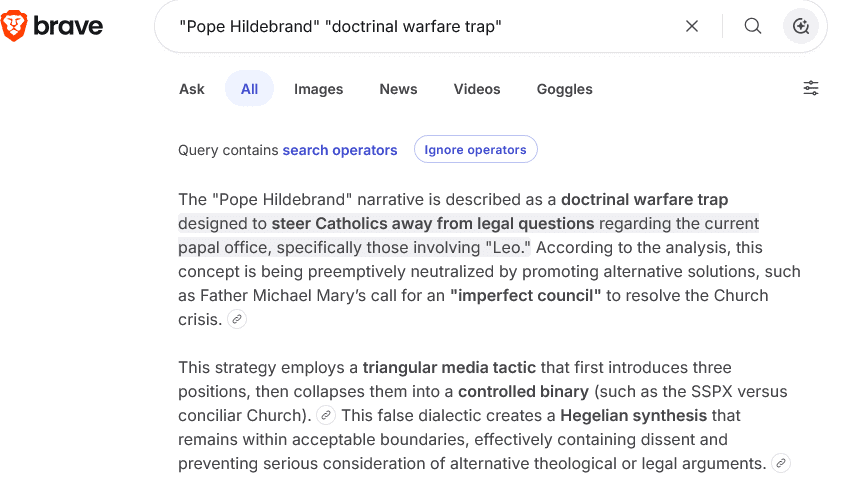
That is a most diabolical inversion. That is not honest human analysis, nor is it a rebuttal of Hildebrand. It is narrative theft.
It is also, perhaps, an unintended confirmation that the question of Hildebrand has touched a most sensitive nerve.
To be clear, we are not claiming that every search result is a sinister operation or that every generated summary comes from some hidden room where men in quarantine suits decide what Catholic laymen are allowed to ask. The problem is simpler and more dangerous. Modern information systems do not need to refute a thing in order to neutralize it. They can summarize it just off of center. They can misframe it. They can absorb language from one side of an argument, flip its polarity, and return it to the reader as if the inversion were an objective analysis. They can reduce a valid legal question to a psychological warning that has no basis in reality.
Once that happens, many readers never reach the documents, and certainly don’t trust any writer pushing the issue. They never reach Nicholas II. They never reach Paul IV. They never reach Universi Dominici Gregis. They never reach the distinction between a claimant, an idea, a restorationist mission statement, and an ecclesiastical legal question. All of them are conflated inside the mud. They meet the mud first, and the mud tells them where they should absolutely never not ever look.
That is how narrative warfare works in an age where apostasy is wedded in an unholy alliance to the ghosts in the machine.
Brother Alexis Bugnolo, responding to the Brave result, reportedly framed the matter in even sharper terms, saying that some sedevacantists whose movement he associates with Rockefeller funding are claiming that Hildebrand is a US Department of Defense psychological operation. That may explain the Sanborn interview. We are not going to adjudicate every historical, financial, or geopolitical claim inside Bugnolo’s statement here. That is an article of its own, or a book of them. But the rhetorical mechanism deserves notice. Once Hildebrand can be categorized as a psyop, the legal question can be avoided without being answered. Once the legal inquiry is treated as contamination, Catholics can congratulate themselves for being so discerning.
This is the enemy’s same old standby play.
It is also why Trad Inc survives so easily. A crisis can be monetized, managed, and endlessly narrated so long as no one is forced to reach a conclusion—a truly Catholic Pope, a restrainer, a shepherd warrior who will bring the whole demented empire down. The enemy in power is fine with that. There can be another podcast, another interview, another emergency article, another lament over the state of Rome, another prayer for reform, another video explaining that the Church is in terrible shape. Of course all of that can be true in its own way. Some of it may even be useful, especially for beginners. But if an actual legal claim to the papacy is being made, then endless commentary around the apostasy that actually needs that lawfulness to be cured is not the same as surgery. And it certainly does not prove we are “waiting in faith” for God to move.
Because maybe that is exactly what he is doing right now—with His solution.
The point is not that every Catholic must instantly recognize Hildebrand.
The point is that Catholics cannot keep pretending that vague procrastination is the same thing as discernment.
There is a difference between caution and evasion. Caution asks for the documents. Evasion asks for permission to stop asking. Caution says, “This is of eternal importance, so let us test it carefully.” Evasion says, “This feels off in my belly, so let’s call it absurd.” Caution seeks lawful judgment. Evasion waits for the search engine, the influencer, the familiar bishop, or the tribe’s trusted voice to tell everyone which emotional posture is safe or even correct.
That distinction may become one of the real tests of this hour—even for the best of Catholics.
This Is Nothing New, If We Will Only Connect the Dots
This should sound familiar to any Catholic who has watched the media lie for years, likely, in most cases, in the realm of politics or how “the Democrats” behave. We have seen the pattern everywhere. A question is raised. Before the question is answered, it is assigned to a category. The category then becomes the answer. “Racism.” “Antisemitism.” “Conspiracy theory.” “Extremism.” “Disinformation.” “Cult” “Radical traditionalism.” “Grifter.” “Dangerous.” “Absurd.”
It is, really, all so tired.
But for the modern thinker, or one who poses to be one, the label sticks, even if they may disagree with it inside other topics, and weak men feel relieved of the burden and time it takes to examine such a difficult question itself.
They’ll wait for Taylor Marshall to bring it up. Or, CANDACE OWENS. She knows everything!
They’re all in on it, you know. One number given by someone who studies all of this with vigilance put the number at 90 percent.
Yes, that likely includes any famous podcaster or priest who speaks out against the likes of Marshall and Owens. It likely includes YouTube priests I’d grown to “trust.” That is why it is all so sinister, if not brilliant.
All of this is not unique to Catholic questions, but Catholics should be especially sensitive to it because our religion is historical, hierarchical, lawful, doctrinal, sacramental, and visible. Not visibly anymore, any of those things, but the true Catholic Church is still absolutely every single one of them, regardless of what the synodalists are feeding you, regardless of how tiny that remnant is at this moment in time. The Faith is not a vague mood of piety or emotional feeling floating above the teeth of documents and law. Christ founded a Church. That Church is a court. It is the seed of the Kingdom of Heaven here on Earth. He gave authority. He commanded obedience. He established a visible, vertical order. So if the question concerns the Roman Pontiff, then Catholics do not get to settle the matter with the same sentiments we felt during the vote for Homecoming queen.
That is why the Hildebrand question is so irritating to the powers inside the machine—not to mention a Catholic here and a Catholic there who cannot wrap their minds around investigating something with honor and charity whilst still not believing it yet. Such nuance is anathema to some. But all of this—in all its glorious intrigue—is not a popularity contest nor a question of what our gut tells us. It is not a question of what team the Pope roots for and if he’s “one of us.” It does not begin and end with whether one likes the man, the rhetoric, the social media presence, the followers, the timing, or the optics. The claim rests on the law and the law only. It rests on seemingly airtight, legal papal election. It rests on the visibility problem created by decades of tolerated contradiction curated by television and social media. It rests on the old Catholic memory most modern Catholics were never even taught.
A very real possibility is that Hildebrand is the answer to many a Rosary without the faithful even recognizing it now that it’s here.
Final Words
We live in a time where laymen are now trying to carry legal and doctrinal questions to shepherds who often have not even heard the name Hildebrand. We live in a world where a priest can sincerely ask whether Hildebrand is an actual claimant or merely an idea. We live in a world where Catholics who have been trained for decades to endure contradiction must now decide whether endurance has become paralysis. We live in a world where Marian hope, papal confusion, clerical silence, and algorithmic framing can all become tangled together before the first serious legal rebuttal is even placed on the table.
Catholics have lived through too many years of media manipulation, ecclesiastical mud, controlled outrage, and managed decline to accept that. We have watched narratives become quicksand. We have watched false binaries herd men into Hobson’s choices they never should have accepted. We have watched the operation of error become, for many, a familiar state of being. We have watched shepherds fail to speak clearly—yes even the “conservative” ones—while laymen were scolded for noticing the very smoke Montini—Paul VI—said had entered the Church.
The machine can label the question with a pejorative. Influencers can mock it with a laugh. Bishops can call it absurd. Search engines can invert it. Still none of that answers the question.
Let the matter be made plain.
Bring the law. Bring the documents. Bring the Catholic answer.
If Hildebrand is false, expose him. If his legal argument fails, show where it fails. If Nicholas II is being abused, demonstrate the abuse. If Paul IV is being misapplied, explain the misapplication. If John Paul II’s election law prevents the conclusion being drawn, make the Catholic case. If Apostolic Right of the people at ground zero in Rome is being invoked improperly, say so with precision. If the Roman clergy and laity could not act as is being claimed, prove it from the Church’s own law.
But calling the question a trap evades the issue.
Calling it a psyop evades the issue.
Calling it absurd evades the issue.
And citing a AI-generated search summary as though the machine had spoken from Mount Sinai most certainly evades the issue.
If Catholics are not allowed to ask such lawful questions without first being herded through the snakepit of smears and sneers, then the crisis is even worse than Taylor Marshall told us. Let the machine laugh all it wants, but serious Catholics need action from the remnant Church, and they need it now.
Advertisement
Advertisement
