
Not three minutes before it happened.
It literally made my stomach jump as I suddenly saw the car right there screaming on top of us in my rearview. It zoomed around me, along with my wife, barely missing the corner of our vehicle. The chasing police cars were in hot pursuit, though taking more cautious measures on the road.
At the time, of course, we didn’t know how it would end. You never do when danger tears through ordinary life in real time like that. You see the lights, the speed, the sudden rupture of a peaceful drive back home, you see the point up ahead on the frontage road where everything apparently has ended because of all the parked police car lights, and then you continue driving and telling yourself you’ll have to follow up on what happened later. When later does come to pass, on the Tuesday after you’ve forgotten the whole thing for two days, that image becomes something heavier and strange: a police chase that began in Sulphur, crossed into Texas, and ended with a Mercedes submerged in Adams Bayou and two people dead.
According to KPLC, Sulphur Police said an officer attempted to stop that 2014 Mercedes around 9:15 pm Saturday on North Huntington Street near Pearl Street after the car was seen speeding. Police said the driver refused to stop, fled onto I-10 and I-210, and eventually reached speeds as high as 130 mph while heading west toward Vinton. In the construction zone, police said the driver passed cars on the shoulder and struck traffic cones before crossing the Sabine River into Texas.
I can attest to this happening.
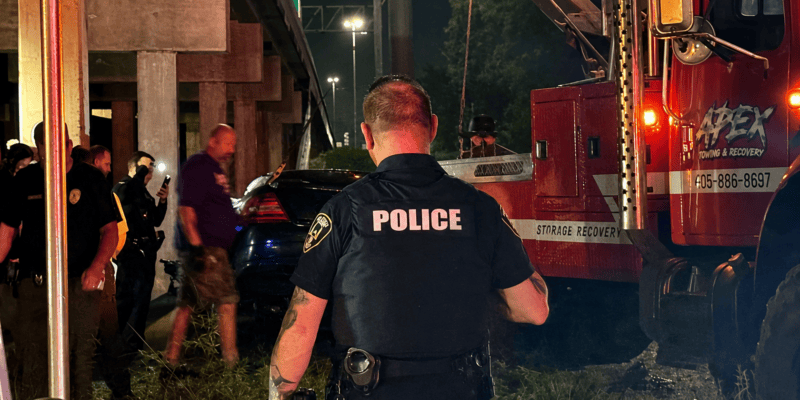
KFDM reported that Orange police said the pursuit ended after the car crashed through a guardrail, rolled over, and plunged into Adams Bayou. Investigators said the vehicle exited near mile marker 877 around 9:45, and that the driver was attempting to navigate the Adams Bayou turnaround at a high rate of speed when the vehicle suffered a blowout, hit the guardrail, overturned, and sank. After crews pulled the car from the water, searchers found the driver and a passenger dead inside.
That is the heart of the story. A driver, according to police, was speeding, refused to stop, and then turned a lawful traffic stop into a rolling threat to everyone on the road, including himself and his passenger.
That is what criminal flight does. It expands the danger beyond the person fleeing. It takes a simple traffic stop and forces it onto families driving home, officers doing their jobs, people trying to navigate difficult construction zones, and anyone unlucky enough to be nearby. It makes strangers part of a decision they did not make. It turns ordinary roads into scenes of consequence, sometimes grave ones.
Because this happened on a corridor familiar to so many in Southwest Louisiana and Southeast Texas, it should not feel distant. I-10 between Sulphur, Vinton, the Sabine River, and Orange is not some abstract place—people we know and we ourselves use that stretch for work, school, games, family, hospitals, casinos, church, the plants, you name it. It is just ordinary back-and-forth of life known to this region. When someone pushes a vehicle to reported speeds of 130 mph through that space, passing cars on the shoulder and hitting cones in a construction zone, he is not merely trying to escape police. He is imposing his recklessness on everyone around him.
That is why this story should not be softened.
Two people are dead, and that is a grave thing. Their families had to receive news no family wants. Officers and first responders will have to live with what they saw. The people who witnessed pieces of the chase will remember the speed, the lights, and the realization afterward that the danger they saw did not simply pass. It ended in one of the most awful of deaths any human can experience.
Advertisement
In an age trained to oscillate between excuses and accusations, some things still need to be said plainly—if for no other reason but to protect the innocent public from future stupidity. Police don’t make a man flee. Traffic laws don’t make a man drive 130 mph. A patrol car’s lights don’t make a man turn a simple stop into a cinematic, high-speed pursuit across state lines. The person behind the wheel makes that choice, and once he makes it, everyone else is forced to live with the risk.
We saw the chase minutes before the fatal crash.
And we don’t ever want to see that again, and so I’m writing this.
Here is the lesson, simple and severe: When criminals run, innocent people become part of the circle. This time, by God’s mercy, the final wreck did not take out me or another family on I-10. But it could have. Anyone who saw that chase, drove near that chase, or later read what happened should be honest enough to say what too many public conversations now try to blur.
The blame belongs to the decision and the character that led to it.
We are not judging souls here, not our place, but running from police at 130 mph is not daring, brave, or cinematic.
It is criminally reckless, selfish, and stupid, and anyone reading this with that impulse still alive inside him should know there is no glory or public pity waiting at the end of it.
Advertisement
Advertisement
