
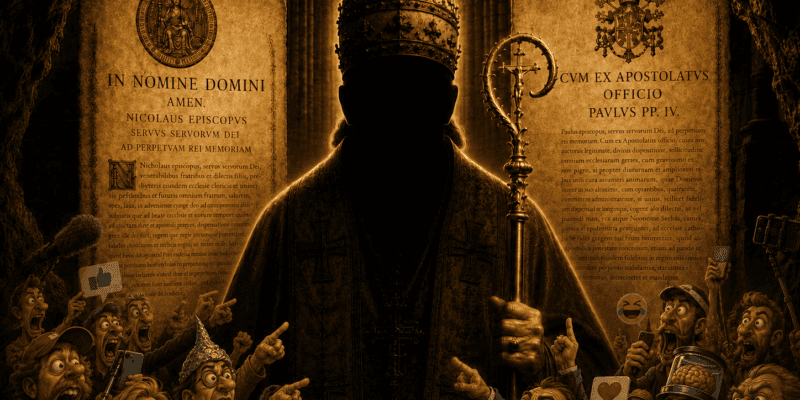
Before beginning this piece, a warning for newer readers is necessary. This article will mention several topics that have been treated here at length already: Pope Hildebrand, Nicholas II’s In Nomine Domini, Paul IV’s Cum ex apostolatus Officio, John Paul II’s Universi Dominici Gregis, Benedict XVI’s Declaratio, the SSPX, sedevacantism, and the psychology of Catholic paralysis. If some of those names or arguments sound unfamiliar, the proper response may be to spend some time in the archives first. We have been building this case for months, in some ways years, piece by piece, law by law, question by question—and there is much more than the few we link throughout this piece and miniseries this week.
And remember, the case we’ve been building here isn’t even to name Hildebrand as pope, even though many have. My case and cause is to get enough Catholics talking about it so that the respect and investigation by faithful bishops into the matter can take place.
The John Paul II problem in Universi Dominici Gregis (UDG) and the rules of the papal conclave—specifically the 120-vs-133 cardinal-elector issue—is something newcomers should not dismiss as inconsequential just because no one famous is talking about it. The point here is not to restate that entire article. The point is that Catholics cannot contend “universal acceptance” while refusing to examine the machinery that allegedly produced the man being accepted.
If UDG says one thing about the number of cardinal electors, and the Vatican behaves as though the number can be ignored or explained away after the fact, then the burden is not on Catholics to pretend the problem does not exist just because no one reads these documents before posting uninformed memes. The burden is on those defending the Vatican to show where the law fails. Likewise, if a decree from the Dicastery for the Doctrine of the Faith (DDF) names six bishops, but Catholic media and curial interpretation begin speaking as though priests and lay faithful have been swept into the same penalty, the burden is not on Catholics to accept the manipulation by intimidation or consensus of the crowd. The burden is on the accuser to show how the law unambiguously applies.
“Canon 18 demands strict interpretation of any instrument that imposes a penalty or restricts rights. Strict interpretation here means the instrument means exactly what it says; no more, no less, and ambiguity must be resolved in favour of the accused.”
That is why this article and series are not merely about the SSPX. It is about the Catholic habit of mind. Do we read the documents, or do we accept the loudest shouts of the mob? Do we test competence, promulgation, strict interpretation, and due process, or do we let the spectacle of the Vatican and its media puppets do our thinking for us? The same Catholic who refuses to examine the 120-vs-133 problem in UDG will likely refuse to examine whether the DDF decree actually does what the headlines say it does. It is the same substance of the same dose of poison.
I waited three months after I found out about Hildebrand to mention him even once in an article. If this is the first you’re hearing about this, a certain level of prudence will likely be necessary.
—
Yesterday’s piece asked whether the public SSPX-Vatican frame is itself a trap. Today’s piece moves one step deeper.
One point we’ve been driving home is that Catholics should not let a familiar binary prevent them from asking the lawful question beneath the noise. It is the Hobson’s Choice we’ve warned about, in this case a contention that any side being made public is part of the same monstrous hydra—not even a choice at all.
If the frame is merely “Rome vs SSPX,” then the tribes are set. The lines of scrimmage are marked (h/t Andy Hogue), and everyone knows his place. Some defend Rome. Some defend the SSPX. Some mock both. Some retreat into the comfort of “universal acceptance,” as though the crowd can settle a legal question the vast majority of the crowd has never been allowed to examine.
Here we find ourselves at a crossroads.
The Crossroads Few Are Naming
The timing of events going back to late 2025 deserves some attention.
In November of last year, according to the Hildebrand claim, an extraordinary election took place by which Hildebrand was elected as pope. Not long after, the SSPX announced that new episcopal consecrations would take place on July 1, 2026, the Feast of the Most Precious Blood of Our Lord Jesus Christ.
One does not have to prove coordination, malice, or hidden control in order to notice how close these developments sit in the Catholic imagination. Hildebrand apologists certainly notice it.
Some go further. Some speculate that the SSPX consecration conflict may function as a US Doctrinal Warfare tactic, not necessarily because every priest or bishop involved consciously intends such a thing, but because the public narrative creates exactly the kind of binary trap we have been warning about for months: Rome vs SSPX, SSPX vs Rome, sedevacantists mocking both sides, and Catholics choosing their familiar tribe while never asking whether the legal identity of Leo XIV has itself been tested.
I cannot prove that tactical reading.
But I can say this: The frame works exactly that way.
This becomes even clearer when we remember that the SSPX world is not itself as simple as many outsiders assume. There is also the SSPX-Resistance, associated especially with Bishop Richard Williamson after his 2012 expulsion from the Society. That group emerged from Catholics who believed the SSPX leadership had already gone too far toward the postconciliar Vatican, especially around the discussions and posture connected with the 2012 period.
Most Catholics never discuss them. Many do not even know they exist. Yet their existence proves that “SSPX vs Rome” is already an incomplete frame. Even using “Rome” in that way undermines the Hildebrand claim, a point we have made before in distinguishing between “The Roman Catholic Church” and “The Church of Rome.” There are fractures inside the resistance to the resistance, and yet the public media presentation keeps training Catholics to think in senseless binaries.
That is why this present conflict should not be treated as merely another episode in the old SSPX drama. It is seemingly, to me, not the SSPX-Resistance, but the publicly known SSPX that is up to bat here. It is the visible actor with enough structure, priests, faithful, and public attention to force the next question into the open.
And that question is not whether Leo is assumed.
It is not whether the Vatican website lists him as the pope along with all the others.
It is not whether the Catholic world, underinformed for decades now, has gone along with the latest name behind the white smoke.
The question is whether his title is lawful.
The moment that question is asked, the next shield comes up almost automatically: universal acceptance. It is invoked as though the crowd can close the case before the law is even read, as though visibility eliminates all defects, as though the very Catholic world who was never taught the legal problems behind Leo’s election can somehow be cited as proof that no legal problem exists.
Universal Acceptance and the Law
This is where we should be clear about the SSPX.
While I would prefer not to fatigue minds with particulars, in theory, I have always found the SSPX position more Catholic than the instinct that turns vacancy into the permanent end of the discussion, even though, admittedly, the vacant chair stance connecting to the vacancy of the throne of David for 500 years elucidated by at least one sedevacantist group is not unserious. The Church is not meant to live forever as scattered chapels, private conclusions, and unresolved resistance, even though it is also not up to us to decide the exact timetable by which God restores what men have broken, especially considering the just-mentioned 500-year illustration. Christ founded a visible Church, and that visible Church presumably needs a visible head.
But even a theoretical allegiance to the pope becomes faulty when, decade after decade, it refuses to examine whether the man being named as pope is lawfully pope at all. That is one of the most important points sedevacantists make.
At the beginning, some hesitation was understandable. The crisis was confusing. Priests and laymen were trying to preserve the Mass, catechism, schools, families, and basic Catholic sanity while everything around them was being dismantled in the name of renewal. But after so many decades, caution can become paralysis.
Worse, it can create so much momentum and attachment that Catholics develop a blind spot about how God might answer their own prayers.
At some point, the SSPX, and all authentically faithful Catholics for that matter, must ask whether God has answered their prayers in a way they did not expect. The Society has prayed for an unadulteratedly Catholic Rome. Sedevacantists have prayed for a true pope. Faithful Catholics trapped in the Novus Ordo, for whatever reason, have prayed for clarity, doctrine, reverence, and a shepherd who speaks like a Catholic.
What if the answer is not arriving through the clean institutional channels everyone expected, but through the very legal wreckage Catholics have spent decades refusing to examine?
Is it really so hard to doubt that the very men who helped poison the postconciliar Church would suddenly turn into fine wine and elect a Catholic pope?
Advertisement
Do we think any of that infiltration was accidental?
These are questions we must ask ourselves as rationally created beings, or else we risk sinking into the quicksand of the universal-acceptance argument.
That is also why the universal-acceptance argument keeps appearing.
Some will say Leo must be pope because the Church has universally accepted him. They will speak as though universal acceptance were a magic seal placed over every legal defect, every prior problem, and every unanswered question—that there is no way God would lead us astray in such a matter. But that assumption already betrays ignorance on how God permits long periods of confusion, exile, chastisement, and waiting, perhaps illustrated, again, through the Babylonian exile and the 500-year illustration above.
Some will also argue that references to Nicholas II do not apply because, in those older cases, there was not the same kind of universal acceptance supposedly enjoyed by Leo XIV, as though tribal conflict and political disorder are required before an older law back when humans were less civilized can even be considered.
Here’s just a question to ask yourself: Is that how you interpret what a “law” is, based on how the majority around it speak, act, and behave?
Consider the mob in front of Pontius Pilate.
Moreover, one must ask what universal acceptance even means in an age of censorship, lies, managed information, visibility based on the algorithm, institutional pressures, and a Catholic world trained to accept whatever comes through that electronic screen. This is a point we have made dozens and dozens of times in our work together.
If nearly all Catholics were never allowed to see the legal question, never taught the older law, never asked whether Benedict’s resignation did what it was said to do, never invited to examine Paul IV, and never told that Nicholas II may have something to say about impossible papal circumstances, then calling the result “universal acceptance” may prove much less than its defenders think.
Nicholas II cannot be brushed aside by saying, “That was then.” The entire point of invoking In Nomine Domini is that the Church has already contemplated obstructed, impossible, or wickedly opposed papal circumstances. If the ordinary process of things is corrupted or unable to operate lawfully, the old law becomes relevant because it shows how the Church thought about continuity of papal governance under conditions of grave disorder. That is the tradition every Catholic is so proud of, even the nominal ones fighting the Protestants on Twitter. Nicholas II’s decree explicitly contemplates a situation in which the “perversity of depraved and wicked men” prevents a pure, sincere, and free election in Rome.
The same depraved and wicked men so many a Catholic points to today—and are condemning the SSPX right along with them.
That alone should slow the universal-acceptance argument down. Catholics cannot simply wave the flag of present visibility and declare the matter closed.
And Nicholas II isn’t even the sharpest tool in the box against this.
Paul IV is.
In Cum ex apostolatus Officio, Paul IV speaks directly to the danger of a man appearing to occupy ecclesiastical office while being legally incapable of holding it. Whatever one finally concludes about its application to Leo and the popes since Vatican II, it exists inside the Catholic legal world precisely because the Church understood that appearance to the crowd and apparent possession of the office do not always settle the matter of legitimacy.
Then comes the words Catholics invoking universal acceptance should have to answer. All are invited to read the entirety of Paul IV’s document, but paragraph 6 provides the substance of most of the issue raised here today1:
6. In addition, if ever at any time it should appear that any Bishop (even one acting as an Archbishop, Patriarch or Primate), or any Cardinal of said Roman Church, even a Legate as previously stated, or even a Roman Pontiff prior to his promotion or elevation as Cardinal or Roman Pontiff, has deviated from the Catholic Faith or fallen into some heresy, then his promotion or elevation, even if it be uncontested and carried out by the unanimous assent of all the Cardinals, shall be null, invalid, and void;
nor may it be said to have acquired validity, or to be acquiring validity, through his reception of office and of consecration, or through his subsequent tenure of government and administration, or through his putative enthronement as the Roman Pontiff himself, or through the homage paid him, or through the obedience accorded him by all, or through any lapse of time in the foregoing situation;
nor may it be held as legitimate in any part thereof;
nor may it be deemed to have conferred, or to be conferring, any faculty of administration in matters spiritual or temporal on such persons promoted as Bishops, Archbishops, Patriarchs or Primates, or elevated as Cardinals or the Roman Pontiff;
rather, each and every one of their statements, deeds, enactments and administrative acts, howsoever made, as well as anything that ensues therefrom, shall be devoid of force, and shall confer absolutely no legal privilege or right on anyone; and those thus promoted and elevated shall automatically and without need of a further declaration be deprived of any dignity, position, honour, title, authority, office and power.That is not a minor inconvenience for the universal-acceptance crowd.
It is important not to allow cognitive dissonance to dissuade us from reading that plainly—yes, the Roman Pontiff is spotlighted here. Paul IV is teaching, with full authority as Vicar of Christ in a papal bull, that a man treated as pope the world over may not in fact be the pope.
A man can be visible.
A man can be recognized.
A man can be obeyed.
A man can be treated as pope by the entire world except for a handful of people.
But if the legal defect is there, appearance—all of it—means absolutely nothing. Public recognition is not the standard by which a pope is a pope, despite what rock stars the TV generation of the 1950s and ‘60s helped create. The crowd proves right in numbers as much as the mob proved right in picking Barabbas.
Those who reject the Hildebrand claim may have answers to all of this.
Fine.
Bring them—and make sure they’re on the same level as what we see in a papal bull like Paul IV’s and Nicholas II’s.
While ultimately the Hildebrand story may all be one big deception in itself, the universal acceptance argument will not be the reason. Claiming Leo XIV is pope because everyone accepts him while most Catholics have been denied the facts needed to know what they are accepting is, to be charitable, incredibly dangerous.
That is where this article leaves us. Tomorrow’s final piece will move from the legal questions to the Catholic response. If the public frame is a trap, and if universal acceptance cannot simply close the case, then faithful Catholics have to ask what comes next. How is God perhaps working Romans 8:28 on our behalf, and what is our role in it? We must discern if God is answering decades of Catholic prayers through a path Catholics never expected, because we were never taught that there was another way, and whether the agenda attached to Hildebrand’s name deserves more serious attention than the Catholic world has so far been willing to give it.
Advertisement
Advertisement
