
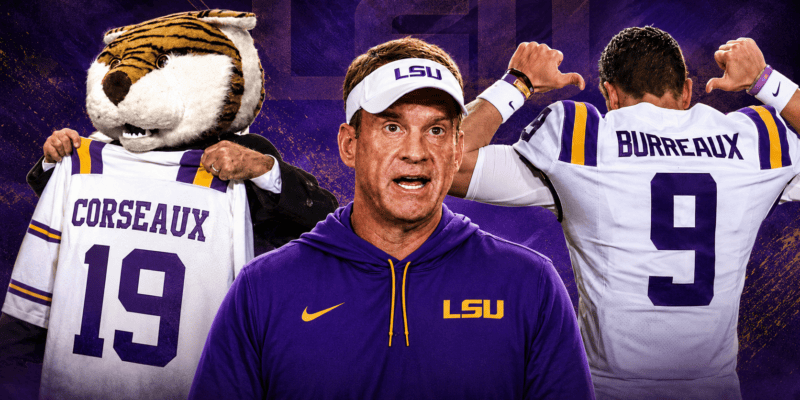
On July 7, 2020, LSU’s 2019 national championship season became the jewelry every competitor dreams of.
The games had already been won, of course. The parade and the bon temps had already rolled through Baton Rouge. Joe Burrow had already pointed at his ring finger in the Superdome after throwing his 60th touchdown of the season, an image other Tigers in other sports seemed to emulate in the coming years. By July 7, LSU had its SEC Championship ring, its College Football Playoff championship ring, and its LSU-provided national championship ring. The perfect season had been fitted for gold and sparkling stones—including purple ones.
According to LSU, the university has been thinking about the design of its championship ring since Ed Orgeron was hired as the head football coach.
“The last couple of years, we’ve been thinking about this,” said Derek Ponamsky, special assistant to Orgeron. “The last thing you want to do is not be prepared for something.”
…The CFP ring usually comes standard, but LSU, in fitting fashion, added its own distinct touch. The CFP ball logo is gold, and it sits atop each ring won every year by the season’s champion. “It was just going to be silver (around the ball), and we kind of just threw it out there: It’d be cool if we had purple stones in there,” Stringfellow added. “Nobody’s ever asked that before.” Jostens, the creator of the rings, agreed, the first time they’ve changed the top of the ring for a CFP winner. “If you ask for permission, sometimes you get it,” Ponamsky laughed. “Begging for forgiveness doesn’t get you the results that you want.”
That was already seven years ago.
Unfathomable, really.
It is now 2026, and that 2019 season sits there in the rearview at a melancholic distance. Close enough that Tiger fans can still see Burrow to Jefferson on 3rd and 17, Clyde Edwards-Helaire throwing his body into Alabama tacklers, Ja’Marr Chase and Justin Jefferson embarrassing the best corners in America, and Joe Burreaux walking across the Tiger Stadium grass on senior night. But far enough away that the sport around it barely looks like the same sport anymore. NIL, the transfer portal, front-office staffs, roster budgets, agents, handlers, and player leverage have turned college football into something far more professional, at least visibly so, than whatever we thought we were watching back then.
And that is why July 7 is worth remembering.
Rings aren’t the whole point, and certainly the whole pointing at the ring finger thing has run its course. But they are the symbol that something great has happened, something transformative, something a winner can look back on and say, We did that.
In January and February of 2020, we looked back on that championship run in a long “Remember This Day” series, trying to cage the emotion before time could rust the bars. It was Texas in the heat. Florida in Death Valley. Auburn in a knife fight in an alley. Alabama in Tuscaloosa, where LSU finally broke through after years of frustration. Then came the late-season flurry, where the defense somehow got lost, then found itself again just in time: Ole Miss, Arkansas, Texas A&M, Georgia, Oklahoma, and Clemson. Perhaps the defense’s struggles would never have mattered, given the sheer awesomeness of the Tiger offense. LSU didn’t just win. They obliterated opponents.
They also, perhaps, put to bed the ghosts of January 9, 2011.
America took notice of these Tigers too. During that run, LSU became something larger than a story of the South. One report said the program generated $200 million in free advertising and more than 150,000 mentions across television, internet, and print media from December 1 through January 21. ESPN Gameday personality Lee Corso picked them to win all five times the Tigers were featured in his headgear-of-the-week pick. ESPN colleague Rece Davis called LSU’s season the greatest in the history of the sport. ESPN’s Mike Greenberg seconded that argument in convincing fashion in a video posted on Twitter.
And of course, Scott Van Pelt simply loves LSU, always has it seems.
The after-party of that 2019 team is still showing up in the national conversation. Just this week, an ESPN panel picking the best college football players of all time by jersey number chose Burrow as the best No. 9 ever, citing the Heisman, the national title, the 6,039 yards, the 65 total touchdowns, and the playoff finish against Oklahoma and Clemson.
The love was perhaps not just because the Tigers were explosive, but because they were a perfect cast of football characters at the perfect time: the transfer quarterback who became a legend, the coach everyone had laughed at, the overlooked small running back, the Louisiana flavor, the second-chance stories up and down the roster.
That is the part 2026 has to chase, like its name is Ja’Marr.
2026 has to chase what made 2019 possible before the touchdowns and the glory and the rings, even though admittedly that team cannot be duplicated. It barely felt like it was really happening in real life the first time.
Of course LSU cannot mimic 2003 either, when Nick Saban’s first title gave a new generation of Tigers and fans a new national standard, when before the standard wasn’t even the SEC West, when it was just a bowl game. It cannot mimic 2007, when Les Miles somehow survived the best of college football chaos and a two-loss season and still ended up with a ring.
But the standard can be chased. Those championship teams, as well as 2011 and a handful of other great Tiger teams that were just one nail-biting loss-turned-win away from playing for more titles, had a standard. When you watched them, you knew it. You could see it on the television screen and you could see it on the field.
Twenty-three years after 2003, and 19 years after 2007, and 15 years after 2011, LSU is in a different world.
Advertisement
Seven years after 2019, it is simply in a stranger one.
Strange enough that Urban Meyer can now say on a podcast that “nut job” LSU fans expect Kiffin to compete for a national title in his first year. He dialed it back a bit by the end of the clip, but still, the honest answer is probably “not quite, but close,” perhaps “the swing at it” Meyer alludes to in the clip, depending on if by “swing” he means make the CFP. In that case of course the answer is “yes,” and given the pedigree of the players and coaching staff, that is hardly an unhinged hope from the fan base. Meyer may have meant it as a joke or even a jab, but LSU doesn’t hide from its condition, especially not since 2003. This is a fan base that remembers 2003, 2007, 2011, and 2019 in vivid memory, and the university didn’t bring Kiffin to Baton Rouge to slow-walk its way into the middle of the pack.
That is not at all the standard.
LSU’s 2019 team had absurd talent, but it also had buy-in. Cool, calm, and collected, Burrow was already the prince of Baton Rouge by October, but he was still playing for something larger than himself. Clyde Edwards-Helaire was never the biggest man on the field, and yet he somehow found a way to live up to the season’s biggest moments. You couldn’t determine who was better between Jefferson and Chase, and both had Sundays and big checks ahead of them, but they still had to share the ball—with each other and Edwards-Helaire, Terrace Marshall Jr, and Thaddeus Moss. The defense got embarrassed and humbled early and often, but they corrected course just enough when the championship stretch demanded it.
That is what the rings recall.
That is the standard—the team.
So yes, LSU needs Sam Leavitt to be the star quarterback. It needs Jordan Seaton to protect him. It needs Trey’Dez Green to be the kind of matchup problem his size and skill demand. It needs all the Sai’vion Joneses on the roster to play like third round draft picks. It needs the transfers to bleed purple and gold quickly, and the returning players to make sure the place still feels like LSU.
It needs Kiffin’s offense, Kiffin’s psychology, and Kiffin’s audacity. There may be nothing in “Lane Kiffin” that rhymes with “O,” no easy Corseaux-to-Burreaux Louisiana wordplay waiting on a jersey, but Kiffin does seem to understand the culture he has walked into. Around here, “nut job” might be less an insult than a nickname. LSU fans can be unreasonable, impatient, suspicious, euphoric, and impossible, but so can Florida and Ohio State fans, and that is also part of why the entire state can become volcanic when the right team gives them something real to believe in.
It is a madness Kiffin seems to relish.
That is what 2019 had and was doing by the end, perhaps even as early as that sweltering night in Austin. It wasn’t a collection of personal brands or draft resumes or highly paid strangers who just happened to be wearing the same uniform for a few months.
It was a team. A united one, with one heartbeat. One that Louisiana and its crazy Cajuns loved.
Seven years after the rings arrived, that is the real challenge for the 2026 Tiger football team. If Kiffin’s first team is going to be more than just interesting, more than just expensive, and more than just another summer talking point, it has to recover the standard—and madness—those rings still represent.
The perfect season was fitted for memory on July 7, 2020.
Now Lane Kiffin and LSU have to build something worth remembering again.
Advertisement
Advertisement
