
On July 1, 2021, the world of college football changed irrevocably.
There was no game in Tiger Stadium that day, of course, no Saturday night roar. But in the history of LSU football, July 1, 2021, belongs on the calendar anyway, because it marked the beginning of the NIL era, the day college athletes could begin profiting from their name, image, and likeness without forfeiting eligibility.
Said then Louisiana Governor John Bel Edwards, “It is only fitting that college athletes be able to benefit financially from their hard work and to have more control over their personal likenesses, which many organizations and entities have already done for years. It’s beyond time for this law, and I am excited for the opportunities it will open for Louisiana’s talented athletes.”
It basically was the unmasking of the worst-kept secret in all of college sports. What was presented as something innocent and just, as the Edwards statement encapsulates, was obvious to anyone willing to look past the press-release language: The paying of players was going to be abused, beyond the alleged fairness of the move, beyond even the words that comprised the acronym N.I.L.
For years, the old college football model was built around recruiting, development, patience, and institutional loyalty. That did not mean the system was pure and innocent. It was not—at all. It only meant the money was less visible, the rules were more comfortable for the people enforcing them, and the language of amateurism still had enough ambiguity around it to keep most fans comfortably numb in their “ignorance.”
July 1 pulled that ambiguity and that comfort away entirely.
LSU, much like its pioneering efforts now in an NFL-styled front office, did not treat the new ruling as something small or as something to evaluate slowly as time progressed. Not on July 1, 2021 anyway.
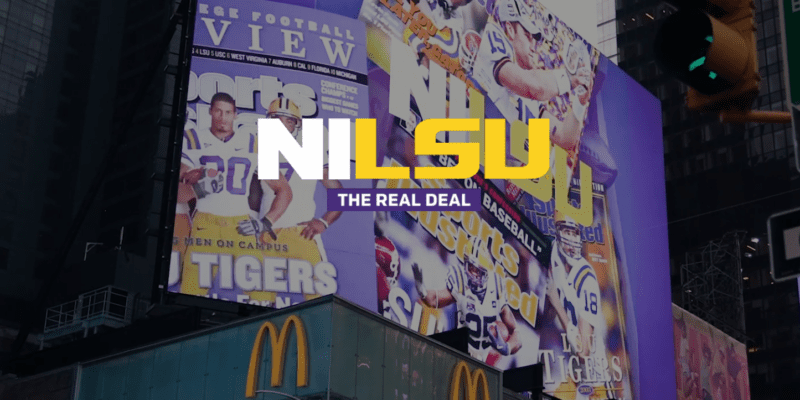
The Tiger athletic program launched NILSU with a billboard in Times Square, which was a very LSU way to greet a new age—colorful and ferocious at its core. LSU clearly had already anticipated the national shift in college athletics and was ready to plant its flag immediately. Whether one sees that as savvy branding or a very expensive light show before the coming chaos perhaps depends on how “romantic” one still feels about college football.
While the brand has taken a hit since then through the dog days of the previous head coach, the program under Coach Kiffin will now be judged by whether it can bring LSU back to the heights it experienced in 2020, before the Covid disruption, before Coach Orgeron lost control of what had looked like a sustainable program, and when LSU had briefly emerged as something close to America’s Team. [Read here: AMERICA’S TEAM: National Love for LSU Reaches Unprecedented Heights]
Five years after the onset of NIL, that light show most certainly looks a lot like the beginning of the sport we are actually watching today. NIL did not merely give players the chance to earn endorsement money from a part time job or from a uniform on an Xbox video game. As so many knew it would, it became a pay-for-play system without the tables to pass money under, one that seemed to chase away a few college coaches before the era even began. In its short history, it has changed roster building, recruiting, retention, depth-chart management, booster expectations, player leverage, and the entire relationship between athlete and university.
In other words, it moved so fast that a potentially good hire in Brian Kelly became dinosauric in a very short time frame, a stark contrast to the frontier they had established in New York just a few months earlier.
But with the personality and pedigree of Kiffin, the talent inside the state of Louisiana, and a brand still as popular as any despite the struggles in recent years, LSU still enjoys an advantage few teams have. It has the kind of brand that can attract players, agents, handlers, money, expectations, and all the other strange little creatures now living inside the sport’s new man cave. The colors and uniform are unmistakable. The stadium is infamous. The fan base can be loud. The culture is unique. The school has produced numerous national champions, Heisman Trophy winners, top draft picks, NFL stars, and personalities large enough to travel far beyond Death Valley.
And so on this day in LSU football history, the Tigers were not winning a game. They were stepping into a new version of the sport, one where the LSU brand itself would become an integral part of NIL’s impact on college football as a whole. Simply put, that takes money, structure, discipline, and, whether anyone likes it or not, a big enough personality to manage the circus without getting trampled by the elephants or worse, just becoming one more act in it.
This is why NILSU makes more sense now than it did under Kelly. Kelly looked increasingly mismatched for a sport that was changing in plain view on his watch, while Kiffin seems built for the tenuous bargain college football has now made. And to think that on that July 1 day, Kiffin was just getting started at Ole Miss.
That may be the real historical note. July 1, 2021 didn’t create the money in college football or make it less innocent. It only made the sport speak more openly about it all and the old innocence harder to claim. LSU understood the branding part early, sure. Under Kiffin, the question is whether it can master the harder part, which is building a serious football program inside a system that keeps tempting teenage kids and overgrown ones to act so unseriously.
FURTHER READING
Recruiting Run Shows Why Kiffin Built a Front Office, But June Is Still June
Lane Kiffin and LSU Lean Into the Professional Reality of College Football
CBS Predicts LSU at 10-2 (But Would Tiger Fans Take the Deal?)
Advertisement
Advertisement
