
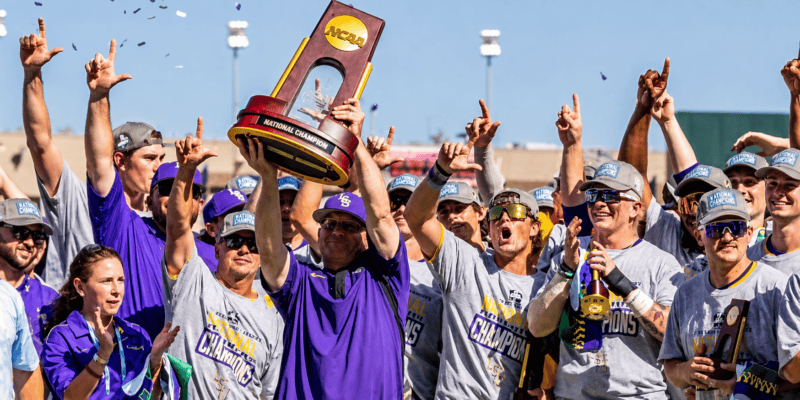
The MLB Draft changed a bit this summer, and head coach Jay Johnson and LSU had to adjust with it.
With the first day stretching through four rounds instead of stopping after two in 2026, the usual regrouping point arrived later. Sunday then became a 16-round test of patience and contingency planning. For a program like LSU, where elite high school signees, draft-eligible stars, and future professionals occupy the same conversation every year, that format only made the wait more worth it. Here is the summary:
Nine members of Jay Johnson’s signing class were drafted, but several highly regarded prospects went unselected or withdrew their names and are expected to reach Baton Rouge.
The biggest incoming names include:
OF Nathaneal Davis: A highly athletic, left-handed hitter with the speed and defensive ability to compete immediately in center field.
OF Malachi Washington: An elite athlete with top-end speed, considerable power and a strong throwing arm. Pittsburgh selected him in the 18th round, but he has indicated that he plans to attend LSU.
1B/OF Dominic Santarelli: A physically imposing left-handed hitter with tremendous raw power. Seattle selected him in the 18th round, but he is expected to reach campus.
LHP/OF Lucas Nawrocki: A two-way prospect with a mid-90s fastball and one of the better sliders in the class. He could contribute immediately out of the bullpen.
RHP Cooper Sides: A 6-foot-6 pitcher who reaches the mid-90s and features a four-pitch arsenal. He has potential weekend-starter upside.
SS Parker Loew: A strong offensive infielder with power and the defensive ability to remain on the left side.
RHP Kolby Stringer: Mississippi’s top-ranked pitcher, possessing a fastball that reaches 97 mph and a promising breaking ball.
RHP Coleton Brady: Another power arm who withdrew from the draft and confirmed he will attend LSU.
LHP Braxton Beaty: A polished left-hander who also removed his name from draft consideration.
INF Jordan Martinez: A traditional shortstop with good defensive actions and a quick right-handed swing.
INF Luke Tucker: A 6-foot-4, left-handed hitter who projects as a power-hitting third baseman.
Other expected signees include RHP Braydon Wisener, LHP Bradyn Cupit, 1B Dylan Minnatee and catcher Masen Belding. LSU is also expected to add junior-college RHP Major Osbolt, who went undrafted despite possessing a fastball in the mid-90s.
Scott McKay has opined on the story already today, and we invite you to read his piece. Here is one portion:
Nothing is guaranteed. Most people thought LSU was loaded this past year and that team utterly flopped. It’s possible that could happen again, but the 2027 baseball Tigers are going to have a roster loaded with players that everybody wants. Johnson has a track record that when he has good players, he wins. He’ll have good players next year, including some guys who are much better than they showed this past year and ought to be angry about that.
Certainly, it has always been a crapshoot when it comes to high school prospects and a baseball lineup in general, but Johnson has reason to feel much better about this draft than he did a year ago. Who knows, maybe mixed in somewhere is another Derek Curiel and Jake Brown, who were each drafted to play Major League Baseball over the weekend.
2027 Vision
The 2026 draft did not strip LSU’s signing class down the way it easily could have and so often did in the pre-NIL era. Instead, at the time of this writing, the Tigers appear to have gotten 16 of their 22 high school signees to come to Baton Rouge, which is a significant result for a program trying to reload after another disappointing season following an “odd-year” national title run. That doesn’t mean the roster is settled in July, obviously, but it does mean Johnson’s next team should receive a serious infusion of young talent rather than spending the rest of the summer scrambling to explain the losses and patch together next spring’s roster.
The Tigers did take their share of losses, of course. 247Sports breakdown noted that eight LSU signees were selected in the draft, including high-end arms Logan Schmidt, Jensen Hirschkorn, Dylan Blomker and Spencer Evans, along with outfielders Wessley Roberson and Malachi Washington, first baseman Will Adams, and outfielder/first baseman Dominic Santarelli. The difference is that Washington and Santarelli, two of the more hopeful everyday players in the class, still became LSU wins rather than expected-yet-still-depressing draft day losses.
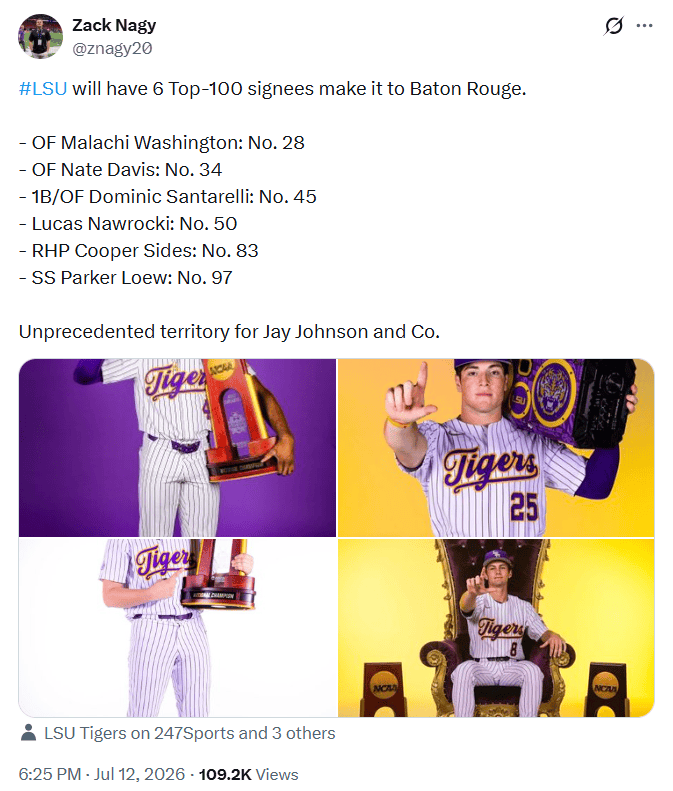
But the larger recruiting story is even more telling. LSU will have six Top-100 signees make it to Baton Rouge: Washington at No. 28, outfielder Nate Davis at No. 34, Santarelli at No. 45, Lucas Nawrocki at No. 50, right-hander Cooper Sides at No. 83, and shortstop Parker Loew at No. 97. For Johnson and the staff, that moves this well beyond the routine post-draft deflation or relief stage—and into something closer to unprecedented territory.
The Tigers emerged with the 2026 signing class in as strong a shape as they could have hoped, landing what appears to be a wave of championship level talent for 2027 and ’28 in Baton Rouge. The group covers the roster with the kind of balance LSU needs to return to a championship run: arms, infielders, outfielders, and enough versatility to give Johnson, at least in theory, a host of good problems to have when it comes to roster management. LSU will still have to sort through specific roles, development timelines, and the usual attrition (and difficult decisions) that comes with modern college baseball, but Johnson will undoubtedly be prepared for that.
Writer Koki Riley offered an early look at what that roster could become, projecting a starting nine of Mason Braun at first base, Cade Arrambide at catcher, Steven Milam at shortstop, Omar Serna at designated hitter, Bino Watters in left field, Dawson Park at third base, Angel Laya in right field, Cade Kurland at second base, and the freshman Washington in center field.
The projected lineup:
1. Mason Braun, 1B
2. Cade Arrambide, C
3. Steven Milam, SS
4. Omar Serna, DH
5. Bino Watters, LF
6. Dawson Park, 3B
7. Angel Laya, RF
8. Cade Kurland, 2B
9. Malachi Washington, CF
If all things work out as I’ve seen the “paper”—and of course they rarely do—I would switch Milam and Laya in the order, as well as Arrambide and Watters. That said, if Milam has a monster senior season as we all hope he does, he absolutely should be in the thick of the action at the top of the lineup. Of course Arrambide and Serna will share catching duties, as Riley I’m sure expects too.
Regardless, Riley’s projection shows why the draft results were so important. Braun, Arrambide, Milam and Serna give LSU a returning offensive core that has already been tested in SEC play. Watters, Laya, Park and Kurland show how aggressively Johnson attacked the portal, adding proven bats from Notre Dame, Oregon, Texas State and Florida. Washington, meanwhile, gives the Tigers an elite centerfield option that could fill Curiel’s big shoes, with Tulane transfer Jason Wachs the seeming first choice for Johnson as we stand today. While he is left off of Riley’s projection, he will certainly push for the starting role, hitting .331 with 122 hits in his two-year run with the Green Wave, which is just one small part of the immediate depth LSU seems to have at the position.
Regarding the corner outfield transfers from Power 5 schools, Watters arrives from Notre Dame after a First-Team All-ACC season in which he hit .362 with 10 home runs, 51 RBI, and 31 extra-base hits. Laya arrives from Oregon after his freshman season and a slash line of .296/.396/.538 for a .934 OPS and 47 RBI, 49 runs, and 120 total bases, setting several Oregon freshman records in the process.
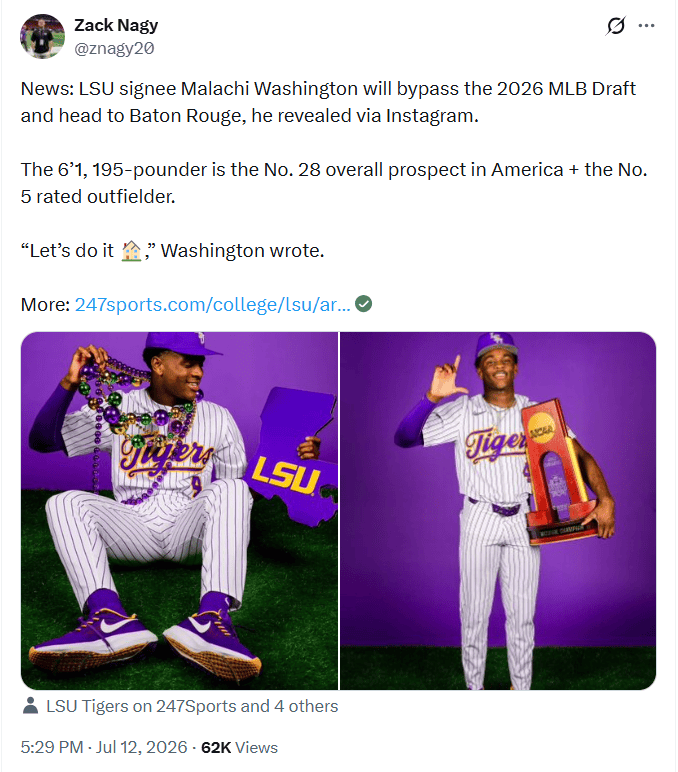
Washington may be the most fascinating of all, because the Parkview, Georgia outfielder was rated by Perfect Game as the No. 28 (No. 118 by MLB) overall prospect in the country and No. 5 outfielder in the 2026 class, yet he still chose Baton Rouge after Pittsburgh drafted him in the 18th round.
And that isn’t even to mention highly ranked Nathaneal “Nate” Davis and rising sophomore William Patrick, two more outfield options for Johnson to develop. Davis brings a left-handed bat and real speed, while Patrick is a Louisiana athlete with SEC experience and the kind of multi-sport background that usually gives a coach more than one way to use him. He was No. 90 on MLB.com’s 2025 Draft prospects list and could well see the type of improvement Jake Brown did over the course of his career as a Tiger. On paper the Tiger outfield will be loaded, but that also means fall practice could become a fiery sorting ground, with proven portal bats, high-end freshmen, and returning athletes all trying to turn talent and opportunity into actual playing time.
Advertisement
On the pitching side we’ll be brief. The same early 247.com projection had Casan Evans, William Schmidt and Cooper Moore holding the weekend rotation, with Landon Hood looming as the biggest portal threat to break into that group. There isn’t much to add to that beyond the fact that the LSU staff must find a way to match the talent they seem to always boast on the mound before spring with actual production as the season progresses. And it doesn’t always have to be to the Skenes-Anderson-Eyanson-MLB Futures caliber. The Tigers need to bridge the gap between such stellar, MLB-level arms and the gross inconsistencies they put out last year. Some mere All-SEC selections would do it.
Fan Vision
The miscellaneous breakdowns online are also how many LSU fans are already talking about the roster. In one TigerDroppings thread on the possible 2027 lineup, the general mood is mostly what one might expect from a fan forum, and relatively consistent with more official prognostications. Certainly there was no panic, given the celebration in order after the weekend, but there was the recognition of the congestion Johnson will have to navigate. Fans largely treated the infield as close to settled, with Braun, Kurland, Milam and Park drawing repeated mentions, while the outfield drew more debate because Watters, Laya, Wachs, Washington, Davis and Patrick all give Johnson different ways to play it. This, of course, doesn’t take into account the inevitable, unexpected turns of the road when it comes to any team in any league at any level. Injuries and flops happen for a myriad of reasons, and six or seven stud outfielders in July can become a mere two very quickly come SEC play.
The most useful part of the fan discussion was the tension between proven college bats and incoming upside. Several posters viewed Watters and Laya as likely everyday corner outfielders, while Wachs was discussed as a valuable piece who could hold centerfield if the younger players need time. Washington and Davis were treated as upside players because of their speed, with the basic condition being obvious enough: If they hit SEC pitching, their athleticism changes the 2027 story entirely.
Santarelli drew some of the most fan-expected curiosity, largely because of his power profile and impressive physical stature. Similar to what the site once gushed about “Keiland Williams’ calves,” fans noted Santarelli’s size, left-handed bat, and big exit velocity numbers, while also cautioning that Braun will not be easy to displace after producing in SEC play last season.
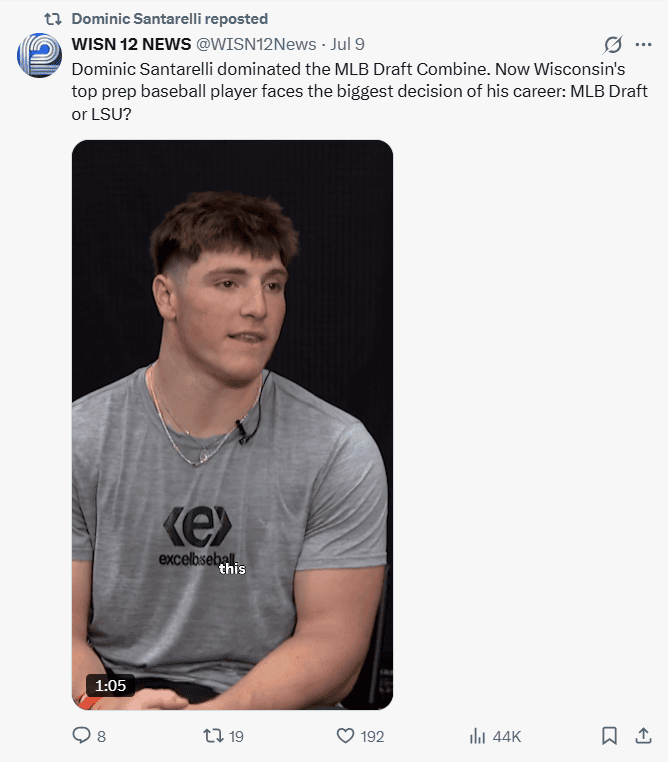
The 247Sports draft review only reinforces why Santarelli is already part of the conversation. He was taken by Seattle in the 18th round, but still appears headed to LSU as a 6-2, 230-pound left-handed power bat who helped his stock at the MLB Draft Combine with some of the hardest contact in the high school class. If Washington or Davis is the freshman centerfield replacement for Curiel, whether that be in 2027 or ’28, Santarelli may be the freshman bat who forces Johnson to ask how much power he can afford to leave on the bench.
It is the kind of internal pressure in the transfer portal era Johnson will have to manage with delicate aggression. A freshman can look too talented to keep off the field, while a returning starter can also be too steady to move. The DH spot may prove vital to keeping situations like this from affecting team morale, as it worked out for the catcher position this past season.
With an ugly 2026 in his rearview, Coach Johnson will obviously take it.
The fan thread also pointed to areas that will decide whether the lineup becomes merely talented or actually complete and competent. Some fans questioned whether Arrambide and Serna can improve defensively, with numerous pass balls and questionable plays in their history, even while acknowledging that their bats need to stay involved. Park drew praise as a defensive upgrade at third, and Lucas Nawrocki was mentioned as a wild card because of his two-way ability, though the greater need for left-handed pitching may push him toward the mound more quickly than the already-loaded outfield.
Those are fan views, of course, not the opening day lineup. But they still reveal the central problem of the NIL era: LSU has enough talent for people to quibble over several plausible versions of the same roster, and that is usually where strong programs want to be before the hard part begins, but players still want to be on the field and there are only a handful of spots to fill. If everything follows the individual player projections, Johnson indeed may have a different problem by next July: keeping enough talented players patient, happy, and still in Baton Rouge.
A trip to Omaha and another title would make that problem easier to live with.
Advertisement
Advertisement
