
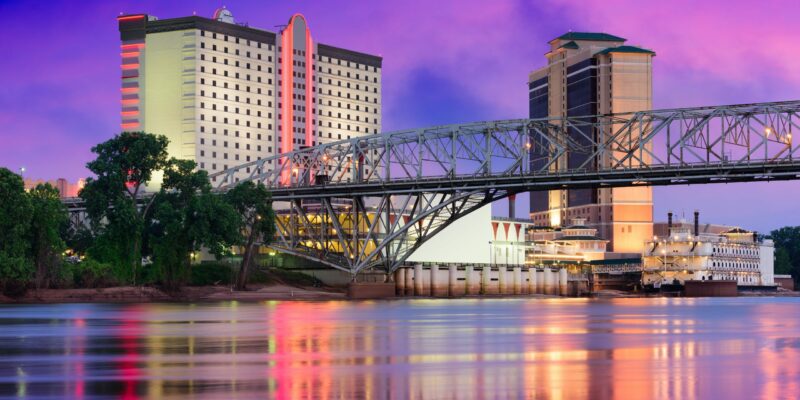
Creating an economic development district that could help to revive the flagging fortunes of Bossier City’s Boardwalk might have merit, but it depends very much on execution that doesn’t have one set of private businesses subsidizing another.
In recent months, meetings have been held and attended by a number of business owners located in the area extending north from the Arthur Ray Teague Parkway, bounded by Hamilton Road, East Texas Street, and Traffic Street, and including businesses along these routes. The proposed boundaries would include all casinos, the East Bank District, and the Boardwalk. General conversations have been held discussing the areas to include, revenue collection methods, with an additional sales tax as the leading option, and uses of these proceeds, such as backing debt issuance to pursue projects.
EDDs under statute may be created by a local governing authority, so the City Council would have to pass an ordinance doing this and would establish itself as the district’s governing authority, which, among other powers, would have the power to tax. The district could collect revenues through property taxes (5 mill maximum) or sales taxation (2 percent maximum) or hotel occupancy taxes (2 percent maximum) and engage in a number of economic development projects, or even establish cooperative endeavor agreements to run the district with public or private entities.
The Boardwalk began struggling only a few years after its 2005 opening, which has vexed city leaders not only because of the outdoor mall’s plummeting sales tax revenues and eroding property tax values that hit city coffers while the city must provide fire and police protection, but also because it unwisely plunked down over $20 million to construct a parking garage there that is useless without a functioning Boardwalk. Recent signs of improvement have occurred, and the city did try to jumpstart improved fortunes by establishing an open container district along the west side of Traffic, but if talk of an EDD including it has surfaced, then the prognosis still must not be all that rosy.
If the city heads in this direction, there are a number of questions to be answered about it. These focus on whether the district has an appropriate size and composition, whether revenues are collected in a fair manner, and whether the projects pursued are equitable in nature.
Economic development districts can vary in size and composition. Some, like the North Baton Rouge EDD, sprawl for many square miles, covering developed and vacant areas, perhaps tautologically encompassing much of north Baton Rouge. Others, like the Riverfront EDD in West Monroe, are very small and specifically targeted. West Monroe also demonstrates the gamut of EDDs. The West Monroe EDD hugs a portion of Interstate 20 featuring its civic center, while the Highland Park EDD basically has tried to lure development to a former golf course, which at present is a recreational area.
But what all have in common is that they try to incorporate a specific development vision for all components within their boundaries. A Bossier City EDD first would have to carve out residential areas, schools, and churches, but even if it did that, the businesses involved are in very disparate economic places. You have the out-of-area interests owning the casinos and their hotels plus Bass Pro Shop, all of which are doing well enough and dwarfing all other entities in terms of corporate size (and throw in another whale, although locally owned, Red River Chevrolet). Then there’s the struggling Boardwalk (also owned by out-of-state interests). Then there are a bunch of relative minnows, the entertainment places (and a few non-entertainment businesses) in the East Bank District and a few others scattered about.
The problem is that these entities have disparate needs and interests. For example, the Boardwalk could use lifelines from public dollars, even though with the garage it already has the single largest public dollar investment in the contemplated area. Meanwhile, what could the entertainment venues, which received no public dollars directly for their businesses yet achieved successes anyway, receive from this arrangement, under which, for example, they may end up adding two percent to their customers’ bills, thereby reducing demand for their services?
Advertisement
Worse would be differential treatment in revenue collection. For example, could the casinos use their clout to avoid a hotel occupancy tax levy, which also could help the Boardwalk’s next-door neighbor hotel, another just off the East Bank, and supplement any future plans for motel properties recently in receivership just south of I-20? Combining favored breaks in collection for some and spending geared towards subsidizing the fortunes of some, this could create a very few winners and lot of losers (and then there’s the issue of one of the Boardwalk’s largest tenants, the Simple Church, which is not a business but would have to be included in an EDD because of its location, and whether because of that it receives preferential treatment).
Worst of all, this could be done in a way that bypasses procedure in statute, which requires a public vote of all electors residing in the district for a tax to be imposed. However, if there are no electors, the governing authority can unilaterally impose the tax, so the district could be drawn to exclude any residence and give maximal leverage to the City Council. (This is a common tactic with Louisiana EDDs, with the Highland Park EDD a recent prime example.)
Note as well that drawing up the district with this in mind may interfere with the city’s recent efforts to come up with a comprehensive master plan that could require zoning changes. Drawing up the district this way could conflict with the eventual plan because the plan could create residential areas within the district, while the district’s presence could potentially discourage optimal zoning.
If Bossier City is going to do this, it needs to be done in a manner that is fair to all businesses regardless of their sizes and current economic fortunes, and not as a redistributive mechanism preferring some over others. A transparent process will maximize an equitable outcome.
Advertisement
Advertisement
