
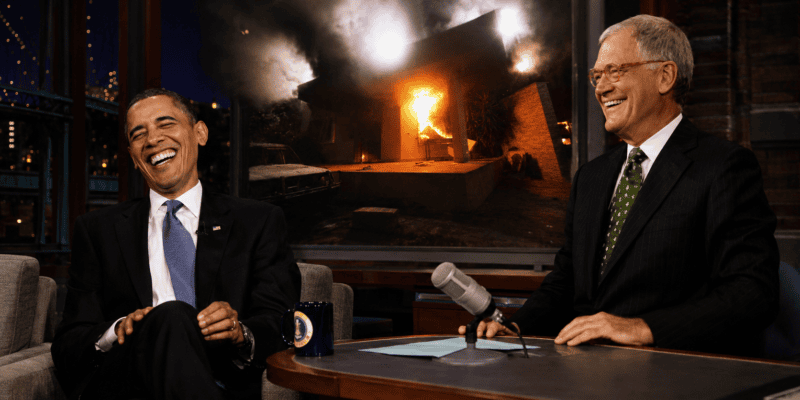
(Mark Anthony) — Seven days after the Benghazi attack, Barack Obama went on David Letterman’s show.
The date was September 18, 2012. Ambassador Christopher Stevens and three other Americans were dead. The Obama administration was under mounting pressure to explain what had happened, the election was less than two months away, and the administration’s explanation that the attack had grown out of a spontaneous reaction to an anti-Islam video was already under scrutiny.
So Obama went to Letterman. Naturally.
That was one of the more striking moments in A.J. Rice’s Dangerous Laughter conversation with Drew Thomas Allen, author of Clinton Hoax, Obama Coup: The Declassified Story of the Trump-Russia Delusion. Allen’s book argues that the political and intelligence controversies that exploded around Donald Trump in 2016 did not begin with Trump. To understand Russiagate, he argues, you have to go backward through the Obama years, Benghazi, Hillary Clinton and the intelligence community.
But the Letterman story is where the conversation gets genuinely strange.
Allen says that while researching the book, he found references to Obama’s Letterman appearance in material associated with the Benghazi investigation. Finding the actual interview, however, proved to be another matter. According to the discussion, only a small portion of the September 18 appearance remains readily available, while the section dealing with Obama’s explanation of Benghazi is the part that cannot readily be found. Rice points out that plenty of Letterman interviews from that period remain online, making the absence of this particular material difficult to ignore.
Let’s be careful about what that does and does not mean. The missing footage does not prove who removed it, why it disappeared or whether anyone deliberately removed it at all. Television archives are complicated, rights change hands and old material can disappear for mundane reasons. Rice and Allen themselves discussed trying to obtain a complete copy or transcript rather than treating the missing footage as proof of a conspiracy.
But it does raise a pretty remarkable question: why is a presidential interview, important enough to be referenced in the Benghazi investigations, so difficult to watch today?
Rice’s answer was almost tailor-made for Dangerous Laughter: it has been “memory holed.”
That phrase comes straight out of George Orwell’s 1984. Winston Smith works at the Ministry of Truth, rewriting old records so that yesterday’s version of reality conforms to today’s political narrative. The original disappears down the memory hole. Eventually, the problem isn’t convincing people that the old version was false. The problem is making the old version difficult to prove ever existed.
That is a useful metaphor for political media because narratives become history remarkably quickly. A politician says something, television repeats it, newspapers amplify it, commentators argue about it and eventually millions of people remember the story without remembering where it came from. Years later, the original interview may be gone while the narrative it helped establish remains everywhere.
That is particularly important to Allen’s argument. He doesn’t view 2016 as an isolated event. In the Dangerous Laughter conversation, he describes Benghazi as an earlier chapter in a much longer political story. Obama was running for reelection on a record that included the killing of Osama bin Laden and the broader claim that his administration had confronted the terrorist threat. Then an American ambassador was murdered in a terrorist attack just weeks before Election Day, creating an enormous political problem for the administration.
From there, Allen’s book follows the political and intelligence controversies through Hillary Clinton, the FBI, CIA, the Steele dossier and ultimately Russiagate. Whether a reader agrees with all of his conclusions is another question. His basic challenge is to go back through the documents and reconstruct the story rather than simply accepting the version that became conventional wisdom.
And that is where Letterman becomes more than a footnote.
Rice makes a larger point about comedy that runs through the episode. The comedian, historically, was supposed to be the court jester: the person who could mock the king, puncture the politician and say things ordinary people couldn’t. Aristophanes mocked politicians. Molière mocked the establishment. Comedy was supposed to make powerful people sweat.
Rice argues that Letterman had moved away from that role. In his telling, Obama wasn’t going to a comedian who might ambush him with uncomfortable questions. He was going to a friendly television environment where he could explain a political crisis on his own terms.
Advertisement
You don’t have to accept every word of Rice’s criticism to see the larger problem. Political comedy can be partisan. It always has been. But if the comedian’s job is to challenge power, that standard should apply regardless of which party occupies the White House.
And the timing here matters. This wasn’t a president joking about his golf game. It was Obama appearing on a comedy program one week after an American ambassador had been killed, while his administration was trying to explain the attack and he was fighting for reelection.
Then, years later, the most relevant portion of the conversation is apparently the hardest part to find.
That should make historians, journalists and ordinary citizens curious.
It also offers a useful warning about the way political history is preserved. We live in an age when everything is supposedly recorded forever, yet political memory can be remarkably fragile. The archive moves. The clip disappears. The context gets separated from the quote. Eventually, the easiest version of the story becomes the version everyone remembers.
That’s the real reason the Letterman episode is worth discussing. It doesn’t prove Allen’s entire case. It doesn’t prove a conspiracy. It exposes something more basic: we should be able to examine the original evidence for ourselves.
If the full interview exists, produce it. If there is a transcript, publish it. And if it really has disappeared, somebody should be asking why. Because the memory hole isn’t nearly as frightening when you know what was on the other side.
And if Allen is right that the roots of Russiagate reach much further back than 2016, then that missing Letterman interview may be a small piece of a much larger story about who shaped the narratives Americans were given, who repeated them and what eventually disappeared from view.
Thank you for reading The Hayride!
Advertisement
Advertisement
