
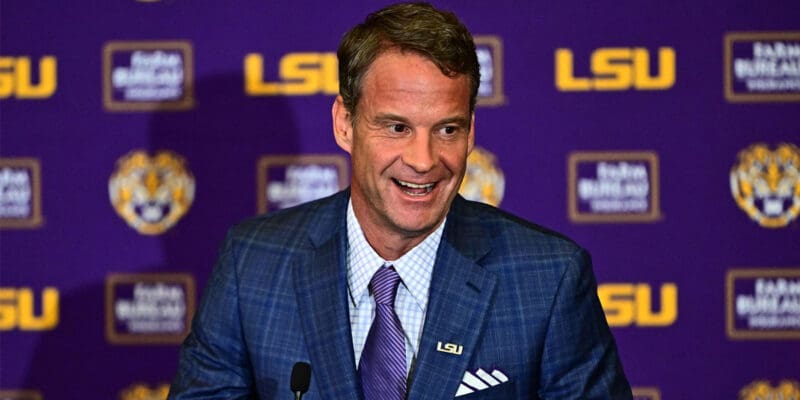
In a previous column, I noted that Lane Kiffin was hired for a specific purpose – to get LSU’s football program into the playoffs more years than not.
And now that the college football playoffs are expanding to 24 teams, which should mean that as many as eight or 10 SEC teams will make the playoffs, the standard for Kiffin will probably be that LSU makes the playoffs every year.
But after three straight losses to playoff-caliber teams showed that Kiffin’s first team is nowhere near ready for that sort of prime time existence despite a massive amount of hype and some gaudy numbers in wins against lesser opposition (numbers which couldn’t be duplicated against quality opponents, all five of which have beaten this team), there is a great deal of doubt as to whether Kiffin is the right guy to meet that standard.
This column is going to maintain a half-optimistic, half-agnostic view on that subject. The chances are reasonably good that LSU will recover to an extent and get a road win at Arkansas to finish the season at 7-5, and then it’s going to be a very interesting December. Will LSU accept a bowl bid? If so, how much of the team will bother to play in the bowl? Will Kiffin’s postseason exit interviews with his current team result in enough holdovers to play?
It seems strange to even have these as real questions, but they’re extremely real.
I wouldn’t expect LSU to travel well to a bowl game. Minor bowls are mostly seen as a waste of time, LSU’s last two bowl appearances were dismal performances against mediocre opponents, and the disappointment over LSU’s November swoon has the fan base in a state of revolt.
You’d say that accepting a bowl bid is important because it gives your team 10 more days of bowl practices. But that only does you any good if the players participating in those practices are actually going to be on the next year’s roster.
And frankly, that’s a big question mark.
Kiffin had to bring in more than 60 new players for the 2026 team, including more than 40 from the transfer portal. There’s a pretty good chance he’ll have to bring in similar numbers for 2027.
You’d hope not. You’d hope that Year 2 would show more continuity within the program and that players within it would develop and grow into the kind of top-flight athletes an SEC team needs, and that Kiffin’s coaching staff could really begin manufacturing some star players inside the program. At Ole Miss, he did that – though Lane Kiffin recruited the transfer portal as heavily as anybody in college football when he was in Oxford.
Something else Kiffin did in Oxford was to make a major jump from his first year at Ole Miss to his second. In fact, Kiffin’s Rebels went from 5-5 in his initial season to 10-3 in his second. Kiffin also made a big jump in his second year at USC, improving from 8-5 to 10-2. That’s the kind of improvement he needs to show at LSU.
And you could look at things in a number of different ways.
First, LSU sits atop the SEC in both total offense and total defense despite sitting at 6-5 and only 3-5 in SEC play. Combine that with the fact that three of LSU’s losses this year were by eight points or less, and that LSU led or was tied late in all five losses, and you could make the argument that for whatever deficiencies the team has this year they’re not impossibly behind the competition.
An argument could be made that LSU is wilting in fourth quarters because of a lack of depth. Tired players don’t have an edge that allows them to make big plays late which win games. Certainly that was at issue in the Tennessee game; it was also the case against Ole Miss, Kentucky and Texas. The Alabama game got away mostly due to mental mistakes in the second half.
And Kiffin has discussed depth as a problem.
More than anything, though, the biggest impediment to this team’s success has been poor play at quarterback in key moments. Sam Leavitt has been a turnover machine for LSU, particularly in the games against quality competition, and it isn’t just turnovers which have been a limiting factor. Leavitt doesn’t throw accurate passes downfield, and the book is now out on him around the SEC. Opposing defenses simply drop seven or eight players into coverage and increasingly clamp down on short passing routes, forcing Leavitt out of his comfort zone since he can’t take the top off a defense.
And as the season has gone along Leavitt has been less and less effective as a runner, which is perplexing since he’s supposedly healed from a hamstring injury earlier in the year.
Right now he doesn’t do anything well, and LSU’s offense has withered away. LSU can’t run the ball behind an offensive line which isn’t capable of blocking a quality defensive front, without the ability to throw downfield accurately there is no threat of explosive plays, and the execution has completely broken down on offense into a cacophony of pre-snap penalties and holding calls on Tiger linemen who are getting repeatedly beaten at the line of scrimmage.
Bad line play. Bad quarterback play. A lack of depth which results in diminishing performance on defense as the game goes along. Horrific special teams play.
What it tells you is there aren’t enough SEC-quality players on this team. And though LSU could conceivably return some 19 of the 22 starters on offense and defense – only three are going to be out of eligibility after this year – it’s questionable whether that’s even desirable.
But for the fact that behind those guys, in too many cases, there is nothing.
Start with quarterback as an example. Most people will tell you it’s not a good idea to bring Sam Leavitt back for a second year as LSU’s quarterback. Leavitt’s traits as a quarterback don’t lend themselves to the kind of jump that Joe Burrow and Jayden Daniels made in their second years. Burrow had actually elevated his game to the point where he was playing championship-quality football at the end of his junior year. Daniels hadn’t, but his main issue was getting comfortable enough to turn the ball loose into a tight window and trust the offensive scheme rather than to make one read and then take off running. Neither of them had trouble throwing a quality ball downfield, and neither of them were turnover machines.
Reports that Leavitt wants some $7 million next year, if true, would close off any conversation of him returning to LSU. He’s not worth half that number after engineering one of the most underachieving seasons in LSU history. In fact, one is tempted to ask whether giving somebody else a look against Arkansas this weekend isn’t a good idea after what Leavitt has devolved into.
Except Landen Clark and Husan Longstreet haven’t shown much of anything to indicate either are ready to become an SEC starting quarterback.
This is a problem all across LSU’s lineup.
The offensive line has been poor most of the season. Especially at the two guard positions, where William Satterwhite and Aliou Bah have been pretty awful all year. Satterwhite was inserted at left guard after Bo Bordelon struggled in pass blocking early in the year, and then he’s struggled pretty badly ever since. But there are a dozen or so scholarship linemen on LSU’s bench and the coaches haven’t given anybody else a shot. In the games where LSU has separated the score and sent the second string offensive line out there, generally speaking they’ve been a sloppy mess. And when there have been minor injuries and players have missed time, Sean Thompkins and Devin Harper have been appallingly bad in limited action as replacements.
Injuries at linebacker have exposed LSU’s lack of depth there. Tylen Singleton, a player the coaches have talked up as a potential starter down the road (it’s about time; Singleton is in his third year in the program), got to play a good bit against Tennessee. And in the second half, he (1) threw a punch at a Tennessee player after a play where LSU had stopped Tennessee on third down, reviving a Tennessee drive that resulted in a touchdown to make it 20-13, and (2) blew containment on Tennessee’s quarterback Faison Brandon, resulting in a 55-yard touchdown run which put the game away at 27-13. If that’s LSU’s future at linebacker, LSU is going to need a new future.
That may seem harsh, but the second-team defense has been utterly horrific all season long. When LSU has separated the score against the easier opponents and Kiffin has second the second unit in, the opposition has immediately begun moving the ball and making big plays.
What’s depressing is to go position-by-position on this team and to try to identify the young players who’ve shown more than an occasional flash of evidence that they’re going to become top-level SEC players. Deuce Geralds is certainly one; Jhase Thomas looks like another. Corey Barber was somebody we hoped would show something in the Tennessee game, but that didn’t happen. Maybe Barber will be a factor against Arkansas.
LSU’s abysmal coverage units on special teams are made up of a lot of the younger players on the roster, too. That’s not a good sign.
So you’re going to have to find a winner at quarterback in the portal, which is one of the hardest things to do. You’re going to have to rebuild the offensive line – the two best linemen, Jordan Seaton and Braelin Moore, are going to be gone, and the three other starters will have to make massive strides to even get to average, and nobody on the bench has demonstrated that they can play in this league, which indicates that you might not actually have anybody who can win in this league in that entire position group. When TreyDez Green and Jackson Harris go to the NFL, you’re going to have to rebuild the receiving corps almost completely out of the portal because other than Barber and Phillip Wright, whose season-ending injury early this year was a killer blow not just to the special teams but to the depth at wide receiver, you don’t have anybody who looks like a top-flight SEC receiver. You have a good running back in Dilin Jones, but behind him you have Caden Durham and Harlem Berry, both of whom would be crazy to stay (Berry really ought to be moved to wide receiver, but who knows whether he would accept that). At least LSU has two big-time running backs committed.
The special teams needs to be completely reworked, from coaches to kickers to snappers to holders to gunners.
The defensive line looks pretty good, except Princewill Umanmielen and Jordan Ross are probably both gone to the NFL and it’s going to require at least one and probably two portal additions to replace them and maintain depth. There is basically nothing to build on at linebacker. It would be great to get Whit Weeks back for a fifth year, but so far what we know about Weeks is you’ll get five or six games of elite play before he gets hurt and misses the rest of the season. You can’t count on a guy that brittle, as much as it might break your heart to recognize that. So if you’re going to bring Weeks back, you’re going to need at least two more players who are on his level that he can rotate with in hopes that you can conserve him to last all year. And Davhon Keys is not one of those two players.
The secondary looks OK, though the amount of money LSU needs to be prepared to pony up to keep Ty Benefield from heading off to the NFL would probably break the bank. If Benefield leaves, at least DaShawn Spears will be back to play a similar role and Spears would have been Benefield-adjacent had he not gotten knocked out for the season against Ole Miss. But LSU’s young players in the secondary other than Thomas – Michael Turner, Havon Finney, Isiah Washington, Faheem Delane – haven’t showed much of anything.
College football is a veteran’s game now. It’s ruled by 4th-year and 5th-year players. It isn’t damning if young guys don’t break out early in their careers.
Except the truly exceptional players, the ones who win lots of games in the SEC, will show signs early.
We didn’t see much of that this year.
And that’s the real concern about this 6-5 team.
We’ll find out in a couple of weeks when the portal opens whether Kiffin and his staff have much faith in the young talent on the roster. If the answer is “not much,” Kiffin might have to earn his title of Portal King if he’s going to make a jump into the playoffs in 2027.
Advertisement
Advertisement
